Event submissions
Published
This submission belongs to the session S3. Emerging Chemicals: Environment Risks and Health Effects of the event The 1st International Online Conference on Xenobiotics
Published date
17 Jun, 2026
Academic Editor
'%3e%3cpath%20d='M12.6657%2010.9104C12.4185%2010.325%2012.0599%209.79327%2011.6097%209.34482C11.1609%208.89508%2010.6293%208.5365%2010.0442%208.28888C10.0389%208.28626%2010.0337%208.28495%2010.0285%208.28233C10.8446%207.69279%2011.3752%206.73249%2011.3752%205.64904C11.3752%203.8542%209.92103%202.39999%208.1262%202.39999C6.33136%202.39999%204.87715%203.8542%204.87715%205.64904C4.87715%206.73249%205.40774%207.69279%206.22393%208.28364C6.21869%208.28626%206.21345%208.28757%206.20821%208.29019C5.62129%208.5378%205.09463%208.89284%204.64265%209.34613C4.1929%209.79493%203.83432%2010.3266%203.58671%2010.9117C3.34345%2011.4845%203.21226%2012.0987%203.20023%2012.7209C3.19988%2012.7349%203.20233%2012.7488%203.20744%2012.7619C3.21255%2012.7749%203.22022%2012.7867%203.22998%2012.7968C3.23975%2012.8068%203.25142%2012.8147%203.26431%2012.8202C3.2772%2012.8256%203.29105%2012.8284%203.30504%2012.8284H4.09109C4.14874%2012.8284%204.19459%2012.7825%204.1959%2012.7262C4.2221%2011.7148%204.62823%2010.7676%205.34617%2010.0497C6.08899%209.30683%207.0755%208.89808%208.1262%208.89808C9.17689%208.89808%2010.1634%209.30683%2010.9062%2010.0497C11.6242%2010.7676%2012.0303%2011.7148%2012.0565%2012.7262C12.0578%2012.7838%2012.1037%2012.8284%2012.1613%2012.8284H12.9474C12.9613%2012.8284%2012.9752%2012.8256%2012.9881%2012.8202C13.001%2012.8147%2013.0126%2012.8068%2013.0224%2012.7968C13.0322%2012.7867%2013.0398%2012.7749%2013.0449%2012.7619C13.0501%2012.7488%2013.0525%2012.7349%2013.0522%2012.7209C13.0391%2012.0947%2012.9094%2011.4855%2012.6657%2010.9104ZM8.1262%207.9024C7.52486%207.9024%206.9589%207.6679%206.53312%207.24211C6.10733%206.81633%205.87283%206.25037%205.87283%205.64904C5.87283%205.0477%206.10733%204.48174%206.53312%204.05596C6.9589%203.63018%207.52486%203.39567%208.1262%203.39567C8.72753%203.39567%209.29349%203.63018%209.71927%204.05596C10.1451%204.48174%2010.3796%205.0477%2010.3796%205.64904C10.3796%206.25037%2010.1451%206.81633%209.71927%207.24211C9.29349%207.6679%208.72753%207.9024%208.1262%207.9024Z'%20fill='%235D1EE1'/%3e%3c/g%3e%3c/svg%3e) Lin-Chi Wang
Lin-Chi WangCitation
Andra Maria Paun, Catalina Mares, Maria Mernea, Speranta Avram, Predicting the Health Effects of AhR Ligands: Bioinformatic Risk Assessment of Environmental Pollutants and Dietary Compounds, in Proceedings of The 1st International Online Conference on Xenobiotics, 22 June–23 June 2026, MDPI: Basel, Switzerland
Share
Email
Facebook
Twitter
LinkedIn
Predicting the Health Effects of AhR Ligands: Bioinformatic Risk Assessment of Environmental Pollutants and Dietary Compounds
'%3e%3cpath%20d='M12.6647%2010.9104C12.4176%2010.325%2012.0589%209.7933%2011.6088%209.34485C11.16%208.89511%2010.6283%208.53653%2010.0432%208.28891C10.038%208.28629%2010.0327%208.28498%2010.0275%208.28236C10.8437%207.69282%2011.3743%206.73252%2011.3743%205.64907C11.3743%203.85423%209.92005%202.40002%208.12522%202.40002C6.33038%202.40002%204.87618%203.85423%204.87618%205.64907C4.87618%206.73252%205.40677%207.69282%206.22296%208.28367C6.21772%208.28629%206.21248%208.2876%206.20724%208.29022C5.62031%208.53783%205.09365%208.89287%204.64167%209.34616C4.19192%209.79496%203.83334%2010.3266%203.58573%2010.9117C3.34247%2011.4846%203.21128%2012.0987%203.19925%2012.721C3.1989%2012.735%203.20135%2012.7489%203.20646%2012.7619C3.21157%2012.7749%203.21924%2012.7868%203.22901%2012.7968C3.23877%2012.8068%203.25045%2012.8148%203.26334%2012.8202C3.27623%2012.8256%203.29007%2012.8284%203.30406%2012.8284H4.09012C4.14776%2012.8284%204.19362%2012.7825%204.19493%2012.7262C4.22113%2011.7148%204.62726%2010.7676%205.34519%2010.0497C6.08802%209.30686%207.07452%208.89811%208.12522%208.89811C9.17592%208.89811%2010.1624%209.30686%2010.9052%2010.0497C11.6232%2010.7676%2012.0293%2011.7148%2012.0555%2012.7262C12.0568%2012.7839%2012.1027%2012.8284%2012.1603%2012.8284H12.9464C12.9604%2012.8284%2012.9742%2012.8256%2012.9871%2012.8202C13%2012.8148%2013.0117%2012.8068%2013.0214%2012.7968C13.0312%2012.7868%2013.0389%2012.7749%2013.044%2012.7619C13.0491%2012.7489%2013.0515%2012.735%2013.0512%2012.721C13.0381%2012.0947%2012.9084%2011.4856%2012.6647%2010.9104ZM8.12522%207.90243C7.52388%207.90243%206.95792%207.66793%206.53214%207.24215C6.10636%206.81636%205.87185%206.2504%205.87185%205.64907C5.87185%205.04773%206.10636%204.48177%206.53214%204.05599C6.95792%203.63021%207.52388%203.3957%208.12522%203.3957C8.72655%203.3957%209.29252%203.63021%209.7183%204.05599C10.1441%204.48177%2010.3786%205.04773%2010.3786%205.64907C10.3786%206.2504%2010.1441%206.81636%209.7183%207.24215C9.29252%207.66793%208.72655%207.90243%208.12522%207.90243Z'%20fill='%235D1EE1'/%3e%3c/g%3e%3c/svg%3e)
Andra Maria Paun 1
Catalina Mares 1
Maria Mernea 1
Speranta Avram 1
1. Department of Anatomy, Animal Physiology and Biophysics, University of Bucharest, Faculty of Biology, Splaiul Independentei 91-95, Bucharest, R-050095, Romania
Abstract
Introduction:
The Aryl hydrocarbon receptor (AhR) functions as a primary genomic defense mechanism against chemical exposure, balancing rapid detoxification with physiological homeostasis. However, persistent environmental ligands can shift the receptor from a protective sensor into a systemic disruptor, leading to severe toxicity. This study looks into the causes behind this transition by analyzing the structural and metabolic profiles of persistent dioxins, polycyclic aromatic hydrocarbons and transient dietary indoles to see how chemical persistence impacts the environment and human health.
Methods:
Physicochemical, pharmacokinetic, and comprehensive toxicological profiles, addressing both human and environmental ecotoxicity, were established using the ADMETlab 3.0, Deep-PK, and ProTox-3.0 platforms. Furthermore, blind molecular docking was executed via Pyrx against two high-resolution human AhR structures (8QMO and 7ZUB) to map binding affinities and core residue interactions within the PAS-B domain.
Results:
The results revealed a significant difference in risks attributed to chemical persistence. Industrial contaminants demonstrated outstanding lipid solubility, blood–brain barrier permeability, and considerable bioaccumulation potential. TCDD exhibited severe acute toxicity, but benzo[a]pyrene had strong predictive markers for carcinogenesis and endocrine disruption. In contrast, Indole-3-Carbinol demonstrated quick elimination, low aquatic toxicity, and a favorable safety profile. Molecular docking confirmed that all compounds bind to the AhR PAS-B pocket. Persistent pollutants, such as 3-MC and Benzo[a]pyrene, demonstrated the highest binding affinities, up to -14.4 kcal/mol, forming persistent complexes with important core residues.
Conclusions:
The metabolic stability of a ligand controls AhR-mediated biological effects. Because persistent pollutants resist metabolic breakdown, they bioaccumulate and maintain prolonged, high-affinity binding to the AhR. This sustained receptor activation, unlike the short-lived response of rapidly cleared dietary compounds, drives systemic toxicity. Overall, this research shows that integrating predictive ADME-Tox profiling with the molecular docking technique delivers a concrete in silico framework to accurately predict the bioaccumulation, receptor affinity, and health hazards of emerging environmental contaminants.
Keywords
AhR
bioinformatics
toxicity
pharmacokinetics
molecular docking
Poster
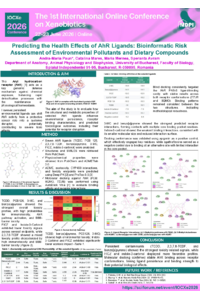
Paun, Mares, Mernea, Avram_poster.pdf
Ecotoxicological assessment of valproic acid in aquatic organisms
Prospective Surveillance of Emerging Chemical Poisoning and its Impact on Health in a South Indian Tertiary Hospital