Event submissions
Published
This submission belongs to the session S3. Emerging Chemicals: Environment Risks and Health Effects of the event The 1st International Online Conference on Xenobiotics
Published date
17 Jun, 2026
Academic Editor
'%3e%3cpath%20d='M12.6657%2010.9104C12.4185%2010.325%2012.0599%209.79327%2011.6097%209.34482C11.1609%208.89508%2010.6293%208.5365%2010.0442%208.28888C10.0389%208.28626%2010.0337%208.28495%2010.0285%208.28233C10.8446%207.69279%2011.3752%206.73249%2011.3752%205.64904C11.3752%203.8542%209.92103%202.39999%208.1262%202.39999C6.33136%202.39999%204.87715%203.8542%204.87715%205.64904C4.87715%206.73249%205.40774%207.69279%206.22393%208.28364C6.21869%208.28626%206.21345%208.28757%206.20821%208.29019C5.62129%208.5378%205.09463%208.89284%204.64265%209.34613C4.1929%209.79493%203.83432%2010.3266%203.58671%2010.9117C3.34345%2011.4845%203.21226%2012.0987%203.20023%2012.7209C3.19988%2012.7349%203.20233%2012.7488%203.20744%2012.7619C3.21255%2012.7749%203.22022%2012.7867%203.22998%2012.7968C3.23975%2012.8068%203.25142%2012.8147%203.26431%2012.8202C3.2772%2012.8256%203.29105%2012.8284%203.30504%2012.8284H4.09109C4.14874%2012.8284%204.19459%2012.7825%204.1959%2012.7262C4.2221%2011.7148%204.62823%2010.7676%205.34617%2010.0497C6.08899%209.30683%207.0755%208.89808%208.1262%208.89808C9.17689%208.89808%2010.1634%209.30683%2010.9062%2010.0497C11.6242%2010.7676%2012.0303%2011.7148%2012.0565%2012.7262C12.0578%2012.7838%2012.1037%2012.8284%2012.1613%2012.8284H12.9474C12.9613%2012.8284%2012.9752%2012.8256%2012.9881%2012.8202C13.001%2012.8147%2013.0126%2012.8068%2013.0224%2012.7968C13.0322%2012.7867%2013.0398%2012.7749%2013.0449%2012.7619C13.0501%2012.7488%2013.0525%2012.7349%2013.0522%2012.7209C13.0391%2012.0947%2012.9094%2011.4855%2012.6657%2010.9104ZM8.1262%207.9024C7.52486%207.9024%206.9589%207.6679%206.53312%207.24211C6.10733%206.81633%205.87283%206.25037%205.87283%205.64904C5.87283%205.0477%206.10733%204.48174%206.53312%204.05596C6.9589%203.63018%207.52486%203.39567%208.1262%203.39567C8.72753%203.39567%209.29349%203.63018%209.71927%204.05596C10.1451%204.48174%2010.3796%205.0477%2010.3796%205.64904C10.3796%206.25037%2010.1451%206.81633%209.71927%207.24211C9.29349%207.6679%208.72753%207.9024%208.1262%207.9024Z'%20fill='%235D1EE1'/%3e%3c/g%3e%3c/svg%3e) Stefano Magni
Stefano MagniCitation
Andrej Rondoš, Alžbeta Kaiglová, Soňa Kucharíková, Roksolana Fromel, Ján Janošovský, Phenolic Compounds from Rapeseed Protein Side Stream as Potential Emerging Xenobiotics, in Proceedings of The 1st International Online Conference on Xenobiotics, 22 June–23 June 2026, MDPI: Basel, Switzerland
Share
Email
Facebook
Twitter
LinkedIn
Phenolic Compounds from Rapeseed Protein Side Stream as Potential Emerging Xenobiotics
'%3e%3cpath%20d='M12.6647%2010.9104C12.4176%2010.325%2012.0589%209.7933%2011.6088%209.34485C11.16%208.89511%2010.6283%208.53653%2010.0432%208.28891C10.038%208.28629%2010.0327%208.28498%2010.0275%208.28236C10.8437%207.69282%2011.3743%206.73252%2011.3743%205.64907C11.3743%203.85423%209.92005%202.40002%208.12522%202.40002C6.33038%202.40002%204.87618%203.85423%204.87618%205.64907C4.87618%206.73252%205.40677%207.69282%206.22296%208.28367C6.21772%208.28629%206.21248%208.2876%206.20724%208.29022C5.62031%208.53783%205.09365%208.89287%204.64167%209.34616C4.19192%209.79496%203.83334%2010.3266%203.58573%2010.9117C3.34247%2011.4846%203.21128%2012.0987%203.19925%2012.721C3.1989%2012.735%203.20135%2012.7489%203.20646%2012.7619C3.21157%2012.7749%203.21924%2012.7868%203.22901%2012.7968C3.23877%2012.8068%203.25045%2012.8148%203.26334%2012.8202C3.27623%2012.8256%203.29007%2012.8284%203.30406%2012.8284H4.09012C4.14776%2012.8284%204.19362%2012.7825%204.19493%2012.7262C4.22113%2011.7148%204.62726%2010.7676%205.34519%2010.0497C6.08802%209.30686%207.07452%208.89811%208.12522%208.89811C9.17592%208.89811%2010.1624%209.30686%2010.9052%2010.0497C11.6232%2010.7676%2012.0293%2011.7148%2012.0555%2012.7262C12.0568%2012.7839%2012.1027%2012.8284%2012.1603%2012.8284H12.9464C12.9604%2012.8284%2012.9742%2012.8256%2012.9871%2012.8202C13%2012.8148%2013.0117%2012.8068%2013.0214%2012.7968C13.0312%2012.7868%2013.0389%2012.7749%2013.044%2012.7619C13.0491%2012.7489%2013.0515%2012.735%2013.0512%2012.721C13.0381%2012.0947%2012.9084%2011.4856%2012.6647%2010.9104ZM8.12522%207.90243C7.52388%207.90243%206.95792%207.66793%206.53214%207.24215C6.10636%206.81636%205.87185%206.2504%205.87185%205.64907C5.87185%205.04773%206.10636%204.48177%206.53214%204.05599C6.95792%203.63021%207.52388%203.3957%208.12522%203.3957C8.72655%203.3957%209.29252%203.63021%209.7183%204.05599C10.1441%204.48177%2010.3786%205.04773%2010.3786%205.64907C10.3786%206.2504%2010.1441%206.81636%209.7183%207.24215C9.29252%207.66793%208.72655%207.90243%208.12522%207.90243Z'%20fill='%235D1EE1'/%3e%3c/g%3e%3c/svg%3e)
Andrej Rondoš 1,2
Alžbeta Kaiglová 1
Soňa Kucharíková 1
Roksolana Fromel 2
Ján Janošovský 2
1. Department of Laboratory Medicine, Faculty of Health Care and Social Work, Trnava University in Trnava, Trnava, Slovakia
2. Centre for Research and Development, Trnavská cesta 1033/7, 920 41 Leopoldov, Slovakia
Abstract
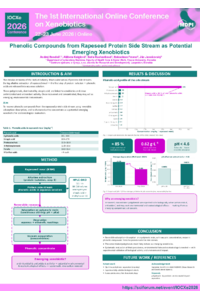
Introduction: The circular economy of the biofuel industry leads to valorisation of side streams by separation of phenolic compounds that are able to act as emerging environmental contaminants. Phenolic acids are released to solution during alkaline extraction of rapeseed meal, the first step of protein isolation. Reversible techniques were used for the recovery approach of polyphenols from rapeseed protein process streams. The optimization of polyphenolic separation is in progress. Many polyphenols are linked to xenobiotics and display antimicrobial and antioxidant activities.
Methods: Phenolic compounds were separated from aqueous solution using a polymeric resin under continuous stirring for adsorption with reversible interactions. Desorption was achieved with an aqueous and ethanolic washings to disrupt interactions between polyphenols and sorbent. The recovered phenolic compounds were collected in an ethanolic solution, which was concentrated using vacuum evaporation to obtain a phenolic concentrate.
Results: The separation of phenolic compounds from protein isolation side stream was achieved by adsorption, desorption and concentrating the solution. Based on literature, it is thought that the recovered polyphenolic compounds exhibit biological activity and may contribute to environmental and ecotoxicological effects.
Conclusions: This study shows the potential of reversible interaction techniques for the recovery of phenolic compounds from protein isolation side streams. The concentrated polyphenols are most likely to behave as emerging xenobiotics. The findings show the need for systematic evaluation of their, persistence, environmental fate and ecotoxicological effects with main focus on experimental validation of their biological activity and environmental impact.
This research was supported by the Slovak Research and Development Agency (APVV) under the project APVV-24-0040 PHERAPE.
Keywords
polyphenols
by-products
environmental impact
separation
Poster
IOCXe2026-poster-PHERAPE-phenolic-compounds-xenobiotics.pdf
Prospective Surveillance of Emerging Chemical Poisoning and its Impact on Health in a South Indian Tertiary Hospital
Pathogen Detection and Functional Gene Analysis of Microbial Communities in a Waste-Impacted River System