Event submissions
Published
This submission belongs to the session S3. Emerging Chemicals: Environment Risks and Health Effects of the event The 1st International Online Conference on Xenobiotics
Published date
17 Jun, 2026
Academic Editor
'%3e%3cpath%20d='M12.6657%2010.9104C12.4185%2010.325%2012.0599%209.79327%2011.6097%209.34482C11.1609%208.89508%2010.6293%208.5365%2010.0442%208.28888C10.0389%208.28626%2010.0337%208.28495%2010.0285%208.28233C10.8446%207.69279%2011.3752%206.73249%2011.3752%205.64904C11.3752%203.8542%209.92103%202.39999%208.1262%202.39999C6.33136%202.39999%204.87715%203.8542%204.87715%205.64904C4.87715%206.73249%205.40774%207.69279%206.22393%208.28364C6.21869%208.28626%206.21345%208.28757%206.20821%208.29019C5.62129%208.5378%205.09463%208.89284%204.64265%209.34613C4.1929%209.79493%203.83432%2010.3266%203.58671%2010.9117C3.34345%2011.4845%203.21226%2012.0987%203.20023%2012.7209C3.19988%2012.7349%203.20233%2012.7488%203.20744%2012.7619C3.21255%2012.7749%203.22022%2012.7867%203.22998%2012.7968C3.23975%2012.8068%203.25142%2012.8147%203.26431%2012.8202C3.2772%2012.8256%203.29105%2012.8284%203.30504%2012.8284H4.09109C4.14874%2012.8284%204.19459%2012.7825%204.1959%2012.7262C4.2221%2011.7148%204.62823%2010.7676%205.34617%2010.0497C6.08899%209.30683%207.0755%208.89808%208.1262%208.89808C9.17689%208.89808%2010.1634%209.30683%2010.9062%2010.0497C11.6242%2010.7676%2012.0303%2011.7148%2012.0565%2012.7262C12.0578%2012.7838%2012.1037%2012.8284%2012.1613%2012.8284H12.9474C12.9613%2012.8284%2012.9752%2012.8256%2012.9881%2012.8202C13.001%2012.8147%2013.0126%2012.8068%2013.0224%2012.7968C13.0322%2012.7867%2013.0398%2012.7749%2013.0449%2012.7619C13.0501%2012.7488%2013.0525%2012.7349%2013.0522%2012.7209C13.0391%2012.0947%2012.9094%2011.4855%2012.6657%2010.9104ZM8.1262%207.9024C7.52486%207.9024%206.9589%207.6679%206.53312%207.24211C6.10733%206.81633%205.87283%206.25037%205.87283%205.64904C5.87283%205.0477%206.10733%204.48174%206.53312%204.05596C6.9589%203.63018%207.52486%203.39567%208.1262%203.39567C8.72753%203.39567%209.29349%203.63018%209.71927%204.05596C10.1451%204.48174%2010.3796%205.0477%2010.3796%205.64904C10.3796%206.25037%2010.1451%206.81633%209.71927%207.24211C9.29349%207.6679%208.72753%207.9024%208.1262%207.9024Z'%20fill='%235D1EE1'/%3e%3c/g%3e%3c/svg%3e) Stefano Magni
Stefano MagniCitation
Nabil Bouarra, Soumaya Kherouf, Loubna Nouri, Adhya eddine Hamitouch, Khaldoun Bachari, QSRR modeling for GC-MS retention prediction of emerging Xenobiotic contaminants: a robust in silico tool for environmental screening and risk assessment, in Proceedings of The 1st International Online Conference on Xenobiotics, 22 June–23 June 2026, MDPI: Basel, Switzerland
Share
Email
Facebook
Twitter
LinkedIn
QSRR modeling for GC-MS retention prediction of emerging Xenobiotic contaminants: a robust in silico tool for environmental screening and risk assessment
'%3e%3cpath%20d='M12.6647%2010.9104C12.4176%2010.325%2012.0589%209.7933%2011.6088%209.34485C11.16%208.89511%2010.6283%208.53653%2010.0432%208.28891C10.038%208.28629%2010.0327%208.28498%2010.0275%208.28236C10.8437%207.69282%2011.3743%206.73252%2011.3743%205.64907C11.3743%203.85423%209.92005%202.40002%208.12522%202.40002C6.33038%202.40002%204.87618%203.85423%204.87618%205.64907C4.87618%206.73252%205.40677%207.69282%206.22296%208.28367C6.21772%208.28629%206.21248%208.2876%206.20724%208.29022C5.62031%208.53783%205.09365%208.89287%204.64167%209.34616C4.19192%209.79496%203.83334%2010.3266%203.58573%2010.9117C3.34247%2011.4846%203.21128%2012.0987%203.19925%2012.721C3.1989%2012.735%203.20135%2012.7489%203.20646%2012.7619C3.21157%2012.7749%203.21924%2012.7868%203.22901%2012.7968C3.23877%2012.8068%203.25045%2012.8148%203.26334%2012.8202C3.27623%2012.8256%203.29007%2012.8284%203.30406%2012.8284H4.09012C4.14776%2012.8284%204.19362%2012.7825%204.19493%2012.7262C4.22113%2011.7148%204.62726%2010.7676%205.34519%2010.0497C6.08802%209.30686%207.07452%208.89811%208.12522%208.89811C9.17592%208.89811%2010.1624%209.30686%2010.9052%2010.0497C11.6232%2010.7676%2012.0293%2011.7148%2012.0555%2012.7262C12.0568%2012.7839%2012.1027%2012.8284%2012.1603%2012.8284H12.9464C12.9604%2012.8284%2012.9742%2012.8256%2012.9871%2012.8202C13%2012.8148%2013.0117%2012.8068%2013.0214%2012.7968C13.0312%2012.7868%2013.0389%2012.7749%2013.044%2012.7619C13.0491%2012.7489%2013.0515%2012.735%2013.0512%2012.721C13.0381%2012.0947%2012.9084%2011.4856%2012.6647%2010.9104ZM8.12522%207.90243C7.52388%207.90243%206.95792%207.66793%206.53214%207.24215C6.10636%206.81636%205.87185%206.2504%205.87185%205.64907C5.87185%205.04773%206.10636%204.48177%206.53214%204.05599C6.95792%203.63021%207.52388%203.3957%208.12522%203.3957C8.72655%203.3957%209.29252%203.63021%209.7183%204.05599C10.1441%204.48177%2010.3786%205.04773%2010.3786%205.64907C10.3786%206.2504%2010.1441%206.81636%209.7183%207.24215C9.29252%207.66793%208.72655%207.90243%208.12522%207.90243Z'%20fill='%235D1EE1'/%3e%3c/g%3e%3c/svg%3e)
Nabil Bouarra 1,2
Soumaya Kherouf 3
Loubna Nouri 1
Adhya eddine Hamitouch 1
Khaldoun Bachari 1
1. Scientific and Technical Research Center in Physico-Chemical Analysis, Industrial Zone, Tipaza, 42004, Algeria.
2. Badji Mokhtar University, Laboratory of Environmental Engineering, Annaba, 23000, Algeria.
3. Department of Chemistry, Organic Synthesis Laboratory Modeling and Optimization of Chemical Processes (LOMOP), Faculty of Sciences, Badji Mokhtar University, PB 12, Annaba 23000, Algeria
Abstract
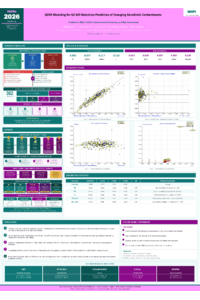
The occurrence of emerging xenobiotic contaminants in the environment poses significant risks to ecosystems and human health, necessitating rapid and reliable analytical methods for their monitoring. Quantitative structure–retention relationship (QSRR) analysis has emerged as a powerful in silico technique for linking molecular structure to chromatographic behavior, enabling the prediction of analytical parameters without reference standards. In this work, we developed a robust QSRR model for predicting the gas chromatography–mass spectrometry (GC-MS) retention times (RTs) of a diverse set of xenobiotic compounds, including potential emerging contaminants. Molecular geometries were optimized using the PM7 semi-empirical method, from which a wide range of theoretical descriptors were computed. A Genetic Algorithm (GA) was employed for feature selection, yielding an optimal five-descriptor combination (DBI, R8i, TPSA_efficiency, Hy, and SM1B(p)). The model was rigorously validated using both internal and external validation strategies. Internal validation demonstrated excellent statistical performance (R² = 0.88, Q²LOO = 0.877, s = 0.11, RMSEtr = 0.11). External validation confirmed the model's strong predictive power (Q²F1 = 0.812, Q²F2 = 0.810, Q²F3 = 0.837, CCCext = 0.89, RMSEext = 0.138). These results underscore the robustness and practical utility of the developed QSRR model as a reliable tool for estimating the GC-MS retention times of emerging xenobiotics. This approach facilitates their rapid screening and identification in complex environmental matrices, thereby supporting exposure assessment and contributing to the broader understanding of their environmental risks and potential health effects.
Keywords
QSRR
MLR
GC-MS
molecular descriptors
PM7
emerging contaminants
environmental analysis
Poster
QSRR_Xenobiotics_BOUARRA Nabil.pdf
Embryonic exposure to di(2-ethylhexyl) phthalate disturbs DNA methylation status of the ovaries in adult female zebrafish and the early development of F1 generation
Cytotoxic, genotoxic, and mutagenic effects of the mixture of dyes used in the formulation of black hair dye