Event submissions
Published
This submission belongs to the session S3. Emerging Chemicals: Environment Risks and Health Effects of the event The 1st International Online Conference on Xenobiotics
Published date
17 Jun, 2026
Academic Editor
'%3e%3cpath%20d='M12.6657%2010.9104C12.4185%2010.325%2012.0599%209.79327%2011.6097%209.34482C11.1609%208.89508%2010.6293%208.5365%2010.0442%208.28888C10.0389%208.28626%2010.0337%208.28495%2010.0285%208.28233C10.8446%207.69279%2011.3752%206.73249%2011.3752%205.64904C11.3752%203.8542%209.92103%202.39999%208.1262%202.39999C6.33136%202.39999%204.87715%203.8542%204.87715%205.64904C4.87715%206.73249%205.40774%207.69279%206.22393%208.28364C6.21869%208.28626%206.21345%208.28757%206.20821%208.29019C5.62129%208.5378%205.09463%208.89284%204.64265%209.34613C4.1929%209.79493%203.83432%2010.3266%203.58671%2010.9117C3.34345%2011.4845%203.21226%2012.0987%203.20023%2012.7209C3.19988%2012.7349%203.20233%2012.7488%203.20744%2012.7619C3.21255%2012.7749%203.22022%2012.7867%203.22998%2012.7968C3.23975%2012.8068%203.25142%2012.8147%203.26431%2012.8202C3.2772%2012.8256%203.29105%2012.8284%203.30504%2012.8284H4.09109C4.14874%2012.8284%204.19459%2012.7825%204.1959%2012.7262C4.2221%2011.7148%204.62823%2010.7676%205.34617%2010.0497C6.08899%209.30683%207.0755%208.89808%208.1262%208.89808C9.17689%208.89808%2010.1634%209.30683%2010.9062%2010.0497C11.6242%2010.7676%2012.0303%2011.7148%2012.0565%2012.7262C12.0578%2012.7838%2012.1037%2012.8284%2012.1613%2012.8284H12.9474C12.9613%2012.8284%2012.9752%2012.8256%2012.9881%2012.8202C13.001%2012.8147%2013.0126%2012.8068%2013.0224%2012.7968C13.0322%2012.7867%2013.0398%2012.7749%2013.0449%2012.7619C13.0501%2012.7488%2013.0525%2012.7349%2013.0522%2012.7209C13.0391%2012.0947%2012.9094%2011.4855%2012.6657%2010.9104ZM8.1262%207.9024C7.52486%207.9024%206.9589%207.6679%206.53312%207.24211C6.10733%206.81633%205.87283%206.25037%205.87283%205.64904C5.87283%205.0477%206.10733%204.48174%206.53312%204.05596C6.9589%203.63018%207.52486%203.39567%208.1262%203.39567C8.72753%203.39567%209.29349%203.63018%209.71927%204.05596C10.1451%204.48174%2010.3796%205.0477%2010.3796%205.64904C10.3796%206.25037%2010.1451%206.81633%209.71927%207.24211C9.29349%207.6679%208.72753%207.9024%208.1262%207.9024Z'%20fill='%235D1EE1'/%3e%3c/g%3e%3c/svg%3e) Stefano Magni
Stefano MagniCitation
Yaliana Tafurt Cardona, Paula Suares-Rocha, Thaís Cristina Casimiro Fernandes, Karen C.M. Moraes, Maria Aparecida Marin-Morales, Cytotoxic, genotoxic, and mutagenic effects of the mixture of dyes used in the formulation of black hair dye, in Proceedings of The 1st International Online Conference on Xenobiotics, 22 June–23 June 2026, MDPI: Basel, Switzerland
Share
Email
Facebook
Twitter
LinkedIn
Cytotoxic, genotoxic, and mutagenic effects of the mixture of dyes used in the formulation of black hair dye
'%3e%3cpath%20d='M12.6647%2010.9104C12.4176%2010.325%2012.0589%209.7933%2011.6088%209.34485C11.16%208.89511%2010.6283%208.53653%2010.0432%208.28891C10.038%208.28629%2010.0327%208.28498%2010.0275%208.28236C10.8437%207.69282%2011.3743%206.73252%2011.3743%205.64907C11.3743%203.85423%209.92005%202.40002%208.12522%202.40002C6.33038%202.40002%204.87618%203.85423%204.87618%205.64907C4.87618%206.73252%205.40677%207.69282%206.22296%208.28367C6.21772%208.28629%206.21248%208.2876%206.20724%208.29022C5.62031%208.53783%205.09365%208.89287%204.64167%209.34616C4.19192%209.79496%203.83334%2010.3266%203.58573%2010.9117C3.34247%2011.4846%203.21128%2012.0987%203.19925%2012.721C3.1989%2012.735%203.20135%2012.7489%203.20646%2012.7619C3.21157%2012.7749%203.21924%2012.7868%203.22901%2012.7968C3.23877%2012.8068%203.25045%2012.8148%203.26334%2012.8202C3.27623%2012.8256%203.29007%2012.8284%203.30406%2012.8284H4.09012C4.14776%2012.8284%204.19362%2012.7825%204.19493%2012.7262C4.22113%2011.7148%204.62726%2010.7676%205.34519%2010.0497C6.08802%209.30686%207.07452%208.89811%208.12522%208.89811C9.17592%208.89811%2010.1624%209.30686%2010.9052%2010.0497C11.6232%2010.7676%2012.0293%2011.7148%2012.0555%2012.7262C12.0568%2012.7839%2012.1027%2012.8284%2012.1603%2012.8284H12.9464C12.9604%2012.8284%2012.9742%2012.8256%2012.9871%2012.8202C13%2012.8148%2013.0117%2012.8068%2013.0214%2012.7968C13.0312%2012.7868%2013.0389%2012.7749%2013.044%2012.7619C13.0491%2012.7489%2013.0515%2012.735%2013.0512%2012.721C13.0381%2012.0947%2012.9084%2011.4856%2012.6647%2010.9104ZM8.12522%207.90243C7.52388%207.90243%206.95792%207.66793%206.53214%207.24215C6.10636%206.81636%205.87185%206.2504%205.87185%205.64907C5.87185%205.04773%206.10636%204.48177%206.53214%204.05599C6.95792%203.63021%207.52388%203.3957%208.12522%203.3957C8.72655%203.3957%209.29252%203.63021%209.7183%204.05599C10.1441%204.48177%2010.3786%205.04773%2010.3786%205.64907C10.3786%206.2504%2010.1441%206.81636%209.7183%207.24215C9.29252%207.66793%208.72655%207.90243%208.12522%207.90243Z'%20fill='%235D1EE1'/%3e%3c/g%3e%3c/svg%3e)
Yaliana Tafurt Cardona 1
Paula Suares-Rocha 1
Thaís Cristina Casimiro Fernandes 1
Karen C.M. Moraes 1
Maria Aparecida Marin-Morales 1
1. Department of General and Applied Biology. Laboratory of Environmental Mutagenesis, Institute of Biosciences, São Paulo State University “Júlio de Mesquita Filho” (UNESP), Rio Claro Campus, 13506-900, São Paulo, Brazil
Abstract
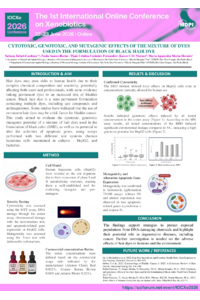
Introduction: Hair dyes may pose risks to human health due to their complex chemical composition and reactivity, potentially affecting both users and professionals, with some evidence linking permanent dyes to an increased risk of bladder cancer.
Black hair dye is a semi-permanent formulation containing multiple dyes, including azo compounds and anthraquinones. This study aimed to evaluate the cytotoxic, genotoxic and mutagenic potential of a mixture of hair dyes used in the formulation of black color (BHD), as well as its potential to alter the activities of apoptosis genes.
Methods: Human hepatoma cells (HepG2) were selected as the test organism due to their expression of phase I and II metabolizing enzymes, making them a well-established tool for evaluating mutagens and pro-mutagens. The tested concentrations were defined based on the commercial usage ratio indicated by the manufacturer (Arianor Cherry Red 0.002%, Arianor Sienna Brown 0.04% and Arianor Ebony 0.32%). In order to access DNA damage induced by BHD, a comet assay, micronucleus test and gene expression analysis were performed with HepG2 cells, while an Ames test was performed with Salmonella typhimurium
Results: Results showed cytotoxicity in HepG2 cells at concentrations allowed for human use; genotoxic effects were recorded by the comet assay for the lowest tested concentrations, and a large number of micronuclei were registered for all tested concentrations of BHD. Mutagenicity was confirmed in Salmonella typhimurium TA100 assays without S9, and altered expression was observed in two apoptosis-related genes (cytochrome c and caspase 9).
Conclusions: The findings support strategies to protect exposed populations from DNA-damaging chemicals and highlight their potential role in degenerative diseases, including cancer. Further investigation is needed on the adverse effects of hair dyes in humans and the environment.
Keywords
azo dyes
anthraquinones
HepG2 cells
micronucleus
comet assay
Salmonella
microsome
apoptosis.
Poster
sciforum-179300.pdf
QSRR modeling for GC-MS retention prediction of emerging Xenobiotic contaminants: a robust in silico tool for environmental screening and risk assessment
Multi-tier Assessment of ecotoxicity of a PEG-Based Pharmaceutical on Danio rerio Embryos: Are Additives the Missing Piece?