Event submissions
Published
This submission belongs to the session S3. Emerging Chemicals: Environment Risks and Health Effects of the event The 1st International Online Conference on Xenobiotics
Published date
17 Jun, 2026
Academic Editor
'%3e%3cpath%20d='M12.6657%2010.9104C12.4185%2010.325%2012.0599%209.79327%2011.6097%209.34482C11.1609%208.89508%2010.6293%208.5365%2010.0442%208.28888C10.0389%208.28626%2010.0337%208.28495%2010.0285%208.28233C10.8446%207.69279%2011.3752%206.73249%2011.3752%205.64904C11.3752%203.8542%209.92103%202.39999%208.1262%202.39999C6.33136%202.39999%204.87715%203.8542%204.87715%205.64904C4.87715%206.73249%205.40774%207.69279%206.22393%208.28364C6.21869%208.28626%206.21345%208.28757%206.20821%208.29019C5.62129%208.5378%205.09463%208.89284%204.64265%209.34613C4.1929%209.79493%203.83432%2010.3266%203.58671%2010.9117C3.34345%2011.4845%203.21226%2012.0987%203.20023%2012.7209C3.19988%2012.7349%203.20233%2012.7488%203.20744%2012.7619C3.21255%2012.7749%203.22022%2012.7867%203.22998%2012.7968C3.23975%2012.8068%203.25142%2012.8147%203.26431%2012.8202C3.2772%2012.8256%203.29105%2012.8284%203.30504%2012.8284H4.09109C4.14874%2012.8284%204.19459%2012.7825%204.1959%2012.7262C4.2221%2011.7148%204.62823%2010.7676%205.34617%2010.0497C6.08899%209.30683%207.0755%208.89808%208.1262%208.89808C9.17689%208.89808%2010.1634%209.30683%2010.9062%2010.0497C11.6242%2010.7676%2012.0303%2011.7148%2012.0565%2012.7262C12.0578%2012.7838%2012.1037%2012.8284%2012.1613%2012.8284H12.9474C12.9613%2012.8284%2012.9752%2012.8256%2012.9881%2012.8202C13.001%2012.8147%2013.0126%2012.8068%2013.0224%2012.7968C13.0322%2012.7867%2013.0398%2012.7749%2013.0449%2012.7619C13.0501%2012.7488%2013.0525%2012.7349%2013.0522%2012.7209C13.0391%2012.0947%2012.9094%2011.4855%2012.6657%2010.9104ZM8.1262%207.9024C7.52486%207.9024%206.9589%207.6679%206.53312%207.24211C6.10733%206.81633%205.87283%206.25037%205.87283%205.64904C5.87283%205.0477%206.10733%204.48174%206.53312%204.05596C6.9589%203.63018%207.52486%203.39567%208.1262%203.39567C8.72753%203.39567%209.29349%203.63018%209.71927%204.05596C10.1451%204.48174%2010.3796%205.0477%2010.3796%205.64904C10.3796%206.25037%2010.1451%206.81633%209.71927%207.24211C9.29349%207.6679%208.72753%207.9024%208.1262%207.9024Z'%20fill='%235D1EE1'/%3e%3c/g%3e%3c/svg%3e) Stefano Magni
Stefano MagniCitation
Gabriel Cornetta Ferraz Ribeiro, Leandro Cardoso de Morais, Vitória Regina Lima de Oliveira, In Silico Assessment of Interactions Between Pharmaceutical Contaminants and Human Metabolic Enzymes Using Molecular Docking, in Proceedings of The 1st International Online Conference on Xenobiotics, 22 June–23 June 2026, MDPI: Basel, Switzerland
Share
Email
Facebook
Twitter
LinkedIn
In Silico Assessment of Interactions Between Pharmaceutical Contaminants and Human Metabolic Enzymes Using Molecular Docking

Gabriel Cornetta Ferraz Ribeiro 1
'%3e%3cpath%20d='M12.6647%2010.9104C12.4176%2010.325%2012.0589%209.7933%2011.6088%209.34485C11.16%208.89511%2010.6283%208.53653%2010.0432%208.28891C10.038%208.28629%2010.0327%208.28498%2010.0275%208.28236C10.8437%207.69282%2011.3743%206.73252%2011.3743%205.64907C11.3743%203.85423%209.92005%202.40002%208.12522%202.40002C6.33038%202.40002%204.87618%203.85423%204.87618%205.64907C4.87618%206.73252%205.40677%207.69282%206.22296%208.28367C6.21772%208.28629%206.21248%208.2876%206.20724%208.29022C5.62031%208.53783%205.09365%208.89287%204.64167%209.34616C4.19192%209.79496%203.83334%2010.3266%203.58573%2010.9117C3.34247%2011.4846%203.21128%2012.0987%203.19925%2012.721C3.1989%2012.735%203.20135%2012.7489%203.20646%2012.7619C3.21157%2012.7749%203.21924%2012.7868%203.22901%2012.7968C3.23877%2012.8068%203.25045%2012.8148%203.26334%2012.8202C3.27623%2012.8256%203.29007%2012.8284%203.30406%2012.8284H4.09012C4.14776%2012.8284%204.19362%2012.7825%204.19493%2012.7262C4.22113%2011.7148%204.62726%2010.7676%205.34519%2010.0497C6.08802%209.30686%207.07452%208.89811%208.12522%208.89811C9.17592%208.89811%2010.1624%209.30686%2010.9052%2010.0497C11.6232%2010.7676%2012.0293%2011.7148%2012.0555%2012.7262C12.0568%2012.7839%2012.1027%2012.8284%2012.1603%2012.8284H12.9464C12.9604%2012.8284%2012.9742%2012.8256%2012.9871%2012.8202C13%2012.8148%2013.0117%2012.8068%2013.0214%2012.7968C13.0312%2012.7868%2013.0389%2012.7749%2013.044%2012.7619C13.0491%2012.7489%2013.0515%2012.735%2013.0512%2012.721C13.0381%2012.0947%2012.9084%2011.4856%2012.6647%2010.9104ZM8.12522%207.90243C7.52388%207.90243%206.95792%207.66793%206.53214%207.24215C6.10636%206.81636%205.87185%206.2504%205.87185%205.64907C5.87185%205.04773%206.10636%204.48177%206.53214%204.05599C6.95792%203.63021%207.52388%203.3957%208.12522%203.3957C8.72655%203.3957%209.29252%203.63021%209.7183%204.05599C10.1441%204.48177%2010.3786%205.04773%2010.3786%205.64907C10.3786%206.2504%2010.1441%206.81636%209.7183%207.24215C9.29252%207.66793%208.72655%207.90243%208.12522%207.90243Z'%20fill='%235D1EE1'/%3e%3c/g%3e%3c/svg%3e)
Leandro Cardoso de Morais 2

Vitória Regina Lima de Oliveira 3
1. Graduate Program in Environmental Sciences, São Paulo State University (UNESP), Brazil
2. Department of Environmental Sciences, São Paulo State University (UNESP), Sorocaba, Brazil
3. Department of Biothecnology, São Paulo State University (UNESP), Assis 19806-900, Brazil
Abstract
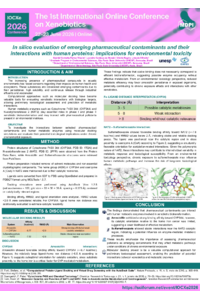
The increasing presence of pharmaceutical compounds in aquatic environments has raised concerns regarding their potential impacts on human health and ecosystems. Many of these substances are considered emerging contaminants due to their persistence, high solubility, and continuous introduction into the environment through industrial effluents and wastewater. Computational approaches have become valuable tools for evaluating the potential interactions between xenobiotics and biological targets, allowing the preliminary assessment of toxicological risks associated with environmental exposure.
This study aimed to investigate the interactions between selected pharmaceutical contaminants and human metabolic enzymes using molecular docking simulations. Protein structures were obtained from the Protein Data Bank and included Cytochrome P450 3A4 (CYP3A4), a key enzyme involved in xenobiotic metabolism, and N-acetyltransferase 2 (NAT2), responsible for acetylation reactions in drug metabolism. Ligand structures were retrieved from public chemical databases and prepared for docking using standard molecular modeling protocols. Docking simulations were performed using AutoDock Vina, and binding affinities and structural orientations were analyzed to evaluate potential interactions.
The results showed that amoxicillin presented a favorable binding affinity with CYP3A4 (approximately −8.7 kcal/mol). However, structural analysis indicated a relatively large distance (~6.5 Å) between the ligand and the heme iron atom, suggesting that although the molecule can occupy the active site, its orientation may not favor efficient catalytic biotransformation. For sulfamethoxazole, docking simulations revealed binding affinities around −7.8 kcal/mol with NAT2 and stable binding poses with RMSD values below 2 Å, suggesting a possible interaction near the catalytic region associated with acetylation.
Overall, the findings suggest that pharmaceutical contaminants may interact with human metabolic enzymes, highlighting the importance of evaluating their potential toxicological effects in scenarios of chronic environmental exposure. Computational approaches such as molecular docking represent useful tools for preliminary risk assessment of emerging contaminants.
Keywords
Environmental toxicology
Xenobiotics
Molecular docking
Emerging contaminants
Pharmaceutical pollutants
Poster
Sciforum_177884FINALVERS.pptx.pdf
Perinatal and Direct Bisphenol A Exposure Shape Gut Microbiota and Behavior in a Sex-Specific Manner In mice
From Homes to Cells: Assessing Genome Damage Induced by Indoor PAH Mixtures