Event submissions
Published
This submission belongs to the session S3. Emerging Chemicals: Environment Risks and Health Effects of the event The 1st International Online Conference on Xenobiotics
Published date
17 Jun, 2026
Academic Editor
'%3e%3cpath%20d='M12.6657%2010.9104C12.4185%2010.325%2012.0599%209.79327%2011.6097%209.34482C11.1609%208.89508%2010.6293%208.5365%2010.0442%208.28888C10.0389%208.28626%2010.0337%208.28495%2010.0285%208.28233C10.8446%207.69279%2011.3752%206.73249%2011.3752%205.64904C11.3752%203.8542%209.92103%202.39999%208.1262%202.39999C6.33136%202.39999%204.87715%203.8542%204.87715%205.64904C4.87715%206.73249%205.40774%207.69279%206.22393%208.28364C6.21869%208.28626%206.21345%208.28757%206.20821%208.29019C5.62129%208.5378%205.09463%208.89284%204.64265%209.34613C4.1929%209.79493%203.83432%2010.3266%203.58671%2010.9117C3.34345%2011.4845%203.21226%2012.0987%203.20023%2012.7209C3.19988%2012.7349%203.20233%2012.7488%203.20744%2012.7619C3.21255%2012.7749%203.22022%2012.7867%203.22998%2012.7968C3.23975%2012.8068%203.25142%2012.8147%203.26431%2012.8202C3.2772%2012.8256%203.29105%2012.8284%203.30504%2012.8284H4.09109C4.14874%2012.8284%204.19459%2012.7825%204.1959%2012.7262C4.2221%2011.7148%204.62823%2010.7676%205.34617%2010.0497C6.08899%209.30683%207.0755%208.89808%208.1262%208.89808C9.17689%208.89808%2010.1634%209.30683%2010.9062%2010.0497C11.6242%2010.7676%2012.0303%2011.7148%2012.0565%2012.7262C12.0578%2012.7838%2012.1037%2012.8284%2012.1613%2012.8284H12.9474C12.9613%2012.8284%2012.9752%2012.8256%2012.9881%2012.8202C13.001%2012.8147%2013.0126%2012.8068%2013.0224%2012.7968C13.0322%2012.7867%2013.0398%2012.7749%2013.0449%2012.7619C13.0501%2012.7488%2013.0525%2012.7349%2013.0522%2012.7209C13.0391%2012.0947%2012.9094%2011.4855%2012.6657%2010.9104ZM8.1262%207.9024C7.52486%207.9024%206.9589%207.6679%206.53312%207.24211C6.10733%206.81633%205.87283%206.25037%205.87283%205.64904C5.87283%205.0477%206.10733%204.48174%206.53312%204.05596C6.9589%203.63018%207.52486%203.39567%208.1262%203.39567C8.72753%203.39567%209.29349%203.63018%209.71927%204.05596C10.1451%204.48174%2010.3796%205.0477%2010.3796%205.64904C10.3796%206.25037%2010.1451%206.81633%209.71927%207.24211C9.29349%207.6679%208.72753%207.9024%208.1262%207.9024Z'%20fill='%235D1EE1'/%3e%3c/g%3e%3c/svg%3e) Stefano Magni
Stefano MagniCitation
P. Barciela, A. Perez-Vazquez, M. Carpena, Miguel A. Prieto, What neurological evidence has been reported on the long-term effects of human exposure to mixtures of environmental neurotoxicants?, in Proceedings of The 1st International Online Conference on Xenobiotics, 22 June–23 June 2026, MDPI: Basel, Switzerland
Share
Email
Facebook
Twitter
LinkedIn
What neurological evidence has been reported on the long-term effects of human exposure to mixtures of environmental neurotoxicants?

P. Barciela 1,2
'%3e%3cpath%20d='M12.6647%2010.9104C12.4176%2010.325%2012.0589%209.7933%2011.6088%209.34485C11.16%208.89511%2010.6283%208.53653%2010.0432%208.28891C10.038%208.28629%2010.0327%208.28498%2010.0275%208.28236C10.8437%207.69282%2011.3743%206.73252%2011.3743%205.64907C11.3743%203.85423%209.92005%202.40002%208.12522%202.40002C6.33038%202.40002%204.87618%203.85423%204.87618%205.64907C4.87618%206.73252%205.40677%207.69282%206.22296%208.28367C6.21772%208.28629%206.21248%208.2876%206.20724%208.29022C5.62031%208.53783%205.09365%208.89287%204.64167%209.34616C4.19192%209.79496%203.83334%2010.3266%203.58573%2010.9117C3.34247%2011.4846%203.21128%2012.0987%203.19925%2012.721C3.1989%2012.735%203.20135%2012.7489%203.20646%2012.7619C3.21157%2012.7749%203.21924%2012.7868%203.22901%2012.7968C3.23877%2012.8068%203.25045%2012.8148%203.26334%2012.8202C3.27623%2012.8256%203.29007%2012.8284%203.30406%2012.8284H4.09012C4.14776%2012.8284%204.19362%2012.7825%204.19493%2012.7262C4.22113%2011.7148%204.62726%2010.7676%205.34519%2010.0497C6.08802%209.30686%207.07452%208.89811%208.12522%208.89811C9.17592%208.89811%2010.1624%209.30686%2010.9052%2010.0497C11.6232%2010.7676%2012.0293%2011.7148%2012.0555%2012.7262C12.0568%2012.7839%2012.1027%2012.8284%2012.1603%2012.8284H12.9464C12.9604%2012.8284%2012.9742%2012.8256%2012.9871%2012.8202C13%2012.8148%2013.0117%2012.8068%2013.0214%2012.7968C13.0312%2012.7868%2013.0389%2012.7749%2013.044%2012.7619C13.0491%2012.7489%2013.0515%2012.735%2013.0512%2012.721C13.0381%2012.0947%2012.9084%2011.4856%2012.6647%2010.9104ZM8.12522%207.90243C7.52388%207.90243%206.95792%207.66793%206.53214%207.24215C6.10636%206.81636%205.87185%206.2504%205.87185%205.64907C5.87185%205.04773%206.10636%204.48177%206.53214%204.05599C6.95792%203.63021%207.52388%203.3957%208.12522%203.3957C8.72655%203.3957%209.29252%203.63021%209.7183%204.05599C10.1441%204.48177%2010.3786%205.04773%2010.3786%205.64907C10.3786%206.2504%2010.1441%206.81636%209.7183%207.24215C9.29252%207.66793%208.72655%207.90243%208.12522%207.90243Z'%20fill='%235D1EE1'/%3e%3c/g%3e%3c/svg%3e)
A. Perez-Vazquez 1,2

M. Carpena 1,2

Miguel A. Prieto 1,2
1. Universidade de Vigo, Nutrition and Food Group (NuFoG), Department of Analytical Chemistry and Food Science, Instituto de Agroecoloxía e Alimentación (IAA) – CITEXVI, 36310 Vigo, Spain.
2. Investigaciones Agroalimentarias Research Group, Galicia Sur Health Research Institute (IIS Galicia Sur). SERGAS-UVIGO, Vigo, Spain.
Abstract
Introduction
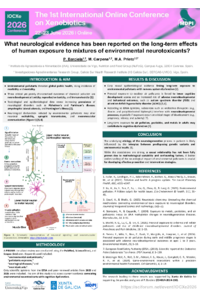
Environmental pollutants threaten global public health, rising incidence of morbidity and mortality. Three critical yet inadequately characterized outcomes of chemical pollution are neurodevelopmental toxicity, reproductive toxicity, and immunotoxicity [1]. Toxicological and epidemiological data reveal an increasing prevalence of neurological disorders such as Alzheimer's and Parkinson's disease, amyotrophic lateral sclerosis, and Huntington’s illness [2]. All of these conditions are characterized by structural and functional abnormalities in neurons of the brain and spinal cord [3,4].
Aim and methods
A PRISMA compliant review was conducted using the PubMed, ScienceDirect, and Scopus databases. Keywords used included: “environmental contaminants,” “pollutants exposure,” “neurological diseases,” and “neurotoxicants”. Only scientific opinions from the European Food Safety Authority (EFSA) and peer-reviewed articles from 2020 and 2025 were included. The aim of this study is to assess current evidence correlating environmental neurotoxicants with cognitive dysfunction.
Results
Data reveal epidemiological evidence linking long-term exposure to environmental pollutants with nervous system dysfunction [2]. Prenatal exposure to outdoor air pollutants is linked to lower cognitive development scores and an increased risk of adverse neurodevelopmental and behavioral outcomes, such as autism spectrum disorder (ASD) and attention deficit hyperactivity disorder (ADHD) [5,6]. According to EFSA opinions, substances such as endocrine disruptors (e.g., dioxins and polychlorinated biphenyls) interfere with neurodevelopmental processes, especially if exposure occurs at critical stages of development (e.g., pregnancy, infancy, and puberty) [7]. Long-term exposure to air pollution, pesticides, and metals in adults may contribute to cognitive dysfunction [4].
Conclusion
The underlying etiology of the neurodegenerative process in patients is likely influenced by the interplay between predisposing genetic variants and environmental insults [8]. While the associations are strong, a causal relationship has not been fully proven due to methodological variability and confounding factors. A better understanding of the neurological impact of environmental pollutants is crucial for developing effective prevention and intervention strategies.
Keywords
Environmental contaminants
Neurotoxicants
Long-term exposure
Neurological disorders
Poster
Sciforum-174467.pdf
Perceived BTEX Exposure and Occupational Safety Knowledge, Attitudes, and Practices among Petrol Station Attendants in Islamabad, Pakistan
Xenobiotics from Water to the Gut: Monitoring Environmental BPA and Assessing Its Gut Bacterial Tolerance for Health Risk and Biodetoxification