Event submissions
Published
This submission belongs to the session S3. Emerging Chemicals: Environment Risks and Health Effects of the event The 1st International Online Conference on Xenobiotics
Published date
17 Jun, 2026
Academic Editor
'%3e%3cpath%20d='M12.6657%2010.9104C12.4185%2010.325%2012.0599%209.79327%2011.6097%209.34482C11.1609%208.89508%2010.6293%208.5365%2010.0442%208.28888C10.0389%208.28626%2010.0337%208.28495%2010.0285%208.28233C10.8446%207.69279%2011.3752%206.73249%2011.3752%205.64904C11.3752%203.8542%209.92103%202.39999%208.1262%202.39999C6.33136%202.39999%204.87715%203.8542%204.87715%205.64904C4.87715%206.73249%205.40774%207.69279%206.22393%208.28364C6.21869%208.28626%206.21345%208.28757%206.20821%208.29019C5.62129%208.5378%205.09463%208.89284%204.64265%209.34613C4.1929%209.79493%203.83432%2010.3266%203.58671%2010.9117C3.34345%2011.4845%203.21226%2012.0987%203.20023%2012.7209C3.19988%2012.7349%203.20233%2012.7488%203.20744%2012.7619C3.21255%2012.7749%203.22022%2012.7867%203.22998%2012.7968C3.23975%2012.8068%203.25142%2012.8147%203.26431%2012.8202C3.2772%2012.8256%203.29105%2012.8284%203.30504%2012.8284H4.09109C4.14874%2012.8284%204.19459%2012.7825%204.1959%2012.7262C4.2221%2011.7148%204.62823%2010.7676%205.34617%2010.0497C6.08899%209.30683%207.0755%208.89808%208.1262%208.89808C9.17689%208.89808%2010.1634%209.30683%2010.9062%2010.0497C11.6242%2010.7676%2012.0303%2011.7148%2012.0565%2012.7262C12.0578%2012.7838%2012.1037%2012.8284%2012.1613%2012.8284H12.9474C12.9613%2012.8284%2012.9752%2012.8256%2012.9881%2012.8202C13.001%2012.8147%2013.0126%2012.8068%2013.0224%2012.7968C13.0322%2012.7867%2013.0398%2012.7749%2013.0449%2012.7619C13.0501%2012.7488%2013.0525%2012.7349%2013.0522%2012.7209C13.0391%2012.0947%2012.9094%2011.4855%2012.6657%2010.9104ZM8.1262%207.9024C7.52486%207.9024%206.9589%207.6679%206.53312%207.24211C6.10733%206.81633%205.87283%206.25037%205.87283%205.64904C5.87283%205.0477%206.10733%204.48174%206.53312%204.05596C6.9589%203.63018%207.52486%203.39567%208.1262%203.39567C8.72753%203.39567%209.29349%203.63018%209.71927%204.05596C10.1451%204.48174%2010.3796%205.0477%2010.3796%205.64904C10.3796%206.25037%2010.1451%206.81633%209.71927%207.24211C9.29349%207.6679%208.72753%207.9024%208.1262%207.9024Z'%20fill='%235D1EE1'/%3e%3c/g%3e%3c/svg%3e) Lin-Chi Wang
Lin-Chi WangCitation
Nidia Pérez García, María Arroyo, Pilar Ortiz, Gracia Luque, Margarita Aguilera, Alicia Ruiz, In silico workflow determining Metagenome-Assembled Genomes (MAGs) from a pediatric cohort exposed to obesogenic xenobiotics revealed different quality metrics, in Proceedings of The 1st International Online Conference on Xenobiotics, 22 June–23 June 2026, MDPI: Basel, Switzerland
Share
Email
Facebook
Twitter
LinkedIn
In silico workflow determining Metagenome-Assembled Genomes (MAGs) from a pediatric cohort exposed to obesogenic xenobiotics revealed different quality metrics
'%3e%3cpath%20d='M12.6647%2010.9104C12.4176%2010.325%2012.0589%209.7933%2011.6088%209.34485C11.16%208.89511%2010.6283%208.53653%2010.0432%208.28891C10.038%208.28629%2010.0327%208.28498%2010.0275%208.28236C10.8437%207.69282%2011.3743%206.73252%2011.3743%205.64907C11.3743%203.85423%209.92005%202.40002%208.12522%202.40002C6.33038%202.40002%204.87618%203.85423%204.87618%205.64907C4.87618%206.73252%205.40677%207.69282%206.22296%208.28367C6.21772%208.28629%206.21248%208.2876%206.20724%208.29022C5.62031%208.53783%205.09365%208.89287%204.64167%209.34616C4.19192%209.79496%203.83334%2010.3266%203.58573%2010.9117C3.34247%2011.4846%203.21128%2012.0987%203.19925%2012.721C3.1989%2012.735%203.20135%2012.7489%203.20646%2012.7619C3.21157%2012.7749%203.21924%2012.7868%203.22901%2012.7968C3.23877%2012.8068%203.25045%2012.8148%203.26334%2012.8202C3.27623%2012.8256%203.29007%2012.8284%203.30406%2012.8284H4.09012C4.14776%2012.8284%204.19362%2012.7825%204.19493%2012.7262C4.22113%2011.7148%204.62726%2010.7676%205.34519%2010.0497C6.08802%209.30686%207.07452%208.89811%208.12522%208.89811C9.17592%208.89811%2010.1624%209.30686%2010.9052%2010.0497C11.6232%2010.7676%2012.0293%2011.7148%2012.0555%2012.7262C12.0568%2012.7839%2012.1027%2012.8284%2012.1603%2012.8284H12.9464C12.9604%2012.8284%2012.9742%2012.8256%2012.9871%2012.8202C13%2012.8148%2013.0117%2012.8068%2013.0214%2012.7968C13.0312%2012.7868%2013.0389%2012.7749%2013.044%2012.7619C13.0491%2012.7489%2013.0515%2012.735%2013.0512%2012.721C13.0381%2012.0947%2012.9084%2011.4856%2012.6647%2010.9104ZM8.12522%207.90243C7.52388%207.90243%206.95792%207.66793%206.53214%207.24215C6.10636%206.81636%205.87185%206.2504%205.87185%205.64907C5.87185%205.04773%206.10636%204.48177%206.53214%204.05599C6.95792%203.63021%207.52388%203.3957%208.12522%203.3957C8.72655%203.3957%209.29252%203.63021%209.7183%204.05599C10.1441%204.48177%2010.3786%205.04773%2010.3786%205.64907C10.3786%206.2504%2010.1441%206.81636%209.7183%207.24215C9.29252%207.66793%208.72655%207.90243%208.12522%207.90243Z'%20fill='%235D1EE1'/%3e%3c/g%3e%3c/svg%3e)
Nidia Pérez García 1
María Arroyo 1
Pilar Ortiz 1
Gracia Luque 1

Margarita Aguilera 1
Alicia Ruiz 1
1. Department of Microbiology, Faculty of Pharmacy, Cartuja University Campus, University of Granada, Granada, 18071, Spain
Abstract
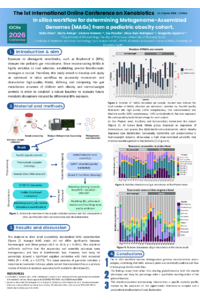
A bioinformatic pipeline and tailored workflow were developed to reconstruct Metagenome-Assembled Genomes (MAGs) from metagenomic data obtained from a cohort of 12 children with obesity and 12 normal-weight children with differential bisphenol A (BPA) exposure levels. Preprocessing and sequence quality control included FastQC, Trimmomatic and host DNA removal with Bowtie2. Assembly was performed using MEGAHIT, with quality evaluated via QUAST. Reads were mapped back to the assembly using Bowtie2 and SamTools to determine coverage. For Binning and Contig Clustering, MetaBAT2 and MaxBin2 were used, followed by optimization through the MetaWRAP bin_refinement module and quality validation (completeness/contamination) through CheckM. Tools for downstream analysis and MAG annotation included Prokka for Gene Prediction and Functional Gene Annotation, enabling the identification of key metabolic pathways. Taxonomic classification was performed using GTDB-Tk to provide standardized phylogenetic assignments. All statistical analyses and data visualization were conducted in RStudio.
Benchmarking of the tested tools revealed differences in the quality of the reconstructed MAGs across varying thresholds, with completeness ranging from >50% to >90% and contamination from <10% to <5%. A consolidated summary of tools and optimized parameters was compiled to evaluate pipeline performance based on completeness, contamination, N50, and taxonomic resolution. This comparative assessment enabled the identification of the most reliable assembly and binning strategies for downstream analyses.
The main results revealed distinct taxonomic signatures and quantitative differences between the two groups. MAG yield was lower in the obesity group compared to the normal-weight group. At the class level, obesity was associated with a distinct profile of Actinomycetes and Bacilli, whereas at the species level, a high prevalence of Bifidobacterium adolescentis was identified in children with obesity. Additionally, BPA exposure levels appeared to modulate microbial diversity and the relative abundance of specific taxa, suggesting a potential interaction between xenobiotic exposure and gut microbiome composition.
Keywords
Metagenome-Assembled Genomes
Obesity
Bisphenol A
Gut microbiome
Pipeline
Poster
Póster Nidia Pérez.pdf
Using the field lizard as a model to study the impact of glyphosate on soil-dwelling vertebrates
Analysis of the Effect of the α-Amylase Enzyme Preparation from the Genetically Modified Strain Komagataella phaffii 2xAmy-BaLi-a-II-ZeoR-(Y-5231) on the Behavioral Reactions of Male Wistar Rats