Event submissions
Published
This submission belongs to the session S3. Emerging Chemicals: Environment Risks and Health Effects of the event The 1st International Online Conference on Xenobiotics
Published date
17 Jun, 2026
Academic Editor
'%3e%3cpath%20d='M12.6657%2010.9104C12.4185%2010.325%2012.0599%209.79327%2011.6097%209.34482C11.1609%208.89508%2010.6293%208.5365%2010.0442%208.28888C10.0389%208.28626%2010.0337%208.28495%2010.0285%208.28233C10.8446%207.69279%2011.3752%206.73249%2011.3752%205.64904C11.3752%203.8542%209.92103%202.39999%208.1262%202.39999C6.33136%202.39999%204.87715%203.8542%204.87715%205.64904C4.87715%206.73249%205.40774%207.69279%206.22393%208.28364C6.21869%208.28626%206.21345%208.28757%206.20821%208.29019C5.62129%208.5378%205.09463%208.89284%204.64265%209.34613C4.1929%209.79493%203.83432%2010.3266%203.58671%2010.9117C3.34345%2011.4845%203.21226%2012.0987%203.20023%2012.7209C3.19988%2012.7349%203.20233%2012.7488%203.20744%2012.7619C3.21255%2012.7749%203.22022%2012.7867%203.22998%2012.7968C3.23975%2012.8068%203.25142%2012.8147%203.26431%2012.8202C3.2772%2012.8256%203.29105%2012.8284%203.30504%2012.8284H4.09109C4.14874%2012.8284%204.19459%2012.7825%204.1959%2012.7262C4.2221%2011.7148%204.62823%2010.7676%205.34617%2010.0497C6.08899%209.30683%207.0755%208.89808%208.1262%208.89808C9.17689%208.89808%2010.1634%209.30683%2010.9062%2010.0497C11.6242%2010.7676%2012.0303%2011.7148%2012.0565%2012.7262C12.0578%2012.7838%2012.1037%2012.8284%2012.1613%2012.8284H12.9474C12.9613%2012.8284%2012.9752%2012.8256%2012.9881%2012.8202C13.001%2012.8147%2013.0126%2012.8068%2013.0224%2012.7968C13.0322%2012.7867%2013.0398%2012.7749%2013.0449%2012.7619C13.0501%2012.7488%2013.0525%2012.7349%2013.0522%2012.7209C13.0391%2012.0947%2012.9094%2011.4855%2012.6657%2010.9104ZM8.1262%207.9024C7.52486%207.9024%206.9589%207.6679%206.53312%207.24211C6.10733%206.81633%205.87283%206.25037%205.87283%205.64904C5.87283%205.0477%206.10733%204.48174%206.53312%204.05596C6.9589%203.63018%207.52486%203.39567%208.1262%203.39567C8.72753%203.39567%209.29349%203.63018%209.71927%204.05596C10.1451%204.48174%2010.3796%205.0477%2010.3796%205.64904C10.3796%206.25037%2010.1451%206.81633%209.71927%207.24211C9.29349%207.6679%208.72753%207.9024%208.1262%207.9024Z'%20fill='%235D1EE1'/%3e%3c/g%3e%3c/svg%3e) Lin-Chi Wang
Lin-Chi WangCitation
Samuel Oluwasegun Adesida, Chibuisi Gideon Alimba, Xenobiotic contaminants emitted from Landfill Fires and Associated Public Health Impacts: A Systematic Review, in Proceedings of The 1st International Online Conference on Xenobiotics, 22 June–23 June 2026, MDPI: Basel, Switzerland
Share
Email
Facebook
Twitter
LinkedIn
Xenobiotic contaminants emitted from Landfill Fires and Associated Public Health Impacts: A Systematic Review
'%3e%3cpath%20d='M12.6647%2010.9104C12.4176%2010.325%2012.0589%209.7933%2011.6088%209.34485C11.16%208.89511%2010.6283%208.53653%2010.0432%208.28891C10.038%208.28629%2010.0327%208.28498%2010.0275%208.28236C10.8437%207.69282%2011.3743%206.73252%2011.3743%205.64907C11.3743%203.85423%209.92005%202.40002%208.12522%202.40002C6.33038%202.40002%204.87618%203.85423%204.87618%205.64907C4.87618%206.73252%205.40677%207.69282%206.22296%208.28367C6.21772%208.28629%206.21248%208.2876%206.20724%208.29022C5.62031%208.53783%205.09365%208.89287%204.64167%209.34616C4.19192%209.79496%203.83334%2010.3266%203.58573%2010.9117C3.34247%2011.4846%203.21128%2012.0987%203.19925%2012.721C3.1989%2012.735%203.20135%2012.7489%203.20646%2012.7619C3.21157%2012.7749%203.21924%2012.7868%203.22901%2012.7968C3.23877%2012.8068%203.25045%2012.8148%203.26334%2012.8202C3.27623%2012.8256%203.29007%2012.8284%203.30406%2012.8284H4.09012C4.14776%2012.8284%204.19362%2012.7825%204.19493%2012.7262C4.22113%2011.7148%204.62726%2010.7676%205.34519%2010.0497C6.08802%209.30686%207.07452%208.89811%208.12522%208.89811C9.17592%208.89811%2010.1624%209.30686%2010.9052%2010.0497C11.6232%2010.7676%2012.0293%2011.7148%2012.0555%2012.7262C12.0568%2012.7839%2012.1027%2012.8284%2012.1603%2012.8284H12.9464C12.9604%2012.8284%2012.9742%2012.8256%2012.9871%2012.8202C13%2012.8148%2013.0117%2012.8068%2013.0214%2012.7968C13.0312%2012.7868%2013.0389%2012.7749%2013.044%2012.7619C13.0491%2012.7489%2013.0515%2012.735%2013.0512%2012.721C13.0381%2012.0947%2012.9084%2011.4856%2012.6647%2010.9104ZM8.12522%207.90243C7.52388%207.90243%206.95792%207.66793%206.53214%207.24215C6.10636%206.81636%205.87185%206.2504%205.87185%205.64907C5.87185%205.04773%206.10636%204.48177%206.53214%204.05599C6.95792%203.63021%207.52388%203.3957%208.12522%203.3957C8.72655%203.3957%209.29252%203.63021%209.7183%204.05599C10.1441%204.48177%2010.3786%205.04773%2010.3786%205.64907C10.3786%206.2504%2010.1441%206.81636%209.7183%207.24215C9.29252%207.66793%208.72655%207.90243%208.12522%207.90243Z'%20fill='%235D1EE1'/%3e%3c/g%3e%3c/svg%3e)
Samuel Oluwasegun Adesida 1
Chibuisi Gideon Alimba 2
1. WASCAL-Graduate Research Program in Climate Change and Biodiversity, Université Felix Houphouet-Boigny, Abidjan, Côte d'Ivoire
2. Leibniz Research Centre for Working Environment and Human Factors (IfADo), Technical University of Dortmund, Dortmund 44139, Germany
Abstract
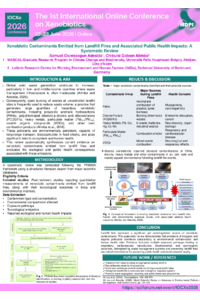
Increases in the volume of solid waste generation remains a global challenge. Driven by limited solid waste management infrastructure, poor regulation, and volume reduction strategies, open burning of these wastes at uncontrolled landfill sites is a common waste‐management practice, particularly in many low- and middle-income countries. Such unsanitary landfill fires generate complex mixture of hazardous pollutants, notably polycyclic aromatic hydrocarbons (PAHs), heavy metals, radiation, particulate matters and polychlorinated dibenzo-p-dioxins and dibenzofurans (PCDD/Fs), many of which are emerging contaminants of public health concern. These compounds are characterized by environmental persistence, bioaccumulation potential, long-range transport, and potent toxic, mutagenic, and carcinogenic properties. This systematic review synthesizes current evidence on xenobiotic contaminants emitted from landfill fires and evaluates their associated environmental and public health effects. A structured literature search is conducted in major scientific databases following PRISMA guidelines. Peer-reviewed studies reporting quantitative measurements of xenobiotic contaminants emitted from landfill fires, along with their toxicological outcomes in biota and environmental matrices, are screened against predefined inclusion criteria. Data is extracted and critically synthesized with attention to emission profiles, concentration ranges, exposure pathways, and biological endpoints. Reports of elevated concentrations of high-molecular-weight PAHs, toxic dioxin congeners, heavy metals and particulate matters in air, ash, soil, food and nearby aquatic systems is consistent following landfill fires. Documented ecotoxic effects include cancer risk, endocrine disruption, impaired growth and reproduction in invertebrates and vertebrates, and bioaccumulation across trophic levels. Overall, landfill fires represent a significant but underregulated source of hazardous inorganic and organic pollutants with measurable ecological risks. Strengthened waste management policies, routine environmental monitoring, and targeted risk assessments are urgently recommended to mitigate the environmental and public health burden associated with open landfill burning.
Keywords
Xenobiotic contaminants
Environmental impact
Ecotoxicological risks
Landfill fire
Public health impact
Open waste burning
Poster
Adesida and Alimba poster presentation.pdf
Xenobiotic emission from indiscriminate solid waste management and risk of neurological disorders: an emerging public health concern
From Algae to Fish: Unravelling the Toxic Effects of Metformin in Freshwater Ecosystems