Event submissions
Published
This submission belongs to the session S3. Emerging Chemicals: Environment Risks and Health Effects of the event The 1st International Online Conference on Xenobiotics
Published date
17 Jun, 2026
Academic Editor
'%3e%3cpath%20d='M12.6657%2010.9104C12.4185%2010.325%2012.0599%209.79327%2011.6097%209.34482C11.1609%208.89508%2010.6293%208.5365%2010.0442%208.28888C10.0389%208.28626%2010.0337%208.28495%2010.0285%208.28233C10.8446%207.69279%2011.3752%206.73249%2011.3752%205.64904C11.3752%203.8542%209.92103%202.39999%208.1262%202.39999C6.33136%202.39999%204.87715%203.8542%204.87715%205.64904C4.87715%206.73249%205.40774%207.69279%206.22393%208.28364C6.21869%208.28626%206.21345%208.28757%206.20821%208.29019C5.62129%208.5378%205.09463%208.89284%204.64265%209.34613C4.1929%209.79493%203.83432%2010.3266%203.58671%2010.9117C3.34345%2011.4845%203.21226%2012.0987%203.20023%2012.7209C3.19988%2012.7349%203.20233%2012.7488%203.20744%2012.7619C3.21255%2012.7749%203.22022%2012.7867%203.22998%2012.7968C3.23975%2012.8068%203.25142%2012.8147%203.26431%2012.8202C3.2772%2012.8256%203.29105%2012.8284%203.30504%2012.8284H4.09109C4.14874%2012.8284%204.19459%2012.7825%204.1959%2012.7262C4.2221%2011.7148%204.62823%2010.7676%205.34617%2010.0497C6.08899%209.30683%207.0755%208.89808%208.1262%208.89808C9.17689%208.89808%2010.1634%209.30683%2010.9062%2010.0497C11.6242%2010.7676%2012.0303%2011.7148%2012.0565%2012.7262C12.0578%2012.7838%2012.1037%2012.8284%2012.1613%2012.8284H12.9474C12.9613%2012.8284%2012.9752%2012.8256%2012.9881%2012.8202C13.001%2012.8147%2013.0126%2012.8068%2013.0224%2012.7968C13.0322%2012.7867%2013.0398%2012.7749%2013.0449%2012.7619C13.0501%2012.7488%2013.0525%2012.7349%2013.0522%2012.7209C13.0391%2012.0947%2012.9094%2011.4855%2012.6657%2010.9104ZM8.1262%207.9024C7.52486%207.9024%206.9589%207.6679%206.53312%207.24211C6.10733%206.81633%205.87283%206.25037%205.87283%205.64904C5.87283%205.0477%206.10733%204.48174%206.53312%204.05596C6.9589%203.63018%207.52486%203.39567%208.1262%203.39567C8.72753%203.39567%209.29349%203.63018%209.71927%204.05596C10.1451%204.48174%2010.3796%205.0477%2010.3796%205.64904C10.3796%206.25037%2010.1451%206.81633%209.71927%207.24211C9.29349%207.6679%208.72753%207.9024%208.1262%207.9024Z'%20fill='%235D1EE1'/%3e%3c/g%3e%3c/svg%3e) Lin-Chi Wang
Lin-Chi WangCitation
Bárbara S. Diogo, Sara Rodrigues, Sara C. Antunes, Interactive effects of temperature, pH, and antibiotics reshape zebrafish physiological stability, in Proceedings of The 1st International Online Conference on Xenobiotics, 22 June–23 June 2026, MDPI: Basel, Switzerland
Share
Email
Facebook
Twitter
LinkedIn
Interactive effects of temperature, pH, and antibiotics reshape zebrafish physiological stability

Bárbara S. Diogo 1,2,3

Sara Rodrigues 4,5,6

Sara C. Antunes 2,3
1. Instituto de Ciências Biomédicas de Abel Salazar (ICBAS), University of Porto, 4050-313 Porto, Portugal
2. Interdisciplinary Centre of Marine and Environmental Research (CIIMAR), University of Porto, Terminal de Cruzeiros do Porto de Leixões, 4450-208 Matosinhos, Portugal
3. Department of Biology, Faculty of Sciences (FCUP), University of Porto, 4169-007 Porto, Portugal
4. Department of Biology, School of Sciences, University of Minho, 4710-057 Braga, Portugal
5. Centre of Molecular and Environmental Biology (CBMA), Aquatic Research Network (ARNET), University of Minho, 4710-057 Braga, Portugal
6. Institute of Science and Innovation for Bio-Sustainability (IB-S), School of Sciences, University of Minho, 4710-057 Braga, Portugal
Abstract
Background: Freshwater organisms are increasingly exposed to multiple stressors, including climate-driven warming, pH shifts, and contamination by antibiotics, which may interact and amplify their effects. Sulfamethoxazole (SMX), trimethoprim (TRIM), and their mixture (MIX) frequently co-occur in aquatic environments, yet their toxicity under projected future environmental scenarios remains poorly understood. This study provides important data to help reduce current knowledge gaps in the combined effects of environmental stressors, particularly in the context of climate change, on Danio rerio. It highlights the need for integrated approaches in environmental research. Methods: A chronic assay was conducted with Danio rerio testing the effects of environmentally relevant concentrations of SMX (150 µg/L), TRIM (30 µg/L), and MIX (150 µg SMX/L + 30 µg TRIM/L) under two environmental scenarios: standard conditions (26 °C + pH 7.5) and a climate-change scenario (28 °C + pH 9.0). A multi-biomarker approach was applied, integrating oxidative stress, lipid peroxidation, neurotransmission, energy metabolism, and DNA damage to evaluate D. rerio health status under different conditions. Results: Antibiotic toxicities were consistently amplified under the climate-change scenario. Under the standard scenario, SMX and TRIM showed limited effects, mainly associated with antioxidant and detoxification responses, whereas MIX caused severe impairment of D. rerio health. Under a climate-change scenario, all antibiotics induced severe alterations in D. rerio, including lipid peroxidation, DNA damage, and disruption of energy metabolism, indicating a clear loss of physiological stability. Conclusions: Overall, these results demonstrate that warming and alkalinization enhanced antibiotic toxicity, both individually and in mixtures, resulting in more pronounced adverse effects on D. rerio. These findings highlight the need for integrative studies that simultaneously address chemical pollution and climate-related stressors to better predict long-term threats to aquatic biodiversity and ecosystem stability.
Keywords
Sulfamethoxazole
Trimethoprim
Mixtures
Climate change
Ecotoxicity
Danio rerio
Poster
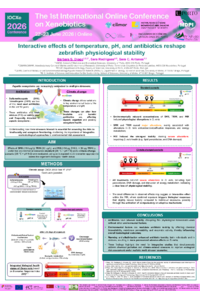
Diogo et al., Poster JOX 2026.pdf
Biomimetic insights into toxicokinetics and health risks of organic environmental pollutants
Clove Oil as a Xenobiotic: Assessment of Acute Oral Toxicity and Multi-Organ Damage in Rats