Event submissions
Published
This submission belongs to the session S1. Environmental Toxicity, Bioaccumulation and Remediation Strategies of the event The 1st International Online Conference on Xenobiotics
Published date
17 Jun, 2026
Academic Editor
'%3e%3cpath%20d='M12.6657%2010.9104C12.4185%2010.325%2012.0599%209.79327%2011.6097%209.34482C11.1609%208.89508%2010.6293%208.5365%2010.0442%208.28888C10.0389%208.28626%2010.0337%208.28495%2010.0285%208.28233C10.8446%207.69279%2011.3752%206.73249%2011.3752%205.64904C11.3752%203.8542%209.92103%202.39999%208.1262%202.39999C6.33136%202.39999%204.87715%203.8542%204.87715%205.64904C4.87715%206.73249%205.40774%207.69279%206.22393%208.28364C6.21869%208.28626%206.21345%208.28757%206.20821%208.29019C5.62129%208.5378%205.09463%208.89284%204.64265%209.34613C4.1929%209.79493%203.83432%2010.3266%203.58671%2010.9117C3.34345%2011.4845%203.21226%2012.0987%203.20023%2012.7209C3.19988%2012.7349%203.20233%2012.7488%203.20744%2012.7619C3.21255%2012.7749%203.22022%2012.7867%203.22998%2012.7968C3.23975%2012.8068%203.25142%2012.8147%203.26431%2012.8202C3.2772%2012.8256%203.29105%2012.8284%203.30504%2012.8284H4.09109C4.14874%2012.8284%204.19459%2012.7825%204.1959%2012.7262C4.2221%2011.7148%204.62823%2010.7676%205.34617%2010.0497C6.08899%209.30683%207.0755%208.89808%208.1262%208.89808C9.17689%208.89808%2010.1634%209.30683%2010.9062%2010.0497C11.6242%2010.7676%2012.0303%2011.7148%2012.0565%2012.7262C12.0578%2012.7838%2012.1037%2012.8284%2012.1613%2012.8284H12.9474C12.9613%2012.8284%2012.9752%2012.8256%2012.9881%2012.8202C13.001%2012.8147%2013.0126%2012.8068%2013.0224%2012.7968C13.0322%2012.7867%2013.0398%2012.7749%2013.0449%2012.7619C13.0501%2012.7488%2013.0525%2012.7349%2013.0522%2012.7209C13.0391%2012.0947%2012.9094%2011.4855%2012.6657%2010.9104ZM8.1262%207.9024C7.52486%207.9024%206.9589%207.6679%206.53312%207.24211C6.10733%206.81633%205.87283%206.25037%205.87283%205.64904C5.87283%205.0477%206.10733%204.48174%206.53312%204.05596C6.9589%203.63018%207.52486%203.39567%208.1262%203.39567C8.72753%203.39567%209.29349%203.63018%209.71927%204.05596C10.1451%204.48174%2010.3796%205.0477%2010.3796%205.64904C10.3796%206.25037%2010.1451%206.81633%209.71927%207.24211C9.29349%207.6679%208.72753%207.9024%208.1262%207.9024Z'%20fill='%235D1EE1'/%3e%3c/g%3e%3c/svg%3e) A. P. Pinto
A. P. PintoCitation
nadeem ali, Ahmed Saleh Summan, Occurrence and Tissue-Specific Distribution of Arsenic and Other Potentially Toxic Elements in Retail Meats: Implications for Dietary Risk Assessment, in Proceedings of The 1st International Online Conference on Xenobiotics, 22 June–23 June 2026, MDPI: Basel, Switzerland
Share
Email
Facebook
Twitter
LinkedIn
Occurrence and Tissue-Specific Distribution of Arsenic and Other Potentially Toxic Elements in Retail Meats: Implications for Dietary Risk Assessment
'%3e%3cpath%20d='M12.6647%2010.9104C12.4176%2010.325%2012.0589%209.7933%2011.6088%209.34485C11.16%208.89511%2010.6283%208.53653%2010.0432%208.28891C10.038%208.28629%2010.0327%208.28498%2010.0275%208.28236C10.8437%207.69282%2011.3743%206.73252%2011.3743%205.64907C11.3743%203.85423%209.92005%202.40002%208.12522%202.40002C6.33038%202.40002%204.87618%203.85423%204.87618%205.64907C4.87618%206.73252%205.40677%207.69282%206.22296%208.28367C6.21772%208.28629%206.21248%208.2876%206.20724%208.29022C5.62031%208.53783%205.09365%208.89287%204.64167%209.34616C4.19192%209.79496%203.83334%2010.3266%203.58573%2010.9117C3.34247%2011.4846%203.21128%2012.0987%203.19925%2012.721C3.1989%2012.735%203.20135%2012.7489%203.20646%2012.7619C3.21157%2012.7749%203.21924%2012.7868%203.22901%2012.7968C3.23877%2012.8068%203.25045%2012.8148%203.26334%2012.8202C3.27623%2012.8256%203.29007%2012.8284%203.30406%2012.8284H4.09012C4.14776%2012.8284%204.19362%2012.7825%204.19493%2012.7262C4.22113%2011.7148%204.62726%2010.7676%205.34519%2010.0497C6.08802%209.30686%207.07452%208.89811%208.12522%208.89811C9.17592%208.89811%2010.1624%209.30686%2010.9052%2010.0497C11.6232%2010.7676%2012.0293%2011.7148%2012.0555%2012.7262C12.0568%2012.7839%2012.1027%2012.8284%2012.1603%2012.8284H12.9464C12.9604%2012.8284%2012.9742%2012.8256%2012.9871%2012.8202C13%2012.8148%2013.0117%2012.8068%2013.0214%2012.7968C13.0312%2012.7868%2013.0389%2012.7749%2013.044%2012.7619C13.0491%2012.7489%2013.0515%2012.735%2013.0512%2012.721C13.0381%2012.0947%2012.9084%2011.4856%2012.6647%2010.9104ZM8.12522%207.90243C7.52388%207.90243%206.95792%207.66793%206.53214%207.24215C6.10636%206.81636%205.87185%206.2504%205.87185%205.64907C5.87185%205.04773%206.10636%204.48177%206.53214%204.05599C6.95792%203.63021%207.52388%203.3957%208.12522%203.3957C8.72655%203.3957%209.29252%203.63021%209.7183%204.05599C10.1441%204.48177%2010.3786%205.04773%2010.3786%205.64907C10.3786%206.2504%2010.1441%206.81636%209.7183%207.24215C9.29252%207.66793%208.72655%207.90243%208.12522%207.90243Z'%20fill='%235D1EE1'/%3e%3c/g%3e%3c/svg%3e)
nadeem ali 1
Ahmed Saleh Summan 1
1. Center of Excellence in Environmental Studies, King Abdulaziz University, Jeddah, 21589, Saudi Arabia
Abstract
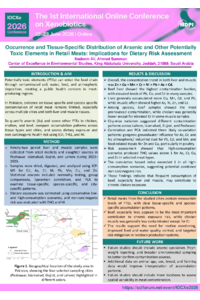
Data on arsenic (As) and other potentially toxic elements (PTEs) in Pakistani retail meats are limited, constraining evidence-based dietary risk assessment and management. This study aimed to determine the concentrations and profiles of As and seven other PTEs (Cr, Ni, Mn, Pb, Cd, Cu, Zn) in commonly consumed meats and to evaluate the associated non-carcinogenic health risks. Ninety-two paired liver and muscle samples from broiler chicken, goat (mutton), and beef cattle were collected from four cities across the Indus Plain and analyzed using inductively coupled plasma mass spectrometry (ICP-MS). Dietary exposure was evaluated using estimated daily intake (EDI), target hazard quotient (THQ) and hazardous index (HI) under typical and high-consumption scenarios. Overall, Zn and Cu exhibited the highest concentrations, followed by Mn and Cr, whereas As, Pb, Ni, and Cd occurred at comparatively lower but environmentally relevant levels. Beef liver exhibited the highest contamination levels, exceeding FAO/WHO permissible limits for Pb, Cu, and Cd in up to 40% of samples. In contrast, mutton and beef muscle contained the highest As and Zn concentrations, while chicken muscle showed elevated Cr levels. Multivariate statistical analysis revealed three dominant co-variation patterns, suggesting potential contamination pathways: (i) geogenic groundwater sources enriched with As, Cr, and Ni; (ii) atmospheric and industrial dust inputs linked with Pb, Cd, and Mn; and (iii) mineral-enriched feed additives potentially contributing to elevated Zn and Cu, particularly in poultry. Under high-consumption scenarios, THQ values for As, Cr, Cu, and Zn exceeded the safety threshold (THQ > 1), highlighting beef products as the dominant source of chronic dietary risk. Overall, the findings highlight pronounced tissue- and species-specific accumulation trends, and emphasize the urgent need for stricter feed and water quality control measures to minimize dietary exposure to PTEs.
Keywords
PTEs
Meat Contamination
Risk Assessment
Food Safety
Poster
IOCXe 2026- PTEs in meat- poster.pdf
In silico ecotoxicological evaluation of hydroxylated progesterone biotransformation products generated by the marine-derived fungus Penicillium oxalicum CBMAI 1996
Bioprotective potential of lichen extract (Pseudevernia furfuracea) and its stimulating effect on the growth of radish (Raphanus sativus L.) and its tolerance to stress induced by cyanobacterial microcystins.