Event submissions
Published
This submission belongs to the session S1. Environmental Toxicity, Bioaccumulation and Remediation Strategies of the event The 1st International Online Conference on Xenobiotics
Published date
17 Jun, 2026
Academic Editor
'%3e%3cpath%20d='M12.6657%2010.9104C12.4185%2010.325%2012.0599%209.79327%2011.6097%209.34482C11.1609%208.89508%2010.6293%208.5365%2010.0442%208.28888C10.0389%208.28626%2010.0337%208.28495%2010.0285%208.28233C10.8446%207.69279%2011.3752%206.73249%2011.3752%205.64904C11.3752%203.8542%209.92103%202.39999%208.1262%202.39999C6.33136%202.39999%204.87715%203.8542%204.87715%205.64904C4.87715%206.73249%205.40774%207.69279%206.22393%208.28364C6.21869%208.28626%206.21345%208.28757%206.20821%208.29019C5.62129%208.5378%205.09463%208.89284%204.64265%209.34613C4.1929%209.79493%203.83432%2010.3266%203.58671%2010.9117C3.34345%2011.4845%203.21226%2012.0987%203.20023%2012.7209C3.19988%2012.7349%203.20233%2012.7488%203.20744%2012.7619C3.21255%2012.7749%203.22022%2012.7867%203.22998%2012.7968C3.23975%2012.8068%203.25142%2012.8147%203.26431%2012.8202C3.2772%2012.8256%203.29105%2012.8284%203.30504%2012.8284H4.09109C4.14874%2012.8284%204.19459%2012.7825%204.1959%2012.7262C4.2221%2011.7148%204.62823%2010.7676%205.34617%2010.0497C6.08899%209.30683%207.0755%208.89808%208.1262%208.89808C9.17689%208.89808%2010.1634%209.30683%2010.9062%2010.0497C11.6242%2010.7676%2012.0303%2011.7148%2012.0565%2012.7262C12.0578%2012.7838%2012.1037%2012.8284%2012.1613%2012.8284H12.9474C12.9613%2012.8284%2012.9752%2012.8256%2012.9881%2012.8202C13.001%2012.8147%2013.0126%2012.8068%2013.0224%2012.7968C13.0322%2012.7867%2013.0398%2012.7749%2013.0449%2012.7619C13.0501%2012.7488%2013.0525%2012.7349%2013.0522%2012.7209C13.0391%2012.0947%2012.9094%2011.4855%2012.6657%2010.9104ZM8.1262%207.9024C7.52486%207.9024%206.9589%207.6679%206.53312%207.24211C6.10733%206.81633%205.87283%206.25037%205.87283%205.64904C5.87283%205.0477%206.10733%204.48174%206.53312%204.05596C6.9589%203.63018%207.52486%203.39567%208.1262%203.39567C8.72753%203.39567%209.29349%203.63018%209.71927%204.05596C10.1451%204.48174%2010.3796%205.0477%2010.3796%205.64904C10.3796%206.25037%2010.1451%206.81633%209.71927%207.24211C9.29349%207.6679%208.72753%207.9024%208.1262%207.9024Z'%20fill='%235D1EE1'/%3e%3c/g%3e%3c/svg%3e) A. P. Pinto
A. P. PintoCitation
Cristina Firincă, Lucian Gabriel Zamfir, Mariana Constantin, Iuliana Răut, Ionuț Adrian Cepleanu-Pascu, Ioana Cătălina Gîfu, Mihaela Doni, Ana Maria Gurban, Innovative Integrated Platform Combining a Myco-Phytoremediation System with Portable Electrochemical Sensing for Sustainable Remediation of Heavy Metal-Contaminated Soils, in Proceedings of The 1st International Online Conference on Xenobiotics, 22 June–23 June 2026, MDPI: Basel, Switzerland
Share
Email
Facebook
Twitter
LinkedIn
Innovative Integrated Platform Combining a Myco-Phytoremediation System with Portable Electrochemical Sensing for Sustainable Remediation of Heavy Metal-Contaminated Soils
'%3e%3cpath%20d='M12.6647%2010.9104C12.4176%2010.325%2012.0589%209.7933%2011.6088%209.34485C11.16%208.89511%2010.6283%208.53653%2010.0432%208.28891C10.038%208.28629%2010.0327%208.28498%2010.0275%208.28236C10.8437%207.69282%2011.3743%206.73252%2011.3743%205.64907C11.3743%203.85423%209.92005%202.40002%208.12522%202.40002C6.33038%202.40002%204.87618%203.85423%204.87618%205.64907C4.87618%206.73252%205.40677%207.69282%206.22296%208.28367C6.21772%208.28629%206.21248%208.2876%206.20724%208.29022C5.62031%208.53783%205.09365%208.89287%204.64167%209.34616C4.19192%209.79496%203.83334%2010.3266%203.58573%2010.9117C3.34247%2011.4846%203.21128%2012.0987%203.19925%2012.721C3.1989%2012.735%203.20135%2012.7489%203.20646%2012.7619C3.21157%2012.7749%203.21924%2012.7868%203.22901%2012.7968C3.23877%2012.8068%203.25045%2012.8148%203.26334%2012.8202C3.27623%2012.8256%203.29007%2012.8284%203.30406%2012.8284H4.09012C4.14776%2012.8284%204.19362%2012.7825%204.19493%2012.7262C4.22113%2011.7148%204.62726%2010.7676%205.34519%2010.0497C6.08802%209.30686%207.07452%208.89811%208.12522%208.89811C9.17592%208.89811%2010.1624%209.30686%2010.9052%2010.0497C11.6232%2010.7676%2012.0293%2011.7148%2012.0555%2012.7262C12.0568%2012.7839%2012.1027%2012.8284%2012.1603%2012.8284H12.9464C12.9604%2012.8284%2012.9742%2012.8256%2012.9871%2012.8202C13%2012.8148%2013.0117%2012.8068%2013.0214%2012.7968C13.0312%2012.7868%2013.0389%2012.7749%2013.044%2012.7619C13.0491%2012.7489%2013.0515%2012.735%2013.0512%2012.721C13.0381%2012.0947%2012.9084%2011.4856%2012.6647%2010.9104ZM8.12522%207.90243C7.52388%207.90243%206.95792%207.66793%206.53214%207.24215C6.10636%206.81636%205.87185%206.2504%205.87185%205.64907C5.87185%205.04773%206.10636%204.48177%206.53214%204.05599C6.95792%203.63021%207.52388%203.3957%208.12522%203.3957C8.72655%203.3957%209.29252%203.63021%209.7183%204.05599C10.1441%204.48177%2010.3786%205.04773%2010.3786%205.64907C10.3786%206.2504%2010.1441%206.81636%209.7183%207.24215C9.29252%207.66793%208.72655%207.90243%208.12522%207.90243Z'%20fill='%235D1EE1'/%3e%3c/g%3e%3c/svg%3e)
Cristina Firincă 1,2
Lucian Gabriel Zamfir 1
Mariana Constantin 1
Iuliana Răut 1
Ionuț Adrian Cepleanu-Pascu 3

Ioana Cătălina Gîfu 1

Mihaela Doni 1
Ana Maria Gurban 1
1. INCDCP-ICECHIM Bucharest, Department of Biotechnology, 202 Spl. Independentei, 6th district, Romania
2. University of Bucharest, Faculty of Biology, Splaiul Independentei 91-95, Bucharest, R-050095, Romania
3. ALA BIOLAB S.R.L., Splaiul Unirii 313, 030108 Bucharest, Romania
Abstract
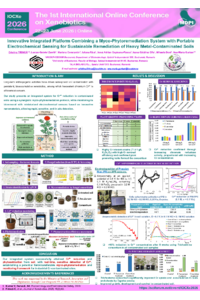
Hexavalent chromium (Cr⁶⁺) is a persistent, bioaccumulative, and highly toxic contaminant of major environmental concern. Biological remediation strategies have emerged as cost-effective, sustainable, and efficient alternatives to conventional treatments (https://doi.org/10.3390/jox15030063); however, large-scale applicability is often limited by the lack of rapid, simple, and reliable in situ monitoring methods for target xenobiotics.
This study proposes an integrated approach combining bioaugmentation and phytoextraction using a novel native consortium of Trichoderma spp. in synergy with Tagetes erecta, a species known for its strong rhizosphere activity and high stress tolerance. Simultaneously, real-time electrochemical detection of Cr⁶⁺ was implemented, enabling continuous, minimally invasive in situ monitoring and supporting the development of an efficient closed-loop soil restoration framework.
Soil samples with varying chromium concentrations were collected from three locations in Bucharest. Metallotolerant fungi isolated from the most contaminated site were evaluated for Cr tolerance, removal efficiency, and plant growth-promoting traits (https://doi.org/10.1016/j.ecoenv.2019.109734). Selected strains were identified by qPCR, assembled into a resistant consortium, and applied to contaminated soils. The reduction of Cr⁶⁺ to Cr³⁺ was assessed via chromate reductase activity using 1,5-diphenylcarbazide and monitored over 8 weeks in soil solution collected with suction lysimeters. Detection was performed using miniaturized amperometric sensors modified with nanomaterials and Prussian blue. Tagetes erecta was cultivated in treated soils for 12 weeks, while chromium accumulation in roots, shoots, and soil was determined by ICP-OES, and bioconcentration and translocation factors were calculated.
The developed Cr-tolerant consortium (Trichoderma harzianum, T. virens, T. atroviride) achieved up to 95% Cr⁶⁺ removal within 8 weeks through enzymatic reduction, while enhancing plant growth and chromium uptake. Electrochemical detection showed high sensitivity (329.12 mA/M·cm²), a linear range of 10–1500 µM, and a detection limit of 9.4 µM, demonstrating excellent reproducibility and stability.
This integrated strategy supports sustainable soil restoration through synergistic bioremediation and real-time electrochemical monitoring.
Keywords
soil bioremediation
heavy metals
nanomaterials
biosenors
hyperaccumulator plants
Poster
Poster Cristina Firincă.pdf
Enhanced biodegradation of phenylurea herbicides in polluted soils using a combined bioagmentation and biostimulation technology
Parallel assessment of the effects of early life exposure to bisphenol S and inhibition of nuclear receptor of thyroid hormones on bone development