Event submissions
Published
This submission belongs to the session S1. Environmental Toxicity, Bioaccumulation and Remediation Strategies of the event The 1st International Online Conference on Xenobiotics
Published date
17 Jun, 2026
Academic Editor
'%3e%3cpath%20d='M12.6657%2010.9104C12.4185%2010.325%2012.0599%209.79327%2011.6097%209.34482C11.1609%208.89508%2010.6293%208.5365%2010.0442%208.28888C10.0389%208.28626%2010.0337%208.28495%2010.0285%208.28233C10.8446%207.69279%2011.3752%206.73249%2011.3752%205.64904C11.3752%203.8542%209.92103%202.39999%208.1262%202.39999C6.33136%202.39999%204.87715%203.8542%204.87715%205.64904C4.87715%206.73249%205.40774%207.69279%206.22393%208.28364C6.21869%208.28626%206.21345%208.28757%206.20821%208.29019C5.62129%208.5378%205.09463%208.89284%204.64265%209.34613C4.1929%209.79493%203.83432%2010.3266%203.58671%2010.9117C3.34345%2011.4845%203.21226%2012.0987%203.20023%2012.7209C3.19988%2012.7349%203.20233%2012.7488%203.20744%2012.7619C3.21255%2012.7749%203.22022%2012.7867%203.22998%2012.7968C3.23975%2012.8068%203.25142%2012.8147%203.26431%2012.8202C3.2772%2012.8256%203.29105%2012.8284%203.30504%2012.8284H4.09109C4.14874%2012.8284%204.19459%2012.7825%204.1959%2012.7262C4.2221%2011.7148%204.62823%2010.7676%205.34617%2010.0497C6.08899%209.30683%207.0755%208.89808%208.1262%208.89808C9.17689%208.89808%2010.1634%209.30683%2010.9062%2010.0497C11.6242%2010.7676%2012.0303%2011.7148%2012.0565%2012.7262C12.0578%2012.7838%2012.1037%2012.8284%2012.1613%2012.8284H12.9474C12.9613%2012.8284%2012.9752%2012.8256%2012.9881%2012.8202C13.001%2012.8147%2013.0126%2012.8068%2013.0224%2012.7968C13.0322%2012.7867%2013.0398%2012.7749%2013.0449%2012.7619C13.0501%2012.7488%2013.0525%2012.7349%2013.0522%2012.7209C13.0391%2012.0947%2012.9094%2011.4855%2012.6657%2010.9104ZM8.1262%207.9024C7.52486%207.9024%206.9589%207.6679%206.53312%207.24211C6.10733%206.81633%205.87283%206.25037%205.87283%205.64904C5.87283%205.0477%206.10733%204.48174%206.53312%204.05596C6.9589%203.63018%207.52486%203.39567%208.1262%203.39567C8.72753%203.39567%209.29349%203.63018%209.71927%204.05596C10.1451%204.48174%2010.3796%205.0477%2010.3796%205.64904C10.3796%206.25037%2010.1451%206.81633%209.71927%207.24211C9.29349%207.6679%208.72753%207.9024%208.1262%207.9024Z'%20fill='%235D1EE1'/%3e%3c/g%3e%3c/svg%3e) A. P. Pinto
A. P. PintoCitation
Belén Rodrígez Morillo, Marina Rubio Bellido, Inés Aguilar Romero, Jaime Villaverde Capellán, Fernando Madrid Diaz, Phenylurea Herbicide Biodegradation in Aqueous Solution using bioaugmentation strategies with Advenella sp. JRO, in Proceedings of The 1st International Online Conference on Xenobiotics, 22 June–23 June 2026, MDPI: Basel, Switzerland
Share
Email
Facebook
Twitter
LinkedIn
Phenylurea Herbicide Biodegradation in Aqueous Solution using bioaugmentation strategies with Advenella sp. JRO
'%3e%3cpath%20d='M12.6647%2010.9104C12.4176%2010.325%2012.0589%209.7933%2011.6088%209.34485C11.16%208.89511%2010.6283%208.53653%2010.0432%208.28891C10.038%208.28629%2010.0327%208.28498%2010.0275%208.28236C10.8437%207.69282%2011.3743%206.73252%2011.3743%205.64907C11.3743%203.85423%209.92005%202.40002%208.12522%202.40002C6.33038%202.40002%204.87618%203.85423%204.87618%205.64907C4.87618%206.73252%205.40677%207.69282%206.22296%208.28367C6.21772%208.28629%206.21248%208.2876%206.20724%208.29022C5.62031%208.53783%205.09365%208.89287%204.64167%209.34616C4.19192%209.79496%203.83334%2010.3266%203.58573%2010.9117C3.34247%2011.4846%203.21128%2012.0987%203.19925%2012.721C3.1989%2012.735%203.20135%2012.7489%203.20646%2012.7619C3.21157%2012.7749%203.21924%2012.7868%203.22901%2012.7968C3.23877%2012.8068%203.25045%2012.8148%203.26334%2012.8202C3.27623%2012.8256%203.29007%2012.8284%203.30406%2012.8284H4.09012C4.14776%2012.8284%204.19362%2012.7825%204.19493%2012.7262C4.22113%2011.7148%204.62726%2010.7676%205.34519%2010.0497C6.08802%209.30686%207.07452%208.89811%208.12522%208.89811C9.17592%208.89811%2010.1624%209.30686%2010.9052%2010.0497C11.6232%2010.7676%2012.0293%2011.7148%2012.0555%2012.7262C12.0568%2012.7839%2012.1027%2012.8284%2012.1603%2012.8284H12.9464C12.9604%2012.8284%2012.9742%2012.8256%2012.9871%2012.8202C13%2012.8148%2013.0117%2012.8068%2013.0214%2012.7968C13.0312%2012.7868%2013.0389%2012.7749%2013.044%2012.7619C13.0491%2012.7489%2013.0515%2012.735%2013.0512%2012.721C13.0381%2012.0947%2012.9084%2011.4856%2012.6647%2010.9104ZM8.12522%207.90243C7.52388%207.90243%206.95792%207.66793%206.53214%207.24215C6.10636%206.81636%205.87185%206.2504%205.87185%205.64907C5.87185%205.04773%206.10636%204.48177%206.53214%204.05599C6.95792%203.63021%207.52388%203.3957%208.12522%203.3957C8.72655%203.3957%209.29252%203.63021%209.7183%204.05599C10.1441%204.48177%2010.3786%205.04773%2010.3786%205.64907C10.3786%206.2504%2010.1441%206.81636%209.7183%207.24215C9.29252%207.66793%208.72655%207.90243%208.12522%207.90243Z'%20fill='%235D1EE1'/%3e%3c/g%3e%3c/svg%3e)
Belén Rodrígez Morillo 1
Marina Rubio Bellido 2
Inés Aguilar Romero 2

Jaime Villaverde Capellán 2
Fernando Madrid Diaz 2
1. Faculty of Pharmacy, University of Seville. Seville, Spain
2. Institute of Natural Resources and Agrobiology of Seville, Department of Agrochemistry, Environmental Microbiology and Soil Conservation, Spanish National Research Council (IRNAS-CSIC), 41012 Seville, Spain
Abstract
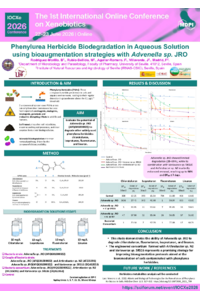
Phenylureas are among the most widely used herbicide families worldwide for weed control. However, the mobility of these compounds and their degradation metabolites poses risks to animals, plants, aquatic invertebrates, microbial communities, and humans. Advenella sp. JRO (AFQG01000022) has previously been identified as an efficient biodegrader of diuron, the most commonly used phenylurea herbicide. Building on this knowledge, the aim of the present study was to evaluate the potential of this strain to degrade other widely used phenylurea herbicides: chlorotoluron, isoproturon, fluometuron, and linuron. HPLC-UV methodology for pesticide detection in solution showed the limited biodegradation capacity of this strain, achieving only 28, 40, 42 and 59 % degradation rate of solutions with 10mgL-1 as single initial concentration of chlorotoluron, isoproturon, linuron and fluometuron, respectively, and with very high DT₅₀ according to kinetic models (range 342-3636 days), so Advenella sp. JRO cannot be considered as a valid method to biodegrade these phenylureas.
To enhance degradation rate, Advenella sp. JRO was also tested as part of consortia with Arthrobacter sp. N2 (AF235091) and Variovorax sp. SRS16 (DQ432053), two strains that previously had shown toxicity reductions and mineralization increases in diuron-contaminated soils by removing toxic metabolites. When these strains were combined, biodegradation significantly improved. The consortium composed of Advenella sp. JRO and Variovorax sp. SRS16 achieved 84% and 96% degradation (DT₅₀: 3 and 7 days) of chlorotoluron and fluometuron, respectively. Similarly, the triad formed by Advenella sp. JRO, Variovorax sp. SRS16, and Arthrobacter sp. N2 degraded 98% of isoproturon (DT₅₀: 7 days).
This study demonstrates, for the first time, the ability of Advenella sp. JRO to degrade chlorotoluron, fluometuron, isoproturon, and linuron. Furthermore, the engineered consortium formed with Arthrobacter sp. N2 and Variovorax sp. SRS16 represents a promising strategy for improving bioaugmentation protocols aimed at the bioremediation of soils contaminated with phenylurea herbicides.
Keywords
Bacterial consortium
Chlorotoluron
Isoproturon
Fluometuron
Linuron
Soil bioremediation
Poster
Phenylurea Herbicide Biodegradation for IOCXe.pdf
Germination and Physiological Responses as Early Biomarkers of Xenobiotic-Induced Phytotoxicity in Triticum durum
Environmental Fate and Bioaccumulation of Antibiotic Xenobiotics in Aquatic Ecosystems: Ecotoxicological Risks and Bioremediation Approaches