Event submissions
Published
This submission belongs to the session S1. Environmental Toxicity, Bioaccumulation and Remediation Strategies of the event The 1st International Online Conference on Xenobiotics
Published date
17 Jun, 2026
Academic Editor
'%3e%3cpath%20d='M12.6657%2010.9104C12.4185%2010.325%2012.0599%209.79327%2011.6097%209.34482C11.1609%208.89508%2010.6293%208.5365%2010.0442%208.28888C10.0389%208.28626%2010.0337%208.28495%2010.0285%208.28233C10.8446%207.69279%2011.3752%206.73249%2011.3752%205.64904C11.3752%203.8542%209.92103%202.39999%208.1262%202.39999C6.33136%202.39999%204.87715%203.8542%204.87715%205.64904C4.87715%206.73249%205.40774%207.69279%206.22393%208.28364C6.21869%208.28626%206.21345%208.28757%206.20821%208.29019C5.62129%208.5378%205.09463%208.89284%204.64265%209.34613C4.1929%209.79493%203.83432%2010.3266%203.58671%2010.9117C3.34345%2011.4845%203.21226%2012.0987%203.20023%2012.7209C3.19988%2012.7349%203.20233%2012.7488%203.20744%2012.7619C3.21255%2012.7749%203.22022%2012.7867%203.22998%2012.7968C3.23975%2012.8068%203.25142%2012.8147%203.26431%2012.8202C3.2772%2012.8256%203.29105%2012.8284%203.30504%2012.8284H4.09109C4.14874%2012.8284%204.19459%2012.7825%204.1959%2012.7262C4.2221%2011.7148%204.62823%2010.7676%205.34617%2010.0497C6.08899%209.30683%207.0755%208.89808%208.1262%208.89808C9.17689%208.89808%2010.1634%209.30683%2010.9062%2010.0497C11.6242%2010.7676%2012.0303%2011.7148%2012.0565%2012.7262C12.0578%2012.7838%2012.1037%2012.8284%2012.1613%2012.8284H12.9474C12.9613%2012.8284%2012.9752%2012.8256%2012.9881%2012.8202C13.001%2012.8147%2013.0126%2012.8068%2013.0224%2012.7968C13.0322%2012.7867%2013.0398%2012.7749%2013.0449%2012.7619C13.0501%2012.7488%2013.0525%2012.7349%2013.0522%2012.7209C13.0391%2012.0947%2012.9094%2011.4855%2012.6657%2010.9104ZM8.1262%207.9024C7.52486%207.9024%206.9589%207.6679%206.53312%207.24211C6.10733%206.81633%205.87283%206.25037%205.87283%205.64904C5.87283%205.0477%206.10733%204.48174%206.53312%204.05596C6.9589%203.63018%207.52486%203.39567%208.1262%203.39567C8.72753%203.39567%209.29349%203.63018%209.71927%204.05596C10.1451%204.48174%2010.3796%205.0477%2010.3796%205.64904C10.3796%206.25037%2010.1451%206.81633%209.71927%207.24211C9.29349%207.6679%208.72753%207.9024%208.1262%207.9024Z'%20fill='%235D1EE1'/%3e%3c/g%3e%3c/svg%3e) Yang-Guang Gu
Yang-Guang GuCitation
Geraldine P. Tica-a, Natasha C. Cayaban, Desiree F. Padkiw, Sherlyn C. Tipayno, Bioremediation Potential of Heavy Metal and Pesticide-Tolerant Poacea Endophytes from an Open Pit Mining Area in Benguet, Philippines, in Proceedings of The 1st International Online Conference on Xenobiotics, 22 June–23 June 2026, MDPI: Basel, Switzerland
Share
Email
Facebook
Twitter
LinkedIn
Bioremediation Potential of Heavy Metal and Pesticide-Tolerant Poacea Endophytes from an Open Pit Mining Area in Benguet, Philippines
'%3e%3cpath%20d='M12.6647%2010.9104C12.4176%2010.325%2012.0589%209.7933%2011.6088%209.34485C11.16%208.89511%2010.6283%208.53653%2010.0432%208.28891C10.038%208.28629%2010.0327%208.28498%2010.0275%208.28236C10.8437%207.69282%2011.3743%206.73252%2011.3743%205.64907C11.3743%203.85423%209.92005%202.40002%208.12522%202.40002C6.33038%202.40002%204.87618%203.85423%204.87618%205.64907C4.87618%206.73252%205.40677%207.69282%206.22296%208.28367C6.21772%208.28629%206.21248%208.2876%206.20724%208.29022C5.62031%208.53783%205.09365%208.89287%204.64167%209.34616C4.19192%209.79496%203.83334%2010.3266%203.58573%2010.9117C3.34247%2011.4846%203.21128%2012.0987%203.19925%2012.721C3.1989%2012.735%203.20135%2012.7489%203.20646%2012.7619C3.21157%2012.7749%203.21924%2012.7868%203.22901%2012.7968C3.23877%2012.8068%203.25045%2012.8148%203.26334%2012.8202C3.27623%2012.8256%203.29007%2012.8284%203.30406%2012.8284H4.09012C4.14776%2012.8284%204.19362%2012.7825%204.19493%2012.7262C4.22113%2011.7148%204.62726%2010.7676%205.34519%2010.0497C6.08802%209.30686%207.07452%208.89811%208.12522%208.89811C9.17592%208.89811%2010.1624%209.30686%2010.9052%2010.0497C11.6232%2010.7676%2012.0293%2011.7148%2012.0555%2012.7262C12.0568%2012.7839%2012.1027%2012.8284%2012.1603%2012.8284H12.9464C12.9604%2012.8284%2012.9742%2012.8256%2012.9871%2012.8202C13%2012.8148%2013.0117%2012.8068%2013.0214%2012.7968C13.0312%2012.7868%2013.0389%2012.7749%2013.044%2012.7619C13.0491%2012.7489%2013.0515%2012.735%2013.0512%2012.721C13.0381%2012.0947%2012.9084%2011.4856%2012.6647%2010.9104ZM8.12522%207.90243C7.52388%207.90243%206.95792%207.66793%206.53214%207.24215C6.10636%206.81636%205.87185%206.2504%205.87185%205.64907C5.87185%205.04773%206.10636%204.48177%206.53214%204.05599C6.95792%203.63021%207.52388%203.3957%208.12522%203.3957C8.72655%203.3957%209.29252%203.63021%209.7183%204.05599C10.1441%204.48177%2010.3786%205.04773%2010.3786%205.64907C10.3786%206.2504%2010.1441%206.81636%209.7183%207.24215C9.29252%207.66793%208.72655%207.90243%208.12522%207.90243Z'%20fill='%235D1EE1'/%3e%3c/g%3e%3c/svg%3e)
Geraldine P. Tica-a 1
Natasha C. Cayaban 1
Desiree F. Padkiw 1
Sherlyn C. Tipayno 1
1. Department of Biology, College of Natural Sciences, Benguet State University, Benguet, Philippines
Abstract
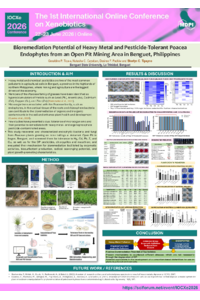
Heavy metals and chemical pesticides are two of the most common pollutants in agricultural soils in Benguet, a province in the highlands of northern Philippines, where mining and agriculture are the biggest drivers of the economy. We isolated endophytes from Poaceae grasses, ubiquitously growing in an open-pit mining area in Itogon, Benguet, with tolerance to high concentrations of lead, mercury, zinc, cadmium, and copper. Interestingly, these bacteria and fungi also showed tolerance to at least 3000ppm of the organophosphate pesticides, chlorpyrifos and malathion. We suspect that the cross-protection came about as adaptive responses against oxidative stress, known to be induced by both agents. Ten highly tolerant bacterial and eight fungal isolates were tested for their ability to exhibit radical scavenging activity and produce protective biosurfactants and degradative enzymes. Under HM stress, the fungi Bjerkandera, Penicillium, and Aspergillus showed the highest antioxidant activity among the isolates. To further assess their potential to promote crop growth while reducing oxidative stress, we screened these isolates for common PGP traits. Seven of the bacterial isolates were positive for nitrogen fixation. Furthermore, species belonging to Acinetobacter, Pseudomonas, Staphylococcus, and Bacillus showed the highest solubilization activity for phosphate and zinc, as well as high IAA and ammonia production of up to 87.25 and 117.76 ppm, respectively. This suggests promising roles in growth enhancement, making available limiting soil nutrients, and thus, reducing the need for fertilizer input. Although microbial tolerance to HM was directly correlated to soil HM concentration, the latter was not found to be correlated with pesticide tolerance. This suggests that the development of cross-protection for these two stressors may not necessarily occur through common mechanisms. Nonetheless, these findings provide foundational data for the development of microbial consortia and formulations for bioremediation of persistent soil pollutants and sustainable promotion of soil health and crop productivity.
Keywords
Bioremediation
Heavy metal
Organophosphate pesticide
Endophytes
PGP
radical scavenging
Poster
POSTER_IOCXe_2026.pdf
Innovative Polysaccharide-Derived Hydrogels for Sustainable Decontamination of Antibiotic-Polluted Matrices
Toxic Effects of Alternaria Fungi Metabolites on the Antioxidant Defense System of Rats