Event submissions
Published
This submission belongs to the session S1. Environmental Toxicity, Bioaccumulation and Remediation Strategies of the event The 1st International Online Conference on Xenobiotics
Published date
17 Jun, 2026
Academic Editor
'%3e%3cpath%20d='M12.6657%2010.9104C12.4185%2010.325%2012.0599%209.79327%2011.6097%209.34482C11.1609%208.89508%2010.6293%208.5365%2010.0442%208.28888C10.0389%208.28626%2010.0337%208.28495%2010.0285%208.28233C10.8446%207.69279%2011.3752%206.73249%2011.3752%205.64904C11.3752%203.8542%209.92103%202.39999%208.1262%202.39999C6.33136%202.39999%204.87715%203.8542%204.87715%205.64904C4.87715%206.73249%205.40774%207.69279%206.22393%208.28364C6.21869%208.28626%206.21345%208.28757%206.20821%208.29019C5.62129%208.5378%205.09463%208.89284%204.64265%209.34613C4.1929%209.79493%203.83432%2010.3266%203.58671%2010.9117C3.34345%2011.4845%203.21226%2012.0987%203.20023%2012.7209C3.19988%2012.7349%203.20233%2012.7488%203.20744%2012.7619C3.21255%2012.7749%203.22022%2012.7867%203.22998%2012.7968C3.23975%2012.8068%203.25142%2012.8147%203.26431%2012.8202C3.2772%2012.8256%203.29105%2012.8284%203.30504%2012.8284H4.09109C4.14874%2012.8284%204.19459%2012.7825%204.1959%2012.7262C4.2221%2011.7148%204.62823%2010.7676%205.34617%2010.0497C6.08899%209.30683%207.0755%208.89808%208.1262%208.89808C9.17689%208.89808%2010.1634%209.30683%2010.9062%2010.0497C11.6242%2010.7676%2012.0303%2011.7148%2012.0565%2012.7262C12.0578%2012.7838%2012.1037%2012.8284%2012.1613%2012.8284H12.9474C12.9613%2012.8284%2012.9752%2012.8256%2012.9881%2012.8202C13.001%2012.8147%2013.0126%2012.8068%2013.0224%2012.7968C13.0322%2012.7867%2013.0398%2012.7749%2013.0449%2012.7619C13.0501%2012.7488%2013.0525%2012.7349%2013.0522%2012.7209C13.0391%2012.0947%2012.9094%2011.4855%2012.6657%2010.9104ZM8.1262%207.9024C7.52486%207.9024%206.9589%207.6679%206.53312%207.24211C6.10733%206.81633%205.87283%206.25037%205.87283%205.64904C5.87283%205.0477%206.10733%204.48174%206.53312%204.05596C6.9589%203.63018%207.52486%203.39567%208.1262%203.39567C8.72753%203.39567%209.29349%203.63018%209.71927%204.05596C10.1451%204.48174%2010.3796%205.0477%2010.3796%205.64904C10.3796%206.25037%2010.1451%206.81633%209.71927%207.24211C9.29349%207.6679%208.72753%207.9024%208.1262%207.9024Z'%20fill='%235D1EE1'/%3e%3c/g%3e%3c/svg%3e) Yang-Guang Gu
Yang-Guang GuCitation
Anastasya Balakina, Nikita Trusov, Anton Konev, Victor Tutelyan, Toxic Effects of Alternaria Fungi Metabolites on the Antioxidant Defense System of Rats, in Proceedings of The 1st International Online Conference on Xenobiotics, 22 June–23 June 2026, MDPI: Basel, Switzerland
Share
Email
Facebook
Twitter
LinkedIn
Toxic Effects of Alternaria Fungi Metabolites on the Antioxidant Defense System of Rats
'%3e%3cpath%20d='M12.6647%2010.9104C12.4176%2010.325%2012.0589%209.7933%2011.6088%209.34485C11.16%208.89511%2010.6283%208.53653%2010.0432%208.28891C10.038%208.28629%2010.0327%208.28498%2010.0275%208.28236C10.8437%207.69282%2011.3743%206.73252%2011.3743%205.64907C11.3743%203.85423%209.92005%202.40002%208.12522%202.40002C6.33038%202.40002%204.87618%203.85423%204.87618%205.64907C4.87618%206.73252%205.40677%207.69282%206.22296%208.28367C6.21772%208.28629%206.21248%208.2876%206.20724%208.29022C5.62031%208.53783%205.09365%208.89287%204.64167%209.34616C4.19192%209.79496%203.83334%2010.3266%203.58573%2010.9117C3.34247%2011.4846%203.21128%2012.0987%203.19925%2012.721C3.1989%2012.735%203.20135%2012.7489%203.20646%2012.7619C3.21157%2012.7749%203.21924%2012.7868%203.22901%2012.7968C3.23877%2012.8068%203.25045%2012.8148%203.26334%2012.8202C3.27623%2012.8256%203.29007%2012.8284%203.30406%2012.8284H4.09012C4.14776%2012.8284%204.19362%2012.7825%204.19493%2012.7262C4.22113%2011.7148%204.62726%2010.7676%205.34519%2010.0497C6.08802%209.30686%207.07452%208.89811%208.12522%208.89811C9.17592%208.89811%2010.1624%209.30686%2010.9052%2010.0497C11.6232%2010.7676%2012.0293%2011.7148%2012.0555%2012.7262C12.0568%2012.7839%2012.1027%2012.8284%2012.1603%2012.8284H12.9464C12.9604%2012.8284%2012.9742%2012.8256%2012.9871%2012.8202C13%2012.8148%2013.0117%2012.8068%2013.0214%2012.7968C13.0312%2012.7868%2013.0389%2012.7749%2013.044%2012.7619C13.0491%2012.7489%2013.0515%2012.735%2013.0512%2012.721C13.0381%2012.0947%2012.9084%2011.4856%2012.6647%2010.9104ZM8.12522%207.90243C7.52388%207.90243%206.95792%207.66793%206.53214%207.24215C6.10636%206.81636%205.87185%206.2504%205.87185%205.64907C5.87185%205.04773%206.10636%204.48177%206.53214%204.05599C6.95792%203.63021%207.52388%203.3957%208.12522%203.3957C8.72655%203.3957%209.29252%203.63021%209.7183%204.05599C10.1441%204.48177%2010.3786%205.04773%2010.3786%205.64907C10.3786%206.2504%2010.1441%206.81636%209.7183%207.24215C9.29252%207.66793%208.72655%207.90243%208.12522%207.90243Z'%20fill='%235D1EE1'/%3e%3c/g%3e%3c/svg%3e)
Anastasya Balakina 1
Nikita Trusov 1
Anton Konev 1
Victor Tutelyan 1
1. Laboratory of Enzymology of Nutrition, Federal Research Centre of Nutrition, Biotechnology and Food Safety, Moscow 109240, Russia
Abstract
Recent studies indicate substantial contamination of food products with Alternaria toxins (ATs), which are toxic metabolites produced by mold fungi of the genus Alternaria. Their ability to exert cyto- and genotoxic effects may pose a significant risk for human health. The most widespread AT is tenuazonic acid (TeA), which is currently not regulated in food products. In this regard, the aim of the present study was to investigate the effects of ATs, particularly TeA, on the antioxidant defense system of the organism.
A single oral administration of pure TeA (30 mg/kg b.w.) or an extract containing a mixture of AT:TeA (30 mg/kg b.w.), alternariol (0.276 mg/kg b.w.), alternariol monomethyl ether (0.902 mg/kg b.w.), and tentoxin (0.018 mg/kg b.w.) was used to evaluate their effects on antioxidant parameters in male Wistar rats.
A strain of the fungus Alternaria alternata was isolated from barley grain and cultivated on tomato paste. The mixture of ATs was extracted from the resulting substrate using a solvent system (ethyl acetate, formic acid). After evaporation, the extract was dissolved in methanol.
To assess the effects on the antioxidant defense system in rats, the following parameters were analyzed: malondialdehyde (TBARS, HPLC-FLD); conjugated dienes (spectrophotometric assay following Folch extraction); protein carbonyl derivatives (spectrophotometric detection after DNPH derivatization and gel filtration); antioxidant defense enzymes (FRAP assay and catalase activity); and expression of antioxidant defense–related genes (real-time RT-PCR).
It was found that both the AT mixture and TeA reduced total antioxidant activity and induced oxidative stress, as evidenced by increased levels of its markers: malondialdehyde, conjugated dienes, and protein carbonyl derivatives; decreased activity of antioxidant defense enzymes; and altered expression of the corresponding genes. Notably, the AT mixture demonstrated more pronounced effects.
Project number FGMF-2025-0001.
Keywords
emergent mycotoxins
Alternaria toxins
in vivo biological models
antioxidant defense system
gene expression
oxidative stress.
Poster
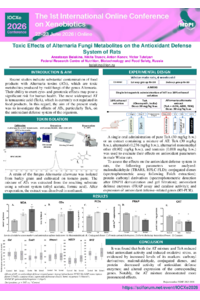
Poster_Balakina et al_Toxic Effects of Alternaria Fungi Metabolites on the Antioxidant Defense System of Rats.pdf
Bioremediation Potential of Heavy Metal and Pesticide-Tolerant Poacea Endophytes from an Open Pit Mining Area in Benguet, Philippines
Occurrence and Effects of Microplastics in the Black Sea: Evidence from Mussels, Water and Sediments