Event submissions
Published
This submission belongs to the session S4. (Micro)plastic Pollution in Environment and Human of the event The 1st International Online Conference on Xenobiotics
Published date
17 Jun, 2026
Academic Editor
'%3e%3cpath%20d='M12.6657%2010.9104C12.4185%2010.325%2012.0599%209.79327%2011.6097%209.34482C11.1609%208.89508%2010.6293%208.5365%2010.0442%208.28888C10.0389%208.28626%2010.0337%208.28495%2010.0285%208.28233C10.8446%207.69279%2011.3752%206.73249%2011.3752%205.64904C11.3752%203.8542%209.92103%202.39999%208.1262%202.39999C6.33136%202.39999%204.87715%203.8542%204.87715%205.64904C4.87715%206.73249%205.40774%207.69279%206.22393%208.28364C6.21869%208.28626%206.21345%208.28757%206.20821%208.29019C5.62129%208.5378%205.09463%208.89284%204.64265%209.34613C4.1929%209.79493%203.83432%2010.3266%203.58671%2010.9117C3.34345%2011.4845%203.21226%2012.0987%203.20023%2012.7209C3.19988%2012.7349%203.20233%2012.7488%203.20744%2012.7619C3.21255%2012.7749%203.22022%2012.7867%203.22998%2012.7968C3.23975%2012.8068%203.25142%2012.8147%203.26431%2012.8202C3.2772%2012.8256%203.29105%2012.8284%203.30504%2012.8284H4.09109C4.14874%2012.8284%204.19459%2012.7825%204.1959%2012.7262C4.2221%2011.7148%204.62823%2010.7676%205.34617%2010.0497C6.08899%209.30683%207.0755%208.89808%208.1262%208.89808C9.17689%208.89808%2010.1634%209.30683%2010.9062%2010.0497C11.6242%2010.7676%2012.0303%2011.7148%2012.0565%2012.7262C12.0578%2012.7838%2012.1037%2012.8284%2012.1613%2012.8284H12.9474C12.9613%2012.8284%2012.9752%2012.8256%2012.9881%2012.8202C13.001%2012.8147%2013.0126%2012.8068%2013.0224%2012.7968C13.0322%2012.7867%2013.0398%2012.7749%2013.0449%2012.7619C13.0501%2012.7488%2013.0525%2012.7349%2013.0522%2012.7209C13.0391%2012.0947%2012.9094%2011.4855%2012.6657%2010.9104ZM8.1262%207.9024C7.52486%207.9024%206.9589%207.6679%206.53312%207.24211C6.10733%206.81633%205.87283%206.25037%205.87283%205.64904C5.87283%205.0477%206.10733%204.48174%206.53312%204.05596C6.9589%203.63018%207.52486%203.39567%208.1262%203.39567C8.72753%203.39567%209.29349%203.63018%209.71927%204.05596C10.1451%204.48174%2010.3796%205.0477%2010.3796%205.64904C10.3796%206.25037%2010.1451%206.81633%209.71927%207.24211C9.29349%207.6679%208.72753%207.9024%208.1262%207.9024Z'%20fill='%235D1EE1'/%3e%3c/g%3e%3c/svg%3e) Tiziana Cappello
Tiziana CappelloCitation
Samuel Fernandes Santos, Luis R. Vieira, Isabel Iglesias, Sandra Nogueira, Garry F. Kett, Isabel Sousa Pinto, Sara C. Antunes, Beyond monitorization: ecological evaluation of the Douro estuary and its microplastic distribution, in Proceedings of The 1st International Online Conference on Xenobiotics, 22 June–23 June 2026, MDPI: Basel, Switzerland
Share
Email
Facebook
Twitter
LinkedIn
Beyond monitorization: ecological evaluation of the Douro estuary and its microplastic distribution
'%3e%3cpath%20d='M12.6647%2010.9104C12.4176%2010.325%2012.0589%209.7933%2011.6088%209.34485C11.16%208.89511%2010.6283%208.53653%2010.0432%208.28891C10.038%208.28629%2010.0327%208.28498%2010.0275%208.28236C10.8437%207.69282%2011.3743%206.73252%2011.3743%205.64907C11.3743%203.85423%209.92005%202.40002%208.12522%202.40002C6.33038%202.40002%204.87618%203.85423%204.87618%205.64907C4.87618%206.73252%205.40677%207.69282%206.22296%208.28367C6.21772%208.28629%206.21248%208.2876%206.20724%208.29022C5.62031%208.53783%205.09365%208.89287%204.64167%209.34616C4.19192%209.79496%203.83334%2010.3266%203.58573%2010.9117C3.34247%2011.4846%203.21128%2012.0987%203.19925%2012.721C3.1989%2012.735%203.20135%2012.7489%203.20646%2012.7619C3.21157%2012.7749%203.21924%2012.7868%203.22901%2012.7968C3.23877%2012.8068%203.25045%2012.8148%203.26334%2012.8202C3.27623%2012.8256%203.29007%2012.8284%203.30406%2012.8284H4.09012C4.14776%2012.8284%204.19362%2012.7825%204.19493%2012.7262C4.22113%2011.7148%204.62726%2010.7676%205.34519%2010.0497C6.08802%209.30686%207.07452%208.89811%208.12522%208.89811C9.17592%208.89811%2010.1624%209.30686%2010.9052%2010.0497C11.6232%2010.7676%2012.0293%2011.7148%2012.0555%2012.7262C12.0568%2012.7839%2012.1027%2012.8284%2012.1603%2012.8284H12.9464C12.9604%2012.8284%2012.9742%2012.8256%2012.9871%2012.8202C13%2012.8148%2013.0117%2012.8068%2013.0214%2012.7968C13.0312%2012.7868%2013.0389%2012.7749%2013.044%2012.7619C13.0491%2012.7489%2013.0515%2012.735%2013.0512%2012.721C13.0381%2012.0947%2012.9084%2011.4856%2012.6647%2010.9104ZM8.12522%207.90243C7.52388%207.90243%206.95792%207.66793%206.53214%207.24215C6.10636%206.81636%205.87185%206.2504%205.87185%205.64907C5.87185%205.04773%206.10636%204.48177%206.53214%204.05599C6.95792%203.63021%207.52388%203.3957%208.12522%203.3957C8.72655%203.3957%209.29252%203.63021%209.7183%204.05599C10.1441%204.48177%2010.3786%205.04773%2010.3786%205.64907C10.3786%206.2504%2010.1441%206.81636%209.7183%207.24215C9.29252%207.66793%208.72655%207.90243%208.12522%207.90243Z'%20fill='%235D1EE1'/%3e%3c/g%3e%3c/svg%3e)
Samuel Fernandes Santos 1

Luis R. Vieira 1,2
Isabel Iglesias 2
Sandra Nogueira 1,2
Garry F. Kett 2
Isabel Sousa Pinto 1,2

Sara C. Antunes 1,2
1. Department of Biology, Faculty of Science (FCUP), University of Porto, 4167-007 Porto, Portugal
2. Interdisciplinary Centre for Marine and Environmental Research (CIIMAR), University of Porto, Leixões Cruise Terminal, 4450-208 Matosinhos, Portugal
Abstract
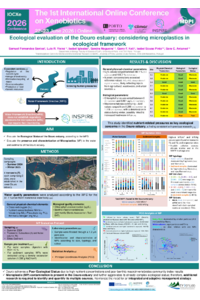
Background: Estuaries are highly productive ecosystems characterised by constant environmental variability, which makes frequent monitorization essential. Estuaries are among some of the most impacted ecosystems, often surrounded by densely urbanised areas and exposed to multiple pollution sources. Microplastics (MPs) are an emerging pollutant that harm aquatic organisms and potentially pose risks to human health. However, MP are still not included in current European water quality guidelines. In this context, the present study assessed the ecological quality of the Douro estuary, in accordance with the Water Framework Directive (WFD), and evaluated the distribution of MPs within this ecosystem. Methods: The ecological evaluation consisted of the analysis of physical and chemical parameters, phytoplankton biomass, macroinvertebrate community, sediment’s organic matter, and granulometry. Along the low estuary, 12 sites were assessed, and MPs were sampled in four transects. Water samples were collected from the surface and sub-surface areas. In sediment, MPs were also sampled along with ecological parameters. MPs were counted, and classified according to size, typology and colour. Results: Physical and chemical results revealed a moderate ecological status, driven by NO2+NO3 concentrations above reference values (1 mg N/L). Phytoplankton biomass showed a high ecological status across all sites. Regarding the macroinvertebrate community, the estuary was classified with a Moderate ecological status. Sediments exhibited low organic matter and a mixed granulometric profile. A total of 9.03 MP m-3 in water and 1650 MP Kg-1 in sediments were recorded, values above those described in Portuguese rivers. A Principal Coordinates Analysis with MP characteristics revealed differences among transects and samples areas consistent with a higher hydrodynamic effect. Conclusion: The estuary holds a Moderate ecological status according to the WFD. MP contamination was also identified across the estuary, although further work is required to identify specific pollution sources.
Keywords
Water Framework Directive
Transitional waters
Ecological status
Anthropogenic pollution
Emergent contaminants
Poster
Santos et a _jox_Ecological evaluation of the Douro estuary_considering microplastics in ecological framework.pdf
New insights into microplastic and benzo[a]pyrene toxicity in seaworm Hediste diversicolor coelomic fluid: A transdisciplinary approach
Linking Human Activities to Microplastic Pollution: Evidence from Marina da Afurada