Event submissions
Published
This submission belongs to the session S4. (Micro)plastic Pollution in Environment and Human of the event The 1st International Online Conference on Xenobiotics
Published date
17 Jun, 2026
Academic Editor
'%3e%3cpath%20d='M12.6657%2010.9104C12.4185%2010.325%2012.0599%209.79327%2011.6097%209.34482C11.1609%208.89508%2010.6293%208.5365%2010.0442%208.28888C10.0389%208.28626%2010.0337%208.28495%2010.0285%208.28233C10.8446%207.69279%2011.3752%206.73249%2011.3752%205.64904C11.3752%203.8542%209.92103%202.39999%208.1262%202.39999C6.33136%202.39999%204.87715%203.8542%204.87715%205.64904C4.87715%206.73249%205.40774%207.69279%206.22393%208.28364C6.21869%208.28626%206.21345%208.28757%206.20821%208.29019C5.62129%208.5378%205.09463%208.89284%204.64265%209.34613C4.1929%209.79493%203.83432%2010.3266%203.58671%2010.9117C3.34345%2011.4845%203.21226%2012.0987%203.20023%2012.7209C3.19988%2012.7349%203.20233%2012.7488%203.20744%2012.7619C3.21255%2012.7749%203.22022%2012.7867%203.22998%2012.7968C3.23975%2012.8068%203.25142%2012.8147%203.26431%2012.8202C3.2772%2012.8256%203.29105%2012.8284%203.30504%2012.8284H4.09109C4.14874%2012.8284%204.19459%2012.7825%204.1959%2012.7262C4.2221%2011.7148%204.62823%2010.7676%205.34617%2010.0497C6.08899%209.30683%207.0755%208.89808%208.1262%208.89808C9.17689%208.89808%2010.1634%209.30683%2010.9062%2010.0497C11.6242%2010.7676%2012.0303%2011.7148%2012.0565%2012.7262C12.0578%2012.7838%2012.1037%2012.8284%2012.1613%2012.8284H12.9474C12.9613%2012.8284%2012.9752%2012.8256%2012.9881%2012.8202C13.001%2012.8147%2013.0126%2012.8068%2013.0224%2012.7968C13.0322%2012.7867%2013.0398%2012.7749%2013.0449%2012.7619C13.0501%2012.7488%2013.0525%2012.7349%2013.0522%2012.7209C13.0391%2012.0947%2012.9094%2011.4855%2012.6657%2010.9104ZM8.1262%207.9024C7.52486%207.9024%206.9589%207.6679%206.53312%207.24211C6.10733%206.81633%205.87283%206.25037%205.87283%205.64904C5.87283%205.0477%206.10733%204.48174%206.53312%204.05596C6.9589%203.63018%207.52486%203.39567%208.1262%203.39567C8.72753%203.39567%209.29349%203.63018%209.71927%204.05596C10.1451%204.48174%2010.3796%205.0477%2010.3796%205.64904C10.3796%206.25037%2010.1451%206.81633%209.71927%207.24211C9.29349%207.6679%208.72753%207.9024%208.1262%207.9024Z'%20fill='%235D1EE1'/%3e%3c/g%3e%3c/svg%3e) Tiziana Cappello
Tiziana CappelloCitation
Vladimir Shipelin, Micro- and Nanoplastics in Food Products and Drinking Water: Risk Assessment, Analytical Methods, and Regulatory Framework Development, in Proceedings of The 1st International Online Conference on Xenobiotics, 22 June–23 June 2026, MDPI: Basel, Switzerland
Share
Email
Facebook
Twitter
LinkedIn
Micro- and Nanoplastics in Food Products and Drinking Water: Risk Assessment, Analytical Methods, and Regulatory Framework Development

Vladimir Shipelin 1
1. Laboratory of food toxicology and safety assessment of nanotechnology, Federal Research Centre of Nutrition, Biotechnology and Food Safety, Moscow 109240, Russia
Abstract
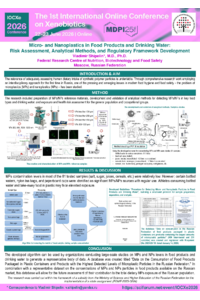
Introduction. Assessing dietary intake of synthetic polymer particles is a critical issue. For the first time in Russia, an interdisciplinary study addressed the emerging problem of microplastics (MPs) and nanoplastics (NPs) in food hygiene and safety.
Methods. The research included global literature analysis, preparation of MPs/NPs reference materials, development and validation of analytical methods for detecting MPs/NPs in key food types and drinking water, and exposure and health risk assessment for the general population and occupational groups.
Results. MPs contamination levels in most of the 81 tested samples (salt, sugar, juices, cereals, etc.) were relatively low. However, certain bottled waters, nylon tea bags, and paperboard cups were identified as significant MP/NP sources with regular use. Athletes consuming bottled water and take-away food in plastic may face elevated exposure. Findings informed the development of methodological guidelines, “Procedure for Detecting Micro- and Nanoplastic Particles in Food Products and Drinking Water”, outlining a structured protocol for sample preparation, separation, and analysis.
Conclusion. The protocol enables organizations to conduct large-scale MPs/NPs studies and generate representative data. A database on consumption of plastic-packaged foods and products with high MPs levels was created. Combined with representative MPs/NPs concentration data in Russian food products, this will support future assessments of dietary MPs exposure for the Russian population.
The research was carried out within the framework of a subsidy from the Ministry of Science and Higher Education of the Russian Federation for the implementation of a state assignment No. 075-00329-26-00.
Keywords
synthetic polymers
microplastics
nanoplastics
food products
drinking water
analysis methods
safety
risk assessment
exposure
epidemiology
Poster
Shipelin_MPS.pdf
Linking Human Activities to Microplastic Pollution: Evidence from Marina da Afurada
Microplastics as Modulators of Xenobiotic Bioavailability and Phytotoxicity in Soil