Event submissions
Published
This submission belongs to the session S4. (Micro)plastic Pollution in Environment and Human of the event The 1st International Online Conference on Xenobiotics
Published date
17 Jun, 2026
Academic Editor
'%3e%3cpath%20d='M12.6657%2010.9104C12.4185%2010.325%2012.0599%209.79327%2011.6097%209.34482C11.1609%208.89508%2010.6293%208.5365%2010.0442%208.28888C10.0389%208.28626%2010.0337%208.28495%2010.0285%208.28233C10.8446%207.69279%2011.3752%206.73249%2011.3752%205.64904C11.3752%203.8542%209.92103%202.39999%208.1262%202.39999C6.33136%202.39999%204.87715%203.8542%204.87715%205.64904C4.87715%206.73249%205.40774%207.69279%206.22393%208.28364C6.21869%208.28626%206.21345%208.28757%206.20821%208.29019C5.62129%208.5378%205.09463%208.89284%204.64265%209.34613C4.1929%209.79493%203.83432%2010.3266%203.58671%2010.9117C3.34345%2011.4845%203.21226%2012.0987%203.20023%2012.7209C3.19988%2012.7349%203.20233%2012.7488%203.20744%2012.7619C3.21255%2012.7749%203.22022%2012.7867%203.22998%2012.7968C3.23975%2012.8068%203.25142%2012.8147%203.26431%2012.8202C3.2772%2012.8256%203.29105%2012.8284%203.30504%2012.8284H4.09109C4.14874%2012.8284%204.19459%2012.7825%204.1959%2012.7262C4.2221%2011.7148%204.62823%2010.7676%205.34617%2010.0497C6.08899%209.30683%207.0755%208.89808%208.1262%208.89808C9.17689%208.89808%2010.1634%209.30683%2010.9062%2010.0497C11.6242%2010.7676%2012.0303%2011.7148%2012.0565%2012.7262C12.0578%2012.7838%2012.1037%2012.8284%2012.1613%2012.8284H12.9474C12.9613%2012.8284%2012.9752%2012.8256%2012.9881%2012.8202C13.001%2012.8147%2013.0126%2012.8068%2013.0224%2012.7968C13.0322%2012.7867%2013.0398%2012.7749%2013.0449%2012.7619C13.0501%2012.7488%2013.0525%2012.7349%2013.0522%2012.7209C13.0391%2012.0947%2012.9094%2011.4855%2012.6657%2010.9104ZM8.1262%207.9024C7.52486%207.9024%206.9589%207.6679%206.53312%207.24211C6.10733%206.81633%205.87283%206.25037%205.87283%205.64904C5.87283%205.0477%206.10733%204.48174%206.53312%204.05596C6.9589%203.63018%207.52486%203.39567%208.1262%203.39567C8.72753%203.39567%209.29349%203.63018%209.71927%204.05596C10.1451%204.48174%2010.3796%205.0477%2010.3796%205.64904C10.3796%206.25037%2010.1451%206.81633%209.71927%207.24211C9.29349%207.6679%208.72753%207.9024%208.1262%207.9024Z'%20fill='%235D1EE1'/%3e%3c/g%3e%3c/svg%3e) Tiziana Cappello
Tiziana CappelloCitation
Ivana Mikavica, Dragana Ranđelović, Miloš Ilić, Ksenija Jakovljević, Tomica Mišljenović, Katarina Pantović Spajić, Jelena Mutić, Redistribution of Ni in soil containing polystyrene microplastics: evidence from sequential extraction, in Proceedings of The 1st International Online Conference on Xenobiotics, 22 June–23 June 2026, MDPI: Basel, Switzerland
Share
Email
Facebook
Twitter
LinkedIn
Redistribution of Ni in soil containing polystyrene microplastics: evidence from sequential extraction

Ivana Mikavica 1

Dragana Ranđelović 2
'%3e%3cpath%20d='M12.6647%2010.9104C12.4176%2010.325%2012.0589%209.7933%2011.6088%209.34485C11.16%208.89511%2010.6283%208.53653%2010.0432%208.28891C10.038%208.28629%2010.0327%208.28498%2010.0275%208.28236C10.8437%207.69282%2011.3743%206.73252%2011.3743%205.64907C11.3743%203.85423%209.92005%202.40002%208.12522%202.40002C6.33038%202.40002%204.87618%203.85423%204.87618%205.64907C4.87618%206.73252%205.40677%207.69282%206.22296%208.28367C6.21772%208.28629%206.21248%208.2876%206.20724%208.29022C5.62031%208.53783%205.09365%208.89287%204.64167%209.34616C4.19192%209.79496%203.83334%2010.3266%203.58573%2010.9117C3.34247%2011.4846%203.21128%2012.0987%203.19925%2012.721C3.1989%2012.735%203.20135%2012.7489%203.20646%2012.7619C3.21157%2012.7749%203.21924%2012.7868%203.22901%2012.7968C3.23877%2012.8068%203.25045%2012.8148%203.26334%2012.8202C3.27623%2012.8256%203.29007%2012.8284%203.30406%2012.8284H4.09012C4.14776%2012.8284%204.19362%2012.7825%204.19493%2012.7262C4.22113%2011.7148%204.62726%2010.7676%205.34519%2010.0497C6.08802%209.30686%207.07452%208.89811%208.12522%208.89811C9.17592%208.89811%2010.1624%209.30686%2010.9052%2010.0497C11.6232%2010.7676%2012.0293%2011.7148%2012.0555%2012.7262C12.0568%2012.7839%2012.1027%2012.8284%2012.1603%2012.8284H12.9464C12.9604%2012.8284%2012.9742%2012.8256%2012.9871%2012.8202C13%2012.8148%2013.0117%2012.8068%2013.0214%2012.7968C13.0312%2012.7868%2013.0389%2012.7749%2013.044%2012.7619C13.0491%2012.7489%2013.0515%2012.735%2013.0512%2012.721C13.0381%2012.0947%2012.9084%2011.4856%2012.6647%2010.9104ZM8.12522%207.90243C7.52388%207.90243%206.95792%207.66793%206.53214%207.24215C6.10636%206.81636%205.87185%206.2504%205.87185%205.64907C5.87185%205.04773%206.10636%204.48177%206.53214%204.05599C6.95792%203.63021%207.52388%203.3957%208.12522%203.3957C8.72655%203.3957%209.29252%203.63021%209.7183%204.05599C10.1441%204.48177%2010.3786%205.04773%2010.3786%205.64907C10.3786%206.2504%2010.1441%206.81636%209.7183%207.24215C9.29252%207.66793%208.72655%207.90243%208.12522%207.90243Z'%20fill='%235D1EE1'/%3e%3c/g%3e%3c/svg%3e)
Miloš Ilić 3
Ksenija Jakovljević 4
Tomica Mišljenović 5
Katarina Pantović Spajić 2
Jelena Mutić 3
1. Department for Analytical Chemistry,
Institute for Technology of Nuclear and other Mineral Raw materials,
Boulevard Franchet d`Esperey 86,
11010, Belgrade, Serbia
2. Department of Metallurgy and Environmental Protection,
Institute for Technology of Nuclear and other Mineral Raw materials,
Boulevard Franchet d`Esperey 86,
11010, Belgrade, Serbia
3. Department for Analytical Chemistry,
University of Belgrade-Faculty of Chemistry,
Studentski trg 12 - 16,
11158, Belgrade, Serbia
4. Department of Ecology,
Institute for Biological Research Siniša Stanković – National Institute of the Republic of Serbia, University of Belgrade,
Boulevard Despot Stefan 142,
11108, Belgrade, Serbia
5. Institute of Botany and Botanical Garden,
Faculty of Biology, University of Belgrade,
Takovska 43,
11120, Belgrade, Serbia
Abstract
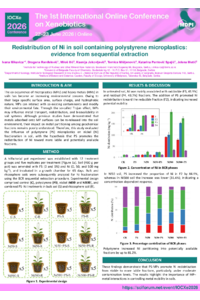
The co-occurrence of microplastics (MPs) and heavy metals in terrestrial ecosystems represents an emerging environmental concern, yet their combined influence on metal partitioning in soil remains less understood. This study investigated the effect of polystyrene (PS) MPs on nickel (Ni) redistribution and mobility using a controlled soil incubation experiment. Soil was amended with 1% (w/w) PS and spiked with Ni at 50 and 500 mg kg-1, followed by sequential extraction according to the BCR protocol to assess Ni fractionation. In untreated soil, Ni was predominantly associated with oxidizable (F3) and residual (F4) fractions, with averages of 41.9% and 43.7% of the total content. The introduction of PS significantly altered Ni partitioning, promoting its transformation toward the reducible fraction (F2), which represents weakly bound, potentially mobile forms. In moderately contaminated soil (50 mg kg-1 of Ni), addition of PS increased the proportion of Ni in F2 by up to 84.6% compared to the corresponding treatment without PS. In highly contaminated soil (500 mg kg-1 of Ni), the increase was less pronounced (31.4%), indicating a concentration-dependent response. The sum of acid-soluble and reducible fractions (F1+F2), considered phytoavailable Ni, increased significantly in PS-treated soils. Polystyrene enhanced Ni availability by up to 81.2% relative to treatments without MPs. Correspondingly, mobility factors (MFs) were consistently higher under PS exposure, demonstrating reduced Ni stability in the soil matrix. These findings demonstrate that PS-MPs modify geochemical partitioning of Ni, promoting its migration from stable to more labile fractions. The effect was most pronounced under moderate contamination levels, suggesting that MPs may act as facilitators of metal redistribution in environmentally relevant scenarios. This mechanistic evidence highlights the importance of considering MP–metal interactions when assessing metal mobility in terrestrial systems.
Keywords
microplastics
polystyrene
nickel
soil
sequential extraction
redistribution
Poster
Mikavica_abs2.pdf
Microplastics as Modulators of Xenobiotic Bioavailability and Phytotoxicity in Soil
Polystyrene microplastic beads and the mussel Mytilus galloprovincialis: an encounter that should never have happened.