Event submissions
Published
This submission belongs to the session S4. (Micro)plastic Pollution in Environment and Human of the event The 1st International Online Conference on Xenobiotics
Published date
17 Jun, 2026
Academic Editor
'%3e%3cpath%20d='M12.6657%2010.9104C12.4185%2010.325%2012.0599%209.79327%2011.6097%209.34482C11.1609%208.89508%2010.6293%208.5365%2010.0442%208.28888C10.0389%208.28626%2010.0337%208.28495%2010.0285%208.28233C10.8446%207.69279%2011.3752%206.73249%2011.3752%205.64904C11.3752%203.8542%209.92103%202.39999%208.1262%202.39999C6.33136%202.39999%204.87715%203.8542%204.87715%205.64904C4.87715%206.73249%205.40774%207.69279%206.22393%208.28364C6.21869%208.28626%206.21345%208.28757%206.20821%208.29019C5.62129%208.5378%205.09463%208.89284%204.64265%209.34613C4.1929%209.79493%203.83432%2010.3266%203.58671%2010.9117C3.34345%2011.4845%203.21226%2012.0987%203.20023%2012.7209C3.19988%2012.7349%203.20233%2012.7488%203.20744%2012.7619C3.21255%2012.7749%203.22022%2012.7867%203.22998%2012.7968C3.23975%2012.8068%203.25142%2012.8147%203.26431%2012.8202C3.2772%2012.8256%203.29105%2012.8284%203.30504%2012.8284H4.09109C4.14874%2012.8284%204.19459%2012.7825%204.1959%2012.7262C4.2221%2011.7148%204.62823%2010.7676%205.34617%2010.0497C6.08899%209.30683%207.0755%208.89808%208.1262%208.89808C9.17689%208.89808%2010.1634%209.30683%2010.9062%2010.0497C11.6242%2010.7676%2012.0303%2011.7148%2012.0565%2012.7262C12.0578%2012.7838%2012.1037%2012.8284%2012.1613%2012.8284H12.9474C12.9613%2012.8284%2012.9752%2012.8256%2012.9881%2012.8202C13.001%2012.8147%2013.0126%2012.8068%2013.0224%2012.7968C13.0322%2012.7867%2013.0398%2012.7749%2013.0449%2012.7619C13.0501%2012.7488%2013.0525%2012.7349%2013.0522%2012.7209C13.0391%2012.0947%2012.9094%2011.4855%2012.6657%2010.9104ZM8.1262%207.9024C7.52486%207.9024%206.9589%207.6679%206.53312%207.24211C6.10733%206.81633%205.87283%206.25037%205.87283%205.64904C5.87283%205.0477%206.10733%204.48174%206.53312%204.05596C6.9589%203.63018%207.52486%203.39567%208.1262%203.39567C8.72753%203.39567%209.29349%203.63018%209.71927%204.05596C10.1451%204.48174%2010.3796%205.0477%2010.3796%205.64904C10.3796%206.25037%2010.1451%206.81633%209.71927%207.24211C9.29349%207.6679%208.72753%207.9024%208.1262%207.9024Z'%20fill='%235D1EE1'/%3e%3c/g%3e%3c/svg%3e) Yang-Guang Gu
Yang-Guang GuCitation
Chiara Francesca Trisoglio, Emanuele Crepet, Elia Nalini, Alice Elisea Lazzarin, Francesco Bonasoro, Stefano Magni, Alessandra Costanzo, Carlo Polidori, Limited Uptake and Effects of End-of-life Tire particles in the gut of the Pavement Ant, Tetramorium immigrans: A First Assessment, in Proceedings of The 1st International Online Conference on Xenobiotics, 22 June–23 June 2026, MDPI: Basel, Switzerland
Share
Email
Facebook
Twitter
LinkedIn
Limited Uptake and Effects of End-of-life Tire particles in the gut of the Pavement Ant, Tetramorium immigrans: A First Assessment
'%3e%3cpath%20d='M12.6647%2010.9104C12.4176%2010.325%2012.0589%209.7933%2011.6088%209.34485C11.16%208.89511%2010.6283%208.53653%2010.0432%208.28891C10.038%208.28629%2010.0327%208.28498%2010.0275%208.28236C10.8437%207.69282%2011.3743%206.73252%2011.3743%205.64907C11.3743%203.85423%209.92005%202.40002%208.12522%202.40002C6.33038%202.40002%204.87618%203.85423%204.87618%205.64907C4.87618%206.73252%205.40677%207.69282%206.22296%208.28367C6.21772%208.28629%206.21248%208.2876%206.20724%208.29022C5.62031%208.53783%205.09365%208.89287%204.64167%209.34616C4.19192%209.79496%203.83334%2010.3266%203.58573%2010.9117C3.34247%2011.4846%203.21128%2012.0987%203.19925%2012.721C3.1989%2012.735%203.20135%2012.7489%203.20646%2012.7619C3.21157%2012.7749%203.21924%2012.7868%203.22901%2012.7968C3.23877%2012.8068%203.25045%2012.8148%203.26334%2012.8202C3.27623%2012.8256%203.29007%2012.8284%203.30406%2012.8284H4.09012C4.14776%2012.8284%204.19362%2012.7825%204.19493%2012.7262C4.22113%2011.7148%204.62726%2010.7676%205.34519%2010.0497C6.08802%209.30686%207.07452%208.89811%208.12522%208.89811C9.17592%208.89811%2010.1624%209.30686%2010.9052%2010.0497C11.6232%2010.7676%2012.0293%2011.7148%2012.0555%2012.7262C12.0568%2012.7839%2012.1027%2012.8284%2012.1603%2012.8284H12.9464C12.9604%2012.8284%2012.9742%2012.8256%2012.9871%2012.8202C13%2012.8148%2013.0117%2012.8068%2013.0214%2012.7968C13.0312%2012.7868%2013.0389%2012.7749%2013.044%2012.7619C13.0491%2012.7489%2013.0515%2012.735%2013.0512%2012.721C13.0381%2012.0947%2012.9084%2011.4856%2012.6647%2010.9104ZM8.12522%207.90243C7.52388%207.90243%206.95792%207.66793%206.53214%207.24215C6.10636%206.81636%205.87185%206.2504%205.87185%205.64907C5.87185%205.04773%206.10636%204.48177%206.53214%204.05599C6.95792%203.63021%207.52388%203.3957%208.12522%203.3957C8.72655%203.3957%209.29252%203.63021%209.7183%204.05599C10.1441%204.48177%2010.3786%205.04773%2010.3786%205.64907C10.3786%206.2504%2010.1441%206.81636%209.7183%207.24215C9.29252%207.66793%208.72655%207.90243%208.12522%207.90243Z'%20fill='%235D1EE1'/%3e%3c/g%3e%3c/svg%3e)
Chiara Francesca Trisoglio 1
Emanuele Crepet 1
Elia Nalini 2
Alice Elisea Lazzarin 1
Francesco Bonasoro 1

Stefano Magni 3
Alessandra Costanzo 1
Carlo Polidori 1
1. Department of Environmental Sciences, University of Milan, Via Celoria 26, 20133 Milan, Italy
2. Institute for Alpine Environment, Eurac Research, Viale Druso 1, 39100 Bozen, Italy
3. Department of Biosciences, University of Milan, Via Celoria 26, 20133 Milan, Italy
Abstract
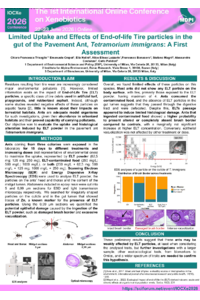
Tires and their wear-derived residues are increasingly recognized as significant environmental pollutants. While numerous studies have documented their adverse effects on aquatic organisms, their impacts on terrestrial ecosystems remain poorly understood. Ants represent a suitable model taxon for such investigations due to their abundance in urban environments and their demonstrated ability to transport other pollutants, including microplastics. In this study, we conducted a first assessment of the effects of End-of-Life Tire (ELT) particles on ants, examining both external and internal exposure pathways, using the pavement ant Tetramorium immigrans as a model species. Laboratory experiments were performed by exposing worker ants to different treatments (ELT powder, ELT-contaminated food, or a combination of both) and to varying doses of ELT particles. Overall, the observed effects were limited. Only 1–2 ELT particles were detected on the cuticle of ten ants, predominantly in individuals subjected to the ELT powder treatment. Ants consumed contaminated food, and the absence of ELT particles in the gut lumen suggests that particles transited through the digestive tract and were subsequently excreted. However, during gut passage, ELT particles appeared to induce mild histological alterations. Specifically, ants that ingested contaminated food exhibited a higher proportion of damage to the epitheliums' brush border (partially altered or entirely absent) compared to control individuals, along with a marginally significant increase in such damage at higher ELT doses. In contrast, epithelial vacuolization was not influenced by either treatment type or particle dose. These preliminary findings suggest that ants may be only weakly affected by ELT particle exposure. However, the limited sample size highlights the need for further investigations to robustly confirm this pattern.
Keywords
ants
end-of-life-tires
histology
cuticle
midgut
Poster
poster_Trisoglio.pdf
Polylactic acid bioplastics (PLA BPs): A threat to the reproductive health of the Mediterranean mussel Mytilus galloprovincialis
Thermodynamic Insights into (Micro)plastic Pollution in the Environment: Interfacial Processes, Chemical Synergism, and Ecological Implications