Event submissions
Published
This submission belongs to the session S4. (Micro)plastic Pollution in Environment and Human of the event The 1st International Online Conference on Xenobiotics
Published date
17 Jun, 2026
Academic Editor
'%3e%3cpath%20d='M12.6657%2010.9104C12.4185%2010.325%2012.0599%209.79327%2011.6097%209.34482C11.1609%208.89508%2010.6293%208.5365%2010.0442%208.28888C10.0389%208.28626%2010.0337%208.28495%2010.0285%208.28233C10.8446%207.69279%2011.3752%206.73249%2011.3752%205.64904C11.3752%203.8542%209.92103%202.39999%208.1262%202.39999C6.33136%202.39999%204.87715%203.8542%204.87715%205.64904C4.87715%206.73249%205.40774%207.69279%206.22393%208.28364C6.21869%208.28626%206.21345%208.28757%206.20821%208.29019C5.62129%208.5378%205.09463%208.89284%204.64265%209.34613C4.1929%209.79493%203.83432%2010.3266%203.58671%2010.9117C3.34345%2011.4845%203.21226%2012.0987%203.20023%2012.7209C3.19988%2012.7349%203.20233%2012.7488%203.20744%2012.7619C3.21255%2012.7749%203.22022%2012.7867%203.22998%2012.7968C3.23975%2012.8068%203.25142%2012.8147%203.26431%2012.8202C3.2772%2012.8256%203.29105%2012.8284%203.30504%2012.8284H4.09109C4.14874%2012.8284%204.19459%2012.7825%204.1959%2012.7262C4.2221%2011.7148%204.62823%2010.7676%205.34617%2010.0497C6.08899%209.30683%207.0755%208.89808%208.1262%208.89808C9.17689%208.89808%2010.1634%209.30683%2010.9062%2010.0497C11.6242%2010.7676%2012.0303%2011.7148%2012.0565%2012.7262C12.0578%2012.7838%2012.1037%2012.8284%2012.1613%2012.8284H12.9474C12.9613%2012.8284%2012.9752%2012.8256%2012.9881%2012.8202C13.001%2012.8147%2013.0126%2012.8068%2013.0224%2012.7968C13.0322%2012.7867%2013.0398%2012.7749%2013.0449%2012.7619C13.0501%2012.7488%2013.0525%2012.7349%2013.0522%2012.7209C13.0391%2012.0947%2012.9094%2011.4855%2012.6657%2010.9104ZM8.1262%207.9024C7.52486%207.9024%206.9589%207.6679%206.53312%207.24211C6.10733%206.81633%205.87283%206.25037%205.87283%205.64904C5.87283%205.0477%206.10733%204.48174%206.53312%204.05596C6.9589%203.63018%207.52486%203.39567%208.1262%203.39567C8.72753%203.39567%209.29349%203.63018%209.71927%204.05596C10.1451%204.48174%2010.3796%205.0477%2010.3796%205.64904C10.3796%206.25037%2010.1451%206.81633%209.71927%207.24211C9.29349%207.6679%208.72753%207.9024%208.1262%207.9024Z'%20fill='%235D1EE1'/%3e%3c/g%3e%3c/svg%3e) Tiziana Cappello
Tiziana CappelloCitation
Ivana Mikavica, Dragana Ranđelović, Miloš Ilić, Ksenija Jakovljević, Dušan Milojkov, Katarina Pantović Spajić, Jelena Mutić, FTIR-based insight into nickel binding mechanisms in soil containing polystyrene microplastics, in Proceedings of The 1st International Online Conference on Xenobiotics, 22 June–23 June 2026, MDPI: Basel, Switzerland
Share
Email
Facebook
Twitter
LinkedIn
FTIR-based insight into nickel binding mechanisms in soil containing polystyrene microplastics

Ivana Mikavica 1

Dragana Ranđelović 2
'%3e%3cpath%20d='M12.6647%2010.9104C12.4176%2010.325%2012.0589%209.7933%2011.6088%209.34485C11.16%208.89511%2010.6283%208.53653%2010.0432%208.28891C10.038%208.28629%2010.0327%208.28498%2010.0275%208.28236C10.8437%207.69282%2011.3743%206.73252%2011.3743%205.64907C11.3743%203.85423%209.92005%202.40002%208.12522%202.40002C6.33038%202.40002%204.87618%203.85423%204.87618%205.64907C4.87618%206.73252%205.40677%207.69282%206.22296%208.28367C6.21772%208.28629%206.21248%208.2876%206.20724%208.29022C5.62031%208.53783%205.09365%208.89287%204.64167%209.34616C4.19192%209.79496%203.83334%2010.3266%203.58573%2010.9117C3.34247%2011.4846%203.21128%2012.0987%203.19925%2012.721C3.1989%2012.735%203.20135%2012.7489%203.20646%2012.7619C3.21157%2012.7749%203.21924%2012.7868%203.22901%2012.7968C3.23877%2012.8068%203.25045%2012.8148%203.26334%2012.8202C3.27623%2012.8256%203.29007%2012.8284%203.30406%2012.8284H4.09012C4.14776%2012.8284%204.19362%2012.7825%204.19493%2012.7262C4.22113%2011.7148%204.62726%2010.7676%205.34519%2010.0497C6.08802%209.30686%207.07452%208.89811%208.12522%208.89811C9.17592%208.89811%2010.1624%209.30686%2010.9052%2010.0497C11.6232%2010.7676%2012.0293%2011.7148%2012.0555%2012.7262C12.0568%2012.7839%2012.1027%2012.8284%2012.1603%2012.8284H12.9464C12.9604%2012.8284%2012.9742%2012.8256%2012.9871%2012.8202C13%2012.8148%2013.0117%2012.8068%2013.0214%2012.7968C13.0312%2012.7868%2013.0389%2012.7749%2013.044%2012.7619C13.0491%2012.7489%2013.0515%2012.735%2013.0512%2012.721C13.0381%2012.0947%2012.9084%2011.4856%2012.6647%2010.9104ZM8.12522%207.90243C7.52388%207.90243%206.95792%207.66793%206.53214%207.24215C6.10636%206.81636%205.87185%206.2504%205.87185%205.64907C5.87185%205.04773%206.10636%204.48177%206.53214%204.05599C6.95792%203.63021%207.52388%203.3957%208.12522%203.3957C8.72655%203.3957%209.29252%203.63021%209.7183%204.05599C10.1441%204.48177%2010.3786%205.04773%2010.3786%205.64907C10.3786%206.2504%2010.1441%206.81636%209.7183%207.24215C9.29252%207.66793%208.72655%207.90243%208.12522%207.90243Z'%20fill='%235D1EE1'/%3e%3c/g%3e%3c/svg%3e)
Miloš Ilić 3
Ksenija Jakovljević 4
Dušan Milojkov 2
Katarina Pantović Spajić 2
Jelena Mutić 3
1. Department for Analytical Chemistry,
Institute for Technology of Nuclear and other Mineral Raw materials,
Boulevard Franchet d`Esperey 86,
11010, Belgrade, Serbia
2. Department of Metallurgy and Environmental Protection, Institute for Technology of Nuclear and other Mineral Raw materials, Boulevard Franchet d`Esperey 86, 11010, Belgrade, Serbia
3. Department for Analytical Chemistry, University of Belgrade-Faculty of Chemistry, Studentski trg 12 - 16, 11158, Belgrade, Serbia
4. Department of Ecology,
Institute for Biological Research Siniša Stanković – National Institute of the Republic of Serbia, University of Belgrade,
Boulevard Despot Stefan 142,
11108, Belgrade, Serbia
Abstract
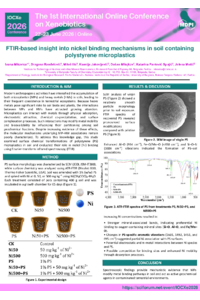
The interaction between microplastics (MPs) and heavy metals in soil is governed by complex surface processes that are still insufficiently characterized at the molecular level. This study investigated surface chemical transformations of polystyrene (PS) MPs in soil and their role in nickel (Ni) binding using Fourier-transform infrared spectroscopy (FTIR). Soil was spiked with 1% (w/w) PS and Ni at 50 and 500 mg kg-1 under controlled conditions. Infrared spectra of PS recovered from soil revealed pronounced surface modifications compared to pristine PS. The appearance and intensification of bands associated with Al–O (914 cm-1) and Fe–O/Mn–O vibrations (<650 cm-1), together with broadening of the 1026 cm-1 band overlapping with Si–O–Si stretching vibrations, indicated the formation of PS–soil associations. These findings suggested that PS particles interact with mineral components, forming composite aggregates enriched in reactive oxygen-containing functional groups. With increasing Ni concentrations, additional spectral changes were observed. Enhanced intensity of mineral-associated bands indicated that Ni mainly interacts with oxygen-containing mineral sites (Si–O, Al–O, and Fe/Mn–O). Moreover, lower but consistent modifications in PS-specific aromatic vibrations (1601, 1492, 1451, and 695 cm-1) demonstrated that Ni interacts not only with soil mineral phases but also partially with PS surfaces. Negatively charged PS surfaces may promote electrostatic attraction of positively charged Ni species, while π–metal interactions between Ni ions and aromatic rings further contribute to localized Ni accumulation. Therefore, partial Ni association with PS may induce competition for binding sites and facilitate subsequent desorption processes. Such interactions may contribute to enhanced Ni mobility in soil systems containing PS-MPs. Spectroscopic findings obtained in this study provide mechanistic evidence that MPs modify metal binding pathways in soil and should be considered active geochemical agents rather than inert particles in contaminated terrestrial environments.
Keywords
microplastics
ATR-FTIR
polystyrene
nickel
interactions
Poster
Mikavica_abs1.pdf
Tire Road Wear Particles (TRWPs) from different asphalts: an ecotoxicological comparison on zebrafish larvae
Microplastic Bioaccumulation and its Trophic Implications in Corbicula fluminea