Event submissions
Published
This submission belongs to the session S4. (Micro)plastic Pollution in Environment and Human of the event The 1st International Online Conference on Xenobiotics
Published date
17 Jun, 2026
Academic Editor
'%3e%3cpath%20d='M12.6657%2010.9104C12.4185%2010.325%2012.0599%209.79327%2011.6097%209.34482C11.1609%208.89508%2010.6293%208.5365%2010.0442%208.28888C10.0389%208.28626%2010.0337%208.28495%2010.0285%208.28233C10.8446%207.69279%2011.3752%206.73249%2011.3752%205.64904C11.3752%203.8542%209.92103%202.39999%208.1262%202.39999C6.33136%202.39999%204.87715%203.8542%204.87715%205.64904C4.87715%206.73249%205.40774%207.69279%206.22393%208.28364C6.21869%208.28626%206.21345%208.28757%206.20821%208.29019C5.62129%208.5378%205.09463%208.89284%204.64265%209.34613C4.1929%209.79493%203.83432%2010.3266%203.58671%2010.9117C3.34345%2011.4845%203.21226%2012.0987%203.20023%2012.7209C3.19988%2012.7349%203.20233%2012.7488%203.20744%2012.7619C3.21255%2012.7749%203.22022%2012.7867%203.22998%2012.7968C3.23975%2012.8068%203.25142%2012.8147%203.26431%2012.8202C3.2772%2012.8256%203.29105%2012.8284%203.30504%2012.8284H4.09109C4.14874%2012.8284%204.19459%2012.7825%204.1959%2012.7262C4.2221%2011.7148%204.62823%2010.7676%205.34617%2010.0497C6.08899%209.30683%207.0755%208.89808%208.1262%208.89808C9.17689%208.89808%2010.1634%209.30683%2010.9062%2010.0497C11.6242%2010.7676%2012.0303%2011.7148%2012.0565%2012.7262C12.0578%2012.7838%2012.1037%2012.8284%2012.1613%2012.8284H12.9474C12.9613%2012.8284%2012.9752%2012.8256%2012.9881%2012.8202C13.001%2012.8147%2013.0126%2012.8068%2013.0224%2012.7968C13.0322%2012.7867%2013.0398%2012.7749%2013.0449%2012.7619C13.0501%2012.7488%2013.0525%2012.7349%2013.0522%2012.7209C13.0391%2012.0947%2012.9094%2011.4855%2012.6657%2010.9104ZM8.1262%207.9024C7.52486%207.9024%206.9589%207.6679%206.53312%207.24211C6.10733%206.81633%205.87283%206.25037%205.87283%205.64904C5.87283%205.0477%206.10733%204.48174%206.53312%204.05596C6.9589%203.63018%207.52486%203.39567%208.1262%203.39567C8.72753%203.39567%209.29349%203.63018%209.71927%204.05596C10.1451%204.48174%2010.3796%205.0477%2010.3796%205.64904C10.3796%206.25037%2010.1451%206.81633%209.71927%207.24211C9.29349%207.6679%208.72753%207.9024%208.1262%207.9024Z'%20fill='%235D1EE1'/%3e%3c/g%3e%3c/svg%3e) A. P. Pinto
A. P. PintoCitation
Lobna Lajmi, Vanessa Charrier, Thierry Leste Lasserre, Nora Abrous, Imed Messaoudi, Impact of Prenatal Polystyrene Microplastic Exposure on Neurodevelopment and Hippocampal Neurogenesis, in Proceedings of The 1st International Online Conference on Xenobiotics, 22 June–23 June 2026, MDPI: Basel, Switzerland
Share
Email
Facebook
Twitter
LinkedIn
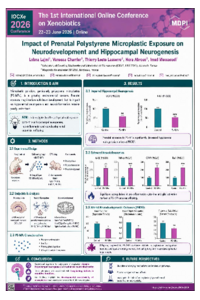
Impact of Prenatal Polystyrene Microplastic Exposure on Neurodevelopment and Hippocampal Neurogenesis
'%3e%3cpath%20d='M12.6647%2010.9104C12.4176%2010.325%2012.0589%209.7933%2011.6088%209.34485C11.16%208.89511%2010.6283%208.53653%2010.0432%208.28891C10.038%208.28629%2010.0327%208.28498%2010.0275%208.28236C10.8437%207.69282%2011.3743%206.73252%2011.3743%205.64907C11.3743%203.85423%209.92005%202.40002%208.12522%202.40002C6.33038%202.40002%204.87618%203.85423%204.87618%205.64907C4.87618%206.73252%205.40677%207.69282%206.22296%208.28367C6.21772%208.28629%206.21248%208.2876%206.20724%208.29022C5.62031%208.53783%205.09365%208.89287%204.64167%209.34616C4.19192%209.79496%203.83334%2010.3266%203.58573%2010.9117C3.34247%2011.4846%203.21128%2012.0987%203.19925%2012.721C3.1989%2012.735%203.20135%2012.7489%203.20646%2012.7619C3.21157%2012.7749%203.21924%2012.7868%203.22901%2012.7968C3.23877%2012.8068%203.25045%2012.8148%203.26334%2012.8202C3.27623%2012.8256%203.29007%2012.8284%203.30406%2012.8284H4.09012C4.14776%2012.8284%204.19362%2012.7825%204.19493%2012.7262C4.22113%2011.7148%204.62726%2010.7676%205.34519%2010.0497C6.08802%209.30686%207.07452%208.89811%208.12522%208.89811C9.17592%208.89811%2010.1624%209.30686%2010.9052%2010.0497C11.6232%2010.7676%2012.0293%2011.7148%2012.0555%2012.7262C12.0568%2012.7839%2012.1027%2012.8284%2012.1603%2012.8284H12.9464C12.9604%2012.8284%2012.9742%2012.8256%2012.9871%2012.8202C13%2012.8148%2013.0117%2012.8068%2013.0214%2012.7968C13.0312%2012.7868%2013.0389%2012.7749%2013.044%2012.7619C13.0491%2012.7489%2013.0515%2012.735%2013.0512%2012.721C13.0381%2012.0947%2012.9084%2011.4856%2012.6647%2010.9104ZM8.12522%207.90243C7.52388%207.90243%206.95792%207.66793%206.53214%207.24215C6.10636%206.81636%205.87185%206.2504%205.87185%205.64907C5.87185%205.04773%206.10636%204.48177%206.53214%204.05599C6.95792%203.63021%207.52388%203.3957%208.12522%203.3957C8.72655%203.3957%209.29252%203.63021%209.7183%204.05599C10.1441%204.48177%2010.3786%205.04773%2010.3786%205.64907C10.3786%206.2504%2010.1441%206.81636%209.7183%207.24215C9.29252%207.66793%208.72655%207.90243%208.12522%207.90243Z'%20fill='%235D1EE1'/%3e%3c/g%3e%3c/svg%3e)
Lobna Lajmi 1
Vanessa Charrier 2
Thierry Leste Lasserre 2
Nora Abrous 2
Imed Messaoudi 1
1. Laboratory of Genetics, Biodiversity and Valorization of Bioresources, Higher Institute of Biotechnology of Monastir, University of Monastir, Monastir 5000, Tunisia
2. Neurocentre Magendie U1215, Bordeaux France
Abstract
The rapid increase in environmental microplastic contamination has raised growing concerns regarding their potential effects on human health, particularly during sensitive developmental periods. Polystyrene microplastics (PS-MPs), among the most prevalent forms, have been detected in food, drinking water, and biological tissues. However, their impact on brain development and long-term neurobiological outcomes remains poorly understood.
This study investigates the consequences of gestational exposure to PS-MPs on hippocampal neurogenesis and neuroinflammatory processes in rat offspring. Pregnant rats received daily, throughout gestation and lactation, 0.5 mL of a pristine polystyrene microplastic suspension containing 0.1 mg of 5 µm PS-MPs by gastric gavage. Offspring were evaluated at distinct developmental stages (G20, PND10, PND21, and PND90). Molecular and protein analyses were performed to assess the expression of key neurogenic markers, pro-inflammatory cytokines, and neurotrophic factors within the hippocampus.
Our findings demonstrate significant developmental stage-dependent alterations in gene and protein expression profiles. Prenatal PS-MP exposure induced a sustained increase in pro-inflammatory markers, particularly IL-6, alongside a marked reduction in DCX expression at adulthood (PND90), suggesting persistent impairment of the hippocampal neurogenic niche. Furthermore, sex-dependent differences were observed, indicating differential vulnerability between males and females.
Collectively, these results provide evidence that gestational exposure to polystyrene microplastics disrupts neurodevelopmental trajectories and promotes long-term neuroinflammatory alterations. This study highlights the potential developmental neurotoxicity of environmental microplastics and underscores the need for further investigation into their impact on brain health.
Keywords
microplastics
brain
development
Poster
Lobna Lajmi Poster (Micro)plastic Pollution in Environment and Human.pdf
Gut plastizyme: Systematic Review to identify gut microbiota enzymesproposed as plastic degradation resources
From Mechanisms to Decisions: Adverse Outcome Pathways Reshaping the Future of Risk Assessment