Event submissions
Published
This submission belongs to the session S1. Energy transition, decarbonization and environmental policy of the event The 1st International Online Conference on Inventions
Published date
22 Jun, 2026
Academic Editor
'%3e%3cpath%20d='M12.6657%2010.9104C12.4185%2010.325%2012.0599%209.79327%2011.6097%209.34482C11.1609%208.89508%2010.6293%208.5365%2010.0442%208.28888C10.0389%208.28626%2010.0337%208.28495%2010.0285%208.28233C10.8446%207.69279%2011.3752%206.73249%2011.3752%205.64904C11.3752%203.8542%209.92103%202.39999%208.1262%202.39999C6.33136%202.39999%204.87715%203.8542%204.87715%205.64904C4.87715%206.73249%205.40774%207.69279%206.22393%208.28364C6.21869%208.28626%206.21345%208.28757%206.20821%208.29019C5.62129%208.5378%205.09463%208.89284%204.64265%209.34613C4.1929%209.79493%203.83432%2010.3266%203.58671%2010.9117C3.34345%2011.4845%203.21226%2012.0987%203.20023%2012.7209C3.19988%2012.7349%203.20233%2012.7488%203.20744%2012.7619C3.21255%2012.7749%203.22022%2012.7867%203.22998%2012.7968C3.23975%2012.8068%203.25142%2012.8147%203.26431%2012.8202C3.2772%2012.8256%203.29105%2012.8284%203.30504%2012.8284H4.09109C4.14874%2012.8284%204.19459%2012.7825%204.1959%2012.7262C4.2221%2011.7148%204.62823%2010.7676%205.34617%2010.0497C6.08899%209.30683%207.0755%208.89808%208.1262%208.89808C9.17689%208.89808%2010.1634%209.30683%2010.9062%2010.0497C11.6242%2010.7676%2012.0303%2011.7148%2012.0565%2012.7262C12.0578%2012.7838%2012.1037%2012.8284%2012.1613%2012.8284H12.9474C12.9613%2012.8284%2012.9752%2012.8256%2012.9881%2012.8202C13.001%2012.8147%2013.0126%2012.8068%2013.0224%2012.7968C13.0322%2012.7867%2013.0398%2012.7749%2013.0449%2012.7619C13.0501%2012.7488%2013.0525%2012.7349%2013.0522%2012.7209C13.0391%2012.0947%2012.9094%2011.4855%2012.6657%2010.9104ZM8.1262%207.9024C7.52486%207.9024%206.9589%207.6679%206.53312%207.24211C6.10733%206.81633%205.87283%206.25037%205.87283%205.64904C5.87283%205.0477%206.10733%204.48174%206.53312%204.05596C6.9589%203.63018%207.52486%203.39567%208.1262%203.39567C8.72753%203.39567%209.29349%203.63018%209.71927%204.05596C10.1451%204.48174%2010.3796%205.0477%2010.3796%205.64904C10.3796%206.25037%2010.1451%206.81633%209.71927%207.24211C9.29349%207.6679%208.72753%207.9024%208.1262%207.9024Z'%20fill='%235D1EE1'/%3e%3c/g%3e%3c/svg%3e) Zahid Ullah
Zahid UllahCitation
Florin Barbu, Eugen-Victor-Cristian Rusu, Liviu-Constantin Stan, Thermal Transient Control and Safety Validation During LNG Tank Cooldown Before First Marine Bunkering Operation, in Proceedings of The 1st International Online Conference on Inventions, 25 June–26 June 2026, MDPI: Basel, Switzerland
Share
Email
Facebook
Twitter
LinkedIn
Thermal Transient Control and Safety Validation During LNG Tank Cooldown Before First Marine Bunkering Operation
'%3e%3cpath%20d='M12.6647%2010.9104C12.4176%2010.325%2012.0589%209.7933%2011.6088%209.34485C11.16%208.89511%2010.6283%208.53653%2010.0432%208.28891C10.038%208.28629%2010.0327%208.28498%2010.0275%208.28236C10.8437%207.69282%2011.3743%206.73252%2011.3743%205.64907C11.3743%203.85423%209.92005%202.40002%208.12522%202.40002C6.33038%202.40002%204.87618%203.85423%204.87618%205.64907C4.87618%206.73252%205.40677%207.69282%206.22296%208.28367C6.21772%208.28629%206.21248%208.2876%206.20724%208.29022C5.62031%208.53783%205.09365%208.89287%204.64167%209.34616C4.19192%209.79496%203.83334%2010.3266%203.58573%2010.9117C3.34247%2011.4846%203.21128%2012.0987%203.19925%2012.721C3.1989%2012.735%203.20135%2012.7489%203.20646%2012.7619C3.21157%2012.7749%203.21924%2012.7868%203.22901%2012.7968C3.23877%2012.8068%203.25045%2012.8148%203.26334%2012.8202C3.27623%2012.8256%203.29007%2012.8284%203.30406%2012.8284H4.09012C4.14776%2012.8284%204.19362%2012.7825%204.19493%2012.7262C4.22113%2011.7148%204.62726%2010.7676%205.34519%2010.0497C6.08802%209.30686%207.07452%208.89811%208.12522%208.89811C9.17592%208.89811%2010.1624%209.30686%2010.9052%2010.0497C11.6232%2010.7676%2012.0293%2011.7148%2012.0555%2012.7262C12.0568%2012.7839%2012.1027%2012.8284%2012.1603%2012.8284H12.9464C12.9604%2012.8284%2012.9742%2012.8256%2012.9871%2012.8202C13%2012.8148%2013.0117%2012.8068%2013.0214%2012.7968C13.0312%2012.7868%2013.0389%2012.7749%2013.044%2012.7619C13.0491%2012.7489%2013.0515%2012.735%2013.0512%2012.721C13.0381%2012.0947%2012.9084%2011.4856%2012.6647%2010.9104ZM8.12522%207.90243C7.52388%207.90243%206.95792%207.66793%206.53214%207.24215C6.10636%206.81636%205.87185%206.2504%205.87185%205.64907C5.87185%205.04773%206.10636%204.48177%206.53214%204.05599C6.95792%203.63021%207.52388%203.3957%208.12522%203.3957C8.72655%203.3957%209.29252%203.63021%209.7183%204.05599C10.1441%204.48177%2010.3786%205.04773%2010.3786%205.64907C10.3786%206.2504%2010.1441%206.81636%209.7183%207.24215C9.29252%207.66793%208.72655%207.90243%208.12522%207.90243Z'%20fill='%235D1EE1'/%3e%3c/g%3e%3c/svg%3e)
Florin Barbu 1

Eugen-Victor-Cristian Rusu 1,2
Liviu-Constantin Stan 3
1. Faculty of Engineering, “Dunarea de Jos” University of Galati, Galati, 47 Domneasca Street, 800008, Romania
2. National Institute for Research and Development in Environmental Protection, 294 Splaiul Independenței Blv, District 6, Zip code 060031, Bucharest, Romania
3. Marine Engineering Faculty, Constanta Maritime University, 104 Mircea cel Batran Street, code 900663, Constanta, Romania
Abstract
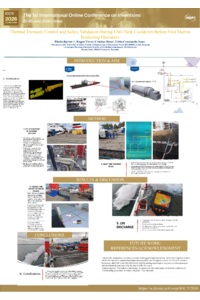
This poster provides a technical overview of the safety framework implemented during the initial thermal conditioning of an LNG storage tank installed on a dual-fuel Ro-Ro vessel prior to its first bunkering operation. The procedure, carried out at Damen Shipyard on 2 May in Romania, consisted of a controlled and progressive cooldown sequence designed to prepare the cryogenic system for LNG introduction while minimizing thermal gradients and mechanical stress. Vaporized and liquid nitrogen were employed in successive stages to gradually decrease tank and pipeline temperatures under strict operational supervision.
Continuous monitoring of temperature evolution, pressure stabilization, and vapor management was conducted to ensure structural integrity and prevent unintended releases. Special consideration was given to the routing, insulation, and secure positioning of cryogenic transfer hoses in order to eliminate the risk of contact with heat-sensitive structural elements of both the vessel and the quay infrastructure. Compliance with the International Code of Safety for Ships Using Gases or Other Low-Flashpoint Fuels (IGF Code) guided all operational decisions and safety precautions.
The poster outlines the principal technical phases of the cooldown procedure, the environmental protection measures adopted, and the risk-mitigation strategies applied throughout the operation. The documented experience contributes to current knowledge on LNG vessel commissioning practices and offers practical guidance for shipyards conducting pre-bunkering preparations in locations without permanent LNG terminal installations.
Keywords
LNG tank cooldown
Dual-fuel vessels
Cryogenic safety procedures
Pre-bunkering operations
IGF Code compliance
Poster
Poster_Florin_Barbu_Thermal Transient Control and Safety Validation During LNG Tank Cooldown Before First Marine Bunkering Operation.pdf
Operational Risk Governance in LNG Bunkering: A Cross-Country Comparative Analysis of Commissioning Practices
Next-Generation eco-friendly plasticizers for energy-efficient and durable polymer coatings in offshore wind and solar energy