Event submissions
Published
This submission belongs to the session S1. Energy transition, decarbonization and environmental policy of the event The 1st International Online Conference on Inventions
Published date
22 Jun, 2026
Academic Editor
'%3e%3cpath%20d='M12.6657%2010.9104C12.4185%2010.325%2012.0599%209.79327%2011.6097%209.34482C11.1609%208.89508%2010.6293%208.5365%2010.0442%208.28888C10.0389%208.28626%2010.0337%208.28495%2010.0285%208.28233C10.8446%207.69279%2011.3752%206.73249%2011.3752%205.64904C11.3752%203.8542%209.92103%202.39999%208.1262%202.39999C6.33136%202.39999%204.87715%203.8542%204.87715%205.64904C4.87715%206.73249%205.40774%207.69279%206.22393%208.28364C6.21869%208.28626%206.21345%208.28757%206.20821%208.29019C5.62129%208.5378%205.09463%208.89284%204.64265%209.34613C4.1929%209.79493%203.83432%2010.3266%203.58671%2010.9117C3.34345%2011.4845%203.21226%2012.0987%203.20023%2012.7209C3.19988%2012.7349%203.20233%2012.7488%203.20744%2012.7619C3.21255%2012.7749%203.22022%2012.7867%203.22998%2012.7968C3.23975%2012.8068%203.25142%2012.8147%203.26431%2012.8202C3.2772%2012.8256%203.29105%2012.8284%203.30504%2012.8284H4.09109C4.14874%2012.8284%204.19459%2012.7825%204.1959%2012.7262C4.2221%2011.7148%204.62823%2010.7676%205.34617%2010.0497C6.08899%209.30683%207.0755%208.89808%208.1262%208.89808C9.17689%208.89808%2010.1634%209.30683%2010.9062%2010.0497C11.6242%2010.7676%2012.0303%2011.7148%2012.0565%2012.7262C12.0578%2012.7838%2012.1037%2012.8284%2012.1613%2012.8284H12.9474C12.9613%2012.8284%2012.9752%2012.8256%2012.9881%2012.8202C13.001%2012.8147%2013.0126%2012.8068%2013.0224%2012.7968C13.0322%2012.7867%2013.0398%2012.7749%2013.0449%2012.7619C13.0501%2012.7488%2013.0525%2012.7349%2013.0522%2012.7209C13.0391%2012.0947%2012.9094%2011.4855%2012.6657%2010.9104ZM8.1262%207.9024C7.52486%207.9024%206.9589%207.6679%206.53312%207.24211C6.10733%206.81633%205.87283%206.25037%205.87283%205.64904C5.87283%205.0477%206.10733%204.48174%206.53312%204.05596C6.9589%203.63018%207.52486%203.39567%208.1262%203.39567C8.72753%203.39567%209.29349%203.63018%209.71927%204.05596C10.1451%204.48174%2010.3796%205.0477%2010.3796%205.64904C10.3796%206.25037%2010.1451%206.81633%209.71927%207.24211C9.29349%207.6679%208.72753%207.9024%208.1262%207.9024Z'%20fill='%235D1EE1'/%3e%3c/g%3e%3c/svg%3e) Zahid Ullah
Zahid UllahCitation
Christian Dewin Nery, Evaluation of Torrefied Fruit and Vegetable Residues as a Sustainable Coal Substitute: Fuel Quality Characterization and ASTM D388 Classification, in Proceedings of The 1st International Online Conference on Inventions, 25 June–26 June 2026, MDPI: Basel, Switzerland
Share
Email
Facebook
Twitter
LinkedIn
Evaluation of Torrefied Fruit and Vegetable Residues as a Sustainable Coal Substitute: Fuel Quality Characterization and ASTM D388 Classification

Christian Dewin Nery 1
1. Department of Chemical Engineering, University of the Philippines - Los Baños, 4031, Philippines
Abstract
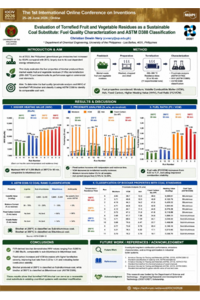
As of 2023, the Philippines’ greenhouse gas emissions had increased by 49.9% compared with 2012, largely due to its coal-dependent energy infrastructure. Identifying renewable, drop-in alternatives to coal is therefore critical for mitigating air pollution and climate change. This study evaluates the fuel properties of biochar produced from market waste fruit and vegetable residues (FVRs) and benchmarks its performance against commercial coal standards.
Biochar samples produced at torrefaction temperatures of 200–300 °C were analyzed following ASTM D1762 (Modified) to determine moisture, volatile combustible matter (VCM), ash, and fixed carbon contents. Higher Heating Value (HHV) was measured using a bomb calorimeter in accordance with ASTM D5865. Fuel properties were classified based on ASTM D388 to identify comparable coal ranks.
The maximum HHV obtained was 11,560 BTU/lb at 300 °C for 90 minutes, comparable to bituminous coal. At 200 °C, HHVs ranged from 9,060 to 10,196 BTU/lb, consistent with sub-bituminous coal. Fixed carbon content increased to 48.00% with increasing torrefaction severity, while VCM decreased to 39.70%, raising the fuel ratio (FC/VCM) from 0.22 to 1.21 and indicating improved combustion stability. Moisture content remained below 5% across all samples, and ash content ranged from 5.75% to 14.20%, within acceptable limits for industrial boiler applications.
These results demonstrate that FVR-derived biochar can serve as a renewable substitute for sub-bituminous and bituminous coal, enabling utilization in existing coal-fired systems with minimal infrastructure modification.
The authors declare no conflicts of interest. This research was funded by the Department of Science and Technology – Engineering Research and Development for Technology (DOST-ERDT) Scholarship.
Keywords
Biochar
Higher Heating Value (HHV)
Proximate Analysis
ASTM D388
Fuel Ratio
Coal Substitute
Poster
IOCIV2026_Poster_Nery_Evaluation_of_Torrefied_FVR_as_a_Coal_Substitute.pdf
An Empirical Analysis of sustainable Energy Development in the Danube Region
Navigating the Regulatory Landscape: Advancing Sustainable Aviation Fuel Production in Brazil’s Energy Transition