Event submissions
Published
This submission belongs to the session S2. Advanced sustainable energy conversion systems of the event The 1st International Online Conference on Inventions
Published date
22 Jun, 2026
Academic Editor
'%3e%3cpath%20d='M12.6657%2010.9104C12.4185%2010.325%2012.0599%209.79327%2011.6097%209.34482C11.1609%208.89508%2010.6293%208.5365%2010.0442%208.28888C10.0389%208.28626%2010.0337%208.28495%2010.0285%208.28233C10.8446%207.69279%2011.3752%206.73249%2011.3752%205.64904C11.3752%203.8542%209.92103%202.39999%208.1262%202.39999C6.33136%202.39999%204.87715%203.8542%204.87715%205.64904C4.87715%206.73249%205.40774%207.69279%206.22393%208.28364C6.21869%208.28626%206.21345%208.28757%206.20821%208.29019C5.62129%208.5378%205.09463%208.89284%204.64265%209.34613C4.1929%209.79493%203.83432%2010.3266%203.58671%2010.9117C3.34345%2011.4845%203.21226%2012.0987%203.20023%2012.7209C3.19988%2012.7349%203.20233%2012.7488%203.20744%2012.7619C3.21255%2012.7749%203.22022%2012.7867%203.22998%2012.7968C3.23975%2012.8068%203.25142%2012.8147%203.26431%2012.8202C3.2772%2012.8256%203.29105%2012.8284%203.30504%2012.8284H4.09109C4.14874%2012.8284%204.19459%2012.7825%204.1959%2012.7262C4.2221%2011.7148%204.62823%2010.7676%205.34617%2010.0497C6.08899%209.30683%207.0755%208.89808%208.1262%208.89808C9.17689%208.89808%2010.1634%209.30683%2010.9062%2010.0497C11.6242%2010.7676%2012.0303%2011.7148%2012.0565%2012.7262C12.0578%2012.7838%2012.1037%2012.8284%2012.1613%2012.8284H12.9474C12.9613%2012.8284%2012.9752%2012.8256%2012.9881%2012.8202C13.001%2012.8147%2013.0126%2012.8068%2013.0224%2012.7968C13.0322%2012.7867%2013.0398%2012.7749%2013.0449%2012.7619C13.0501%2012.7488%2013.0525%2012.7349%2013.0522%2012.7209C13.0391%2012.0947%2012.9094%2011.4855%2012.6657%2010.9104ZM8.1262%207.9024C7.52486%207.9024%206.9589%207.6679%206.53312%207.24211C6.10733%206.81633%205.87283%206.25037%205.87283%205.64904C5.87283%205.0477%206.10733%204.48174%206.53312%204.05596C6.9589%203.63018%207.52486%203.39567%208.1262%203.39567C8.72753%203.39567%209.29349%203.63018%209.71927%204.05596C10.1451%204.48174%2010.3796%205.0477%2010.3796%205.64904C10.3796%206.25037%2010.1451%206.81633%209.71927%207.24211C9.29349%207.6679%208.72753%207.9024%208.1262%207.9024Z'%20fill='%235D1EE1'/%3e%3c/g%3e%3c/svg%3e) Said Al-Hallaj
Said Al-HallajCitation
Vandana Kumari Jha, Conceptual Design of Freeze‑Cast Porous Structures for Advanced Sustainable Thermal‑Systems, in Proceedings of The 1st International Online Conference on Inventions, 25 June–26 June 2026, MDPI: Basel, Switzerland
Share
Email
Facebook
Twitter
LinkedIn
Conceptual Design of Freeze‑Cast Porous Structures for Advanced Sustainable Thermal‑Systems
'%3e%3cpath%20d='M12.6647%2010.9104C12.4176%2010.325%2012.0589%209.7933%2011.6088%209.34485C11.16%208.89511%2010.6283%208.53653%2010.0432%208.28891C10.038%208.28629%2010.0327%208.28498%2010.0275%208.28236C10.8437%207.69282%2011.3743%206.73252%2011.3743%205.64907C11.3743%203.85423%209.92005%202.40002%208.12522%202.40002C6.33038%202.40002%204.87618%203.85423%204.87618%205.64907C4.87618%206.73252%205.40677%207.69282%206.22296%208.28367C6.21772%208.28629%206.21248%208.2876%206.20724%208.29022C5.62031%208.53783%205.09365%208.89287%204.64167%209.34616C4.19192%209.79496%203.83334%2010.3266%203.58573%2010.9117C3.34247%2011.4846%203.21128%2012.0987%203.19925%2012.721C3.1989%2012.735%203.20135%2012.7489%203.20646%2012.7619C3.21157%2012.7749%203.21924%2012.7868%203.22901%2012.7968C3.23877%2012.8068%203.25045%2012.8148%203.26334%2012.8202C3.27623%2012.8256%203.29007%2012.8284%203.30406%2012.8284H4.09012C4.14776%2012.8284%204.19362%2012.7825%204.19493%2012.7262C4.22113%2011.7148%204.62726%2010.7676%205.34519%2010.0497C6.08802%209.30686%207.07452%208.89811%208.12522%208.89811C9.17592%208.89811%2010.1624%209.30686%2010.9052%2010.0497C11.6232%2010.7676%2012.0293%2011.7148%2012.0555%2012.7262C12.0568%2012.7839%2012.1027%2012.8284%2012.1603%2012.8284H12.9464C12.9604%2012.8284%2012.9742%2012.8256%2012.9871%2012.8202C13%2012.8148%2013.0117%2012.8068%2013.0214%2012.7968C13.0312%2012.7868%2013.0389%2012.7749%2013.044%2012.7619C13.0491%2012.7489%2013.0515%2012.735%2013.0512%2012.721C13.0381%2012.0947%2012.9084%2011.4856%2012.6647%2010.9104ZM8.12522%207.90243C7.52388%207.90243%206.95792%207.66793%206.53214%207.24215C6.10636%206.81636%205.87185%206.2504%205.87185%205.64907C5.87185%205.04773%206.10636%204.48177%206.53214%204.05599C6.95792%203.63021%207.52388%203.3957%208.12522%203.3957C8.72655%203.3957%209.29252%203.63021%209.7183%204.05599C10.1441%204.48177%2010.3786%205.04773%2010.3786%205.64907C10.3786%206.2504%2010.1441%206.81636%209.7183%207.24215C9.29252%207.66793%208.72655%207.90243%208.12522%207.90243Z'%20fill='%235D1EE1'/%3e%3c/g%3e%3c/svg%3e)
Vandana Kumari Jha 1
1. Department of Chemical Engineering, KTH Royal Institute of Technology, Stockholm 114 28, Sweden
Abstract
Freeze casting, a well-established processing technique for producing porous structures with directionally aligned pores, provide a unique combination of high surface‑area‑to‑volume, and anisotropic thermal transport, promising a platform for next‑generation sustainable heat‑exchanger components. Recent work on freeze‑cast regenerators demonstrated 10–15% higher heat‑transfer performance than conventional packed‑bed, under passive oscillating‑flow water conditions (ΔT = 10 K, T = 15–30 °C) at matched pressure drop, confirming the feasibility in heat‑exchange [1]. This design approach is informed by recent advances in directional freeze‑casting, which show aligned porous structures can be engineered with predictable transport pathways suitable for energy‑conversion and thermal‑management [2]. While such materials have been studied at microstructural level, their potential in macro-scale heat exchanger design remains insufficiently explored. Unlike prior studies, which focus on microstructure, this work introduces first conceptual, component‑level framework for integrating freeze‑cast structures into general heat‑exchangers. It proposes new integration strategies as: freeze‑cast lamellar plates as replacements for conventional internal fins/passive inserts. A conceptual design framework is presented that examines incorporation of freeze‑cast structures into heat‑exchangers from a macroscopic engineering‑design perspective, focusing on qualitative relationships between pore morphology and expected transport behavior such as flow guidance, and heat‑transfer pathways. The framework emphasizes design‑relevant considerations including component integration, flow alignment, and potential roles as structured inserts or passive enhancement elements. By synthesizing insights from directional freeze‑casting research and established heat‑exchanger design principles, this work outlines novel design routes for future investigations into material‑efficient sustainable thermal systems.
References
[1] J. Liang, C.D. Christiansen, K. Engelbrecht, K.K. Nielsen, R. Bjørk, C.R.H. Bahl, Heat transfer and flow resistance analysis of a novel freeze-cast regenerator, Int. J. Heat Mass Transf. 155 (2020). https://doi.org/10.1016/j.ijheatmasstransfer.2020.119772.
[2] S. Shaik, V. Kumari Jha, G. Bae, D. Kim, Flow-driven directional freeze-casting of graphene aerogels on tubular components for enhanced thermal energy management, Energy Convers. Manag. 325 (2025). https://doi.org/10.1016/j.enconman.2024.119389.
Keywords
Freeze casting
Macro-scale
Conceptual design
Heat transfer
Thermal sustainable system
Poster
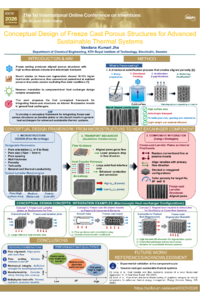
IOCIV 2026_Poster_Vandana Kumari Jha.pdf
Design and Development of a Hybrid Low-Emissivity and Thermoelectric Window Glazing Systems: A Systematic Review
Exploring the Potential of Castor Oil for Biodiesel Production: Process Optimization and Fuel Property Evaluation