Event submissions
Published
This submission belongs to the session S2. Advanced sustainable energy conversion systems of the event The 1st International Online Conference on Inventions
Published date
22 Jun, 2026
Academic Editor
'%3e%3cpath%20d='M12.6657%2010.9104C12.4185%2010.325%2012.0599%209.79327%2011.6097%209.34482C11.1609%208.89508%2010.6293%208.5365%2010.0442%208.28888C10.0389%208.28626%2010.0337%208.28495%2010.0285%208.28233C10.8446%207.69279%2011.3752%206.73249%2011.3752%205.64904C11.3752%203.8542%209.92103%202.39999%208.1262%202.39999C6.33136%202.39999%204.87715%203.8542%204.87715%205.64904C4.87715%206.73249%205.40774%207.69279%206.22393%208.28364C6.21869%208.28626%206.21345%208.28757%206.20821%208.29019C5.62129%208.5378%205.09463%208.89284%204.64265%209.34613C4.1929%209.79493%203.83432%2010.3266%203.58671%2010.9117C3.34345%2011.4845%203.21226%2012.0987%203.20023%2012.7209C3.19988%2012.7349%203.20233%2012.7488%203.20744%2012.7619C3.21255%2012.7749%203.22022%2012.7867%203.22998%2012.7968C3.23975%2012.8068%203.25142%2012.8147%203.26431%2012.8202C3.2772%2012.8256%203.29105%2012.8284%203.30504%2012.8284H4.09109C4.14874%2012.8284%204.19459%2012.7825%204.1959%2012.7262C4.2221%2011.7148%204.62823%2010.7676%205.34617%2010.0497C6.08899%209.30683%207.0755%208.89808%208.1262%208.89808C9.17689%208.89808%2010.1634%209.30683%2010.9062%2010.0497C11.6242%2010.7676%2012.0303%2011.7148%2012.0565%2012.7262C12.0578%2012.7838%2012.1037%2012.8284%2012.1613%2012.8284H12.9474C12.9613%2012.8284%2012.9752%2012.8256%2012.9881%2012.8202C13.001%2012.8147%2013.0126%2012.8068%2013.0224%2012.7968C13.0322%2012.7867%2013.0398%2012.7749%2013.0449%2012.7619C13.0501%2012.7488%2013.0525%2012.7349%2013.0522%2012.7209C13.0391%2012.0947%2012.9094%2011.4855%2012.6657%2010.9104ZM8.1262%207.9024C7.52486%207.9024%206.9589%207.6679%206.53312%207.24211C6.10733%206.81633%205.87283%206.25037%205.87283%205.64904C5.87283%205.0477%206.10733%204.48174%206.53312%204.05596C6.9589%203.63018%207.52486%203.39567%208.1262%203.39567C8.72753%203.39567%209.29349%203.63018%209.71927%204.05596C10.1451%204.48174%2010.3796%205.0477%2010.3796%205.64904C10.3796%206.25037%2010.1451%206.81633%209.71927%207.24211C9.29349%207.6679%208.72753%207.9024%208.1262%207.9024Z'%20fill='%235D1EE1'/%3e%3c/g%3e%3c/svg%3e) Said Al-Hallaj
Said Al-HallajCitation
Lasitha Madhusanka, Indunil Chamara, Lakshan Priyankara, Isuranga Abejeewa, Chanika Kariyawasam, Helitha Nilmalgoda, Chanaka Galpaya, Kaveenga Koswattage, Exploring the Potential of Castor Oil for Biodiesel Production: Process Optimization and Fuel Property Evaluation, in Proceedings of The 1st International Online Conference on Inventions, 25 June–26 June 2026, MDPI: Basel, Switzerland
Share
Email
Facebook
Twitter
LinkedIn
Exploring the Potential of Castor Oil for Biodiesel Production: Process Optimization and Fuel Property Evaluation

Lasitha Madhusanka 1
'%3e%3cpath%20d='M12.6647%2010.9104C12.4176%2010.325%2012.0589%209.7933%2011.6088%209.34485C11.16%208.89511%2010.6283%208.53653%2010.0432%208.28891C10.038%208.28629%2010.0327%208.28498%2010.0275%208.28236C10.8437%207.69282%2011.3743%206.73252%2011.3743%205.64907C11.3743%203.85423%209.92005%202.40002%208.12522%202.40002C6.33038%202.40002%204.87618%203.85423%204.87618%205.64907C4.87618%206.73252%205.40677%207.69282%206.22296%208.28367C6.21772%208.28629%206.21248%208.2876%206.20724%208.29022C5.62031%208.53783%205.09365%208.89287%204.64167%209.34616C4.19192%209.79496%203.83334%2010.3266%203.58573%2010.9117C3.34247%2011.4846%203.21128%2012.0987%203.19925%2012.721C3.1989%2012.735%203.20135%2012.7489%203.20646%2012.7619C3.21157%2012.7749%203.21924%2012.7868%203.22901%2012.7968C3.23877%2012.8068%203.25045%2012.8148%203.26334%2012.8202C3.27623%2012.8256%203.29007%2012.8284%203.30406%2012.8284H4.09012C4.14776%2012.8284%204.19362%2012.7825%204.19493%2012.7262C4.22113%2011.7148%204.62726%2010.7676%205.34519%2010.0497C6.08802%209.30686%207.07452%208.89811%208.12522%208.89811C9.17592%208.89811%2010.1624%209.30686%2010.9052%2010.0497C11.6232%2010.7676%2012.0293%2011.7148%2012.0555%2012.7262C12.0568%2012.7839%2012.1027%2012.8284%2012.1603%2012.8284H12.9464C12.9604%2012.8284%2012.9742%2012.8256%2012.9871%2012.8202C13%2012.8148%2013.0117%2012.8068%2013.0214%2012.7968C13.0312%2012.7868%2013.0389%2012.7749%2013.044%2012.7619C13.0491%2012.7489%2013.0515%2012.735%2013.0512%2012.721C13.0381%2012.0947%2012.9084%2011.4856%2012.6647%2010.9104ZM8.12522%207.90243C7.52388%207.90243%206.95792%207.66793%206.53214%207.24215C6.10636%206.81636%205.87185%206.2504%205.87185%205.64907C5.87185%205.04773%206.10636%204.48177%206.53214%204.05599C6.95792%203.63021%207.52388%203.3957%208.12522%203.3957C8.72655%203.3957%209.29252%203.63021%209.7183%204.05599C10.1441%204.48177%2010.3786%205.04773%2010.3786%205.64907C10.3786%206.2504%2010.1441%206.81636%209.7183%207.24215C9.29252%207.66793%208.72655%207.90243%208.12522%207.90243Z'%20fill='%235D1EE1'/%3e%3c/g%3e%3c/svg%3e)
Indunil Chamara 2
Lakshan Priyankara 1
Isuranga Abejeewa 1
Chanika Kariyawasam 1

Helitha Nilmalgoda 2
Chanaka Galpaya 1
Kaveenga Koswattage 3
1. Center for Nanodevice Fabrication and Characterization,Faculty of Technology,Sabaragamuwa University of Sri Lanka,Belihuloya 70140,Sri Lanka
2. Department of Biosystems Technology,Faculty of Technology,Sabaragamuwa University of Sri Lanka,Belihuloya 70140,Sri Lanka
3. Department of Engineering Technology,Faculty of Technology,Sabaragamuwa University of Sri Lanka,Belihuloya 70140,Sri Lanka
Abstract
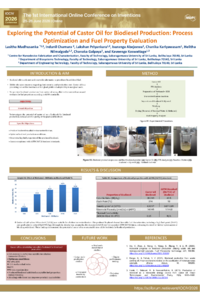
Biodiesel has gained significant attention as a renewable and environmentally friendly alternative to petroleum-based diesel fuel. However, the use of edible vegetable oils as feedstock for biodiesel production raises concerns regarding food security and economic cost. Consequently, non-edible oil sources have been increasingly explored as sustainable alternatives. Castor oil (Ricinus communis), a non-edible oil with high availability and adaptability to marginal lands, represents a promising feedstock for biodiesel production. This study investigates biodiesel production from castor oil using homogeneous alkaline transesterification and evaluates its fuel properties in accordance with the ASTM D6751 biodiesel standard. The effects of key reaction parameters, including catalyst concentration, methanol-to-oil molar ratio, reaction temperature, and reaction time, were systematically examined. The free fatty acid (FFA) content of the castor oil was determined to be 1.02%, indicating suitability for alkaline-catalyzed transesterification. A maximum biodiesel yield of 94.71 wt% was achieved under optimal conditions of 2 wt% KOH catalyst, a 12:1 methanol-to-oil molar ratio, a reaction temperature of 60 °C, and a reaction time of 90 minutes. The produced biodiesel exhibited a calorific value of 38.249 MJ/kg, a flash point of 194 °C, a density of 0.9247 g/cm³, and a kinematic viscosity of 14.045 mm²/s. Although the viscosity exceeded the limits specified by the ASTM standard, blending with conventional petroleum diesel could improve fuel properties for practical applications. These findings demonstrate the feasibility of producing biodiesel from non-edible castor oil under optimized reaction conditions, supporting the development of sustainable biofuels and reducing dependence on fossil-based energy resources.
Keywords
biodiesel
castor oil
transesterification
renewable energy
energy security
sustainable development
Poster
Lasitha Madhusanka_Poster.pdf
Conceptual Design of Freeze‑Cast Porous Structures for Advanced Sustainable Thermal‑Systems
Experimental analysis of single-slope solar still equipped with jute and nano-enhanced jute cloth for clean water production