Event submissions
Published
This submission belongs to the session S2. Advanced sustainable energy conversion systems of the event The 1st International Online Conference on Inventions
Published date
22 Jun, 2026
Academic Editor
'%3e%3cpath%20d='M12.6657%2010.9104C12.4185%2010.325%2012.0599%209.79327%2011.6097%209.34482C11.1609%208.89508%2010.6293%208.5365%2010.0442%208.28888C10.0389%208.28626%2010.0337%208.28495%2010.0285%208.28233C10.8446%207.69279%2011.3752%206.73249%2011.3752%205.64904C11.3752%203.8542%209.92103%202.39999%208.1262%202.39999C6.33136%202.39999%204.87715%203.8542%204.87715%205.64904C4.87715%206.73249%205.40774%207.69279%206.22393%208.28364C6.21869%208.28626%206.21345%208.28757%206.20821%208.29019C5.62129%208.5378%205.09463%208.89284%204.64265%209.34613C4.1929%209.79493%203.83432%2010.3266%203.58671%2010.9117C3.34345%2011.4845%203.21226%2012.0987%203.20023%2012.7209C3.19988%2012.7349%203.20233%2012.7488%203.20744%2012.7619C3.21255%2012.7749%203.22022%2012.7867%203.22998%2012.7968C3.23975%2012.8068%203.25142%2012.8147%203.26431%2012.8202C3.2772%2012.8256%203.29105%2012.8284%203.30504%2012.8284H4.09109C4.14874%2012.8284%204.19459%2012.7825%204.1959%2012.7262C4.2221%2011.7148%204.62823%2010.7676%205.34617%2010.0497C6.08899%209.30683%207.0755%208.89808%208.1262%208.89808C9.17689%208.89808%2010.1634%209.30683%2010.9062%2010.0497C11.6242%2010.7676%2012.0303%2011.7148%2012.0565%2012.7262C12.0578%2012.7838%2012.1037%2012.8284%2012.1613%2012.8284H12.9474C12.9613%2012.8284%2012.9752%2012.8256%2012.9881%2012.8202C13.001%2012.8147%2013.0126%2012.8068%2013.0224%2012.7968C13.0322%2012.7867%2013.0398%2012.7749%2013.0449%2012.7619C13.0501%2012.7488%2013.0525%2012.7349%2013.0522%2012.7209C13.0391%2012.0947%2012.9094%2011.4855%2012.6657%2010.9104ZM8.1262%207.9024C7.52486%207.9024%206.9589%207.6679%206.53312%207.24211C6.10733%206.81633%205.87283%206.25037%205.87283%205.64904C5.87283%205.0477%206.10733%204.48174%206.53312%204.05596C6.9589%203.63018%207.52486%203.39567%208.1262%203.39567C8.72753%203.39567%209.29349%203.63018%209.71927%204.05596C10.1451%204.48174%2010.3796%205.0477%2010.3796%205.64904C10.3796%206.25037%2010.1451%206.81633%209.71927%207.24211C9.29349%207.6679%208.72753%207.9024%208.1262%207.9024Z'%20fill='%235D1EE1'/%3e%3c/g%3e%3c/svg%3e) Said Al-Hallaj
Said Al-HallajCitation
vaeshnave M, Krisnan K, Brathikan VM, Development and Experimental Assessment of a Passive Microclimate-Controlled Cart for Sustainable Post-Harvest Flower Preservation, in Proceedings of The 1st International Online Conference on Inventions, 25 June–26 June 2026, MDPI: Basel, Switzerland
Share
Email
Facebook
Twitter
LinkedIn
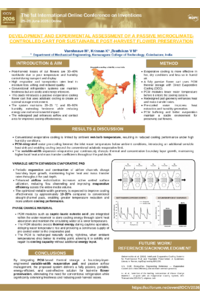
Development and Experimental Assessment of a Passive Microclimate-Controlled Cart for Sustainable Post-Harvest Flower Preservation
'%3e%3cpath%20d='M12.6647%2010.9104C12.4176%2010.325%2012.0589%209.7933%2011.6088%209.34485C11.16%208.89511%2010.6283%208.53653%2010.0432%208.28891C10.038%208.28629%2010.0327%208.28498%2010.0275%208.28236C10.8437%207.69282%2011.3743%206.73252%2011.3743%205.64907C11.3743%203.85423%209.92005%202.40002%208.12522%202.40002C6.33038%202.40002%204.87618%203.85423%204.87618%205.64907C4.87618%206.73252%205.40677%207.69282%206.22296%208.28367C6.21772%208.28629%206.21248%208.2876%206.20724%208.29022C5.62031%208.53783%205.09365%208.89287%204.64167%209.34616C4.19192%209.79496%203.83334%2010.3266%203.58573%2010.9117C3.34247%2011.4846%203.21128%2012.0987%203.19925%2012.721C3.1989%2012.735%203.20135%2012.7489%203.20646%2012.7619C3.21157%2012.7749%203.21924%2012.7868%203.22901%2012.7968C3.23877%2012.8068%203.25045%2012.8148%203.26334%2012.8202C3.27623%2012.8256%203.29007%2012.8284%203.30406%2012.8284H4.09012C4.14776%2012.8284%204.19362%2012.7825%204.19493%2012.7262C4.22113%2011.7148%204.62726%2010.7676%205.34519%2010.0497C6.08802%209.30686%207.07452%208.89811%208.12522%208.89811C9.17592%208.89811%2010.1624%209.30686%2010.9052%2010.0497C11.6232%2010.7676%2012.0293%2011.7148%2012.0555%2012.7262C12.0568%2012.7839%2012.1027%2012.8284%2012.1603%2012.8284H12.9464C12.9604%2012.8284%2012.9742%2012.8256%2012.9871%2012.8202C13%2012.8148%2013.0117%2012.8068%2013.0214%2012.7968C13.0312%2012.7868%2013.0389%2012.7749%2013.044%2012.7619C13.0491%2012.7489%2013.0515%2012.735%2013.0512%2012.721C13.0381%2012.0947%2012.9084%2011.4856%2012.6647%2010.9104ZM8.12522%207.90243C7.52388%207.90243%206.95792%207.66793%206.53214%207.24215C6.10636%206.81636%205.87185%206.2504%205.87185%205.64907C5.87185%205.04773%206.10636%204.48177%206.53214%204.05599C6.95792%203.63021%207.52388%203.3957%208.12522%203.3957C8.72655%203.3957%209.29252%203.63021%209.7183%204.05599C10.1441%204.48177%2010.3786%205.04773%2010.3786%205.64907C10.3786%206.2504%2010.1441%206.81636%209.7183%207.24215C9.29252%207.66793%208.72655%207.90243%208.12522%207.90243Z'%20fill='%235D1EE1'/%3e%3c/g%3e%3c/svg%3e)
vaeshnave M 1
Krisnan K 1
Brathikan VM 1
1. Department of Mechanical Engineering, Kumaraguru College of Technology, Coimbatore, India
Abstract
Post-harvest losses in floriculture supply chains remain a persistent global challenge, with reported deterioration rates of 30–40% primarily attributed to inadequate temperature and relative humidity control during transportation and retail display. Cut flowers are characterized by high metabolic activity, rapid transpiration, and sensitivity to vapor pressure deficit, leading to accelerated wilting and senescence under ambient conditions. Conventional vapor-compression refrigeration systems can mitigate these effects but involve high capital investment, continuous electrical demand, and increased environmental burden. Therefore, a low-energy, decentralized microclimate stabilization solution is critically required. This study presents the development and experimental assessment of a passive microclimate-controlled vending cart based on direct evaporative cooling (DEC) principles. The system operates on adiabatic saturation, enabling sensible heat reduction through water evaporation while simultaneously increasing relative humidity. The cart incorporates a wetted porous cooling medium, capillary-fed water distribution, insulated composite wall panels, and passive airflow channels to enhance heat and mass transfer without active refrigeration. Experimental evaluation under varying ambient conditions demonstrated that the chamber temperature was consistently maintained within 20–25 °C, while relative humidity was stabilized between 85–92%, conditions suitable for minimizing transpiration-induced moisture loss in cut flowers. The system operates with significantly lower power consumption compared to conventional vapor-compression refrigeration, requiring only minimal auxiliary energy for water circulation. Shelf-life studies indicated an extension from approximately 12 hours under uncontrolled ambient exposure to up to 3 days within the controlled chamber environment. The proposed system offers a thermodynamically efficient, low-carbon, and economically viable alternative to conventional cold-chain infrastructure, providing a scalable solution for sustainable last-mile post-harvest flower preservation.
Keywords
Passive cooling
DEC
Climate control
Post-harvest
Flower storage
RH control
Sustainable cooling
Low-energy
Supply chain
Poster
MDPI poster.pdf
Bimetallic and Trimetallic Electrocatalysts for Efficient Hydrogen and Oxygen Evolution in Alkaline Media
Influence of Li Substitution on the Dielectric Behavior of (Na₀.₅₂₅K₀.₄₇₅)NbO₃ at the Morphotropic Phase Boundary