Event submissions
Published
This submission belongs to the session S2. Advanced sustainable energy conversion systems of the event The 1st International Online Conference on Inventions
Published date
22 Jun, 2026
Academic Editor
'%3e%3cpath%20d='M12.6657%2010.9104C12.4185%2010.325%2012.0599%209.79327%2011.6097%209.34482C11.1609%208.89508%2010.6293%208.5365%2010.0442%208.28888C10.0389%208.28626%2010.0337%208.28495%2010.0285%208.28233C10.8446%207.69279%2011.3752%206.73249%2011.3752%205.64904C11.3752%203.8542%209.92103%202.39999%208.1262%202.39999C6.33136%202.39999%204.87715%203.8542%204.87715%205.64904C4.87715%206.73249%205.40774%207.69279%206.22393%208.28364C6.21869%208.28626%206.21345%208.28757%206.20821%208.29019C5.62129%208.5378%205.09463%208.89284%204.64265%209.34613C4.1929%209.79493%203.83432%2010.3266%203.58671%2010.9117C3.34345%2011.4845%203.21226%2012.0987%203.20023%2012.7209C3.19988%2012.7349%203.20233%2012.7488%203.20744%2012.7619C3.21255%2012.7749%203.22022%2012.7867%203.22998%2012.7968C3.23975%2012.8068%203.25142%2012.8147%203.26431%2012.8202C3.2772%2012.8256%203.29105%2012.8284%203.30504%2012.8284H4.09109C4.14874%2012.8284%204.19459%2012.7825%204.1959%2012.7262C4.2221%2011.7148%204.62823%2010.7676%205.34617%2010.0497C6.08899%209.30683%207.0755%208.89808%208.1262%208.89808C9.17689%208.89808%2010.1634%209.30683%2010.9062%2010.0497C11.6242%2010.7676%2012.0303%2011.7148%2012.0565%2012.7262C12.0578%2012.7838%2012.1037%2012.8284%2012.1613%2012.8284H12.9474C12.9613%2012.8284%2012.9752%2012.8256%2012.9881%2012.8202C13.001%2012.8147%2013.0126%2012.8068%2013.0224%2012.7968C13.0322%2012.7867%2013.0398%2012.7749%2013.0449%2012.7619C13.0501%2012.7488%2013.0525%2012.7349%2013.0522%2012.7209C13.0391%2012.0947%2012.9094%2011.4855%2012.6657%2010.9104ZM8.1262%207.9024C7.52486%207.9024%206.9589%207.6679%206.53312%207.24211C6.10733%206.81633%205.87283%206.25037%205.87283%205.64904C5.87283%205.0477%206.10733%204.48174%206.53312%204.05596C6.9589%203.63018%207.52486%203.39567%208.1262%203.39567C8.72753%203.39567%209.29349%203.63018%209.71927%204.05596C10.1451%204.48174%2010.3796%205.0477%2010.3796%205.64904C10.3796%206.25037%2010.1451%206.81633%209.71927%207.24211C9.29349%207.6679%208.72753%207.9024%208.1262%207.9024Z'%20fill='%235D1EE1'/%3e%3c/g%3e%3c/svg%3e) Said Al-Hallaj
Said Al-HallajCitation
Rukaiya Beevi, Krisnan K, Brathikan V M, Strain-Invariant Atmospheric Micro-Gap Solar Thermal Membrane: Redefining Flexible High-Temperature Operation, in Proceedings of The 1st International Online Conference on Inventions, 25 June–26 June 2026, MDPI: Basel, Switzerland
Share
Email
Facebook
Twitter
LinkedIn
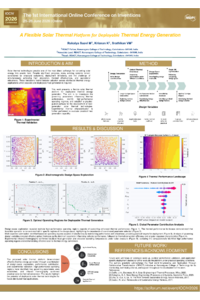
Strain-Invariant Atmospheric Micro-Gap Solar Thermal Membrane: Redefining Flexible High-Temperature Operation
'%3e%3cpath%20d='M12.6647%2010.9104C12.4176%2010.325%2012.0589%209.7933%2011.6088%209.34485C11.16%208.89511%2010.6283%208.53653%2010.0432%208.28891C10.038%208.28629%2010.0327%208.28498%2010.0275%208.28236C10.8437%207.69282%2011.3743%206.73252%2011.3743%205.64907C11.3743%203.85423%209.92005%202.40002%208.12522%202.40002C6.33038%202.40002%204.87618%203.85423%204.87618%205.64907C4.87618%206.73252%205.40677%207.69282%206.22296%208.28367C6.21772%208.28629%206.21248%208.2876%206.20724%208.29022C5.62031%208.53783%205.09365%208.89287%204.64167%209.34616C4.19192%209.79496%203.83334%2010.3266%203.58573%2010.9117C3.34247%2011.4846%203.21128%2012.0987%203.19925%2012.721C3.1989%2012.735%203.20135%2012.7489%203.20646%2012.7619C3.21157%2012.7749%203.21924%2012.7868%203.22901%2012.7968C3.23877%2012.8068%203.25045%2012.8148%203.26334%2012.8202C3.27623%2012.8256%203.29007%2012.8284%203.30406%2012.8284H4.09012C4.14776%2012.8284%204.19362%2012.7825%204.19493%2012.7262C4.22113%2011.7148%204.62726%2010.7676%205.34519%2010.0497C6.08802%209.30686%207.07452%208.89811%208.12522%208.89811C9.17592%208.89811%2010.1624%209.30686%2010.9052%2010.0497C11.6232%2010.7676%2012.0293%2011.7148%2012.0555%2012.7262C12.0568%2012.7839%2012.1027%2012.8284%2012.1603%2012.8284H12.9464C12.9604%2012.8284%2012.9742%2012.8256%2012.9871%2012.8202C13%2012.8148%2013.0117%2012.8068%2013.0214%2012.7968C13.0312%2012.7868%2013.0389%2012.7749%2013.044%2012.7619C13.0491%2012.7489%2013.0515%2012.735%2013.0512%2012.721C13.0381%2012.0947%2012.9084%2011.4856%2012.6647%2010.9104ZM8.12522%207.90243C7.52388%207.90243%206.95792%207.66793%206.53214%207.24215C6.10636%206.81636%205.87185%206.2504%205.87185%205.64907C5.87185%205.04773%206.10636%204.48177%206.53214%204.05599C6.95792%203.63021%207.52388%203.3957%208.12522%203.3957C8.72655%203.3957%209.29252%203.63021%209.7183%204.05599C10.1441%204.48177%2010.3786%205.04773%2010.3786%205.64907C10.3786%206.2504%2010.1441%206.81636%209.7183%207.24215C9.29252%207.66793%208.72655%207.90243%208.12522%207.90243Z'%20fill='%235D1EE1'/%3e%3c/g%3e%3c/svg%3e)
Rukaiya Beevi 1
Krisnan K 2
Brathikan V M 3
1. Department of Electronics and Communication Engineering, Kumaraguru College of Technology (Affiliated to Anna University), Coimbatore, Tamil Nadu 641049, India
2. R&D Facilitator, REACT, Kumaraguru College of Technology (Affiliated to Anna University), Coimbatore, Tamil Nadu 641049, India
3. Head – REACT, Kumaraguru College of Technology (Affiliated to Anna University), Coimbatore, Tamil Nadu 641049, India
Abstract
Existing solar thermal technologies confront irreconcilable tradeoffs: rigid evacuated glazing demands mm-scale gaps with structural spacers; polymer-based flexible collectors sacrifice thermal insulation for mechanical compliance; spectrally-selective absorbers rely on resonant nanostructures vulnerable to deployment strain and incidence angle. Critically absent is an architecture unifying sub-300 µm atmospheric noble-gas confinement, roll-to-roll manufacturability, strain-robust broadband absorption, and suppressed thermal emission without vacuum infrastructure or discrete mechanical supports.
This invention introduces a fundamentally novel coupled electromagnetic-mechanical-thermal platform: a tension-stabilized atmospheric micro-gap membrane incorporating non-resonant impedance-synthesized multilayer absorbers operating in the sub-wavelength regime (βd ≪ 1). Electromagnetic design minimizes input impedance mismatch across solar spectrum (0.3-2.5 µm) and wide angular aperture (0°-60° TE/TM), while deliberate avoidance of quarter-wave resonances confers intrinsic robustness to thickness nonuniformity and bending-induced strain.
Mechanical innovation leverages moderate biaxial pre-tension (not structural) with engineered ultra-low adhesion surfaces (≤20 mN/m) to maintain nominal 250 µm argon gap across 15-20 cm spans, suppressing convection (Ra ∝ L³ reduction) without internal pillars, vacuum differentials, or sustained high stress risking creep failure.
Thermal directionality engineered via asymmetric conduction ensures efficient substrate heat extraction. Target outcome: flexible roll-to-roll deployment delivering evacuated-tube performance in atmospheric operation, targeting industrial process heat, rooftop thermal generation, and CSP augmentation.
The invention'screativity resides in rejecting conventional paradigms with no spacers, no vacuum, no resonance, replacing them with coupled physics operating at unprecedented thin-gap tolerance. This addresses the core gap preventing flexible solar thermal industrialization.
Keywords
micro-gap thermal insulation
non-resonant impedance matching
strain-robust solar absorption
roll-to-roll solar thermal
coupled opto-mechanics
Poster
MDPI_poster_submission.pdf
Influence of Li Substitution on the Dielectric Behavior of (Na₀.₅₂₅K₀.₄₇₅)NbO₃ at the Morphotropic Phase Boundary
Exploring Wild Arachis pintoi Biomass for Sustainable Bioenergy: A Multi-Product Strategy for Biofuel Production