Event submissions
Published
This submission belongs to the session S2. Advanced sustainable energy conversion systems of the event The 1st International Online Conference on Inventions
Published date
22 Jun, 2026
Academic Editor
'%3e%3cpath%20d='M12.6657%2010.9104C12.4185%2010.325%2012.0599%209.79327%2011.6097%209.34482C11.1609%208.89508%2010.6293%208.5365%2010.0442%208.28888C10.0389%208.28626%2010.0337%208.28495%2010.0285%208.28233C10.8446%207.69279%2011.3752%206.73249%2011.3752%205.64904C11.3752%203.8542%209.92103%202.39999%208.1262%202.39999C6.33136%202.39999%204.87715%203.8542%204.87715%205.64904C4.87715%206.73249%205.40774%207.69279%206.22393%208.28364C6.21869%208.28626%206.21345%208.28757%206.20821%208.29019C5.62129%208.5378%205.09463%208.89284%204.64265%209.34613C4.1929%209.79493%203.83432%2010.3266%203.58671%2010.9117C3.34345%2011.4845%203.21226%2012.0987%203.20023%2012.7209C3.19988%2012.7349%203.20233%2012.7488%203.20744%2012.7619C3.21255%2012.7749%203.22022%2012.7867%203.22998%2012.7968C3.23975%2012.8068%203.25142%2012.8147%203.26431%2012.8202C3.2772%2012.8256%203.29105%2012.8284%203.30504%2012.8284H4.09109C4.14874%2012.8284%204.19459%2012.7825%204.1959%2012.7262C4.2221%2011.7148%204.62823%2010.7676%205.34617%2010.0497C6.08899%209.30683%207.0755%208.89808%208.1262%208.89808C9.17689%208.89808%2010.1634%209.30683%2010.9062%2010.0497C11.6242%2010.7676%2012.0303%2011.7148%2012.0565%2012.7262C12.0578%2012.7838%2012.1037%2012.8284%2012.1613%2012.8284H12.9474C12.9613%2012.8284%2012.9752%2012.8256%2012.9881%2012.8202C13.001%2012.8147%2013.0126%2012.8068%2013.0224%2012.7968C13.0322%2012.7867%2013.0398%2012.7749%2013.0449%2012.7619C13.0501%2012.7488%2013.0525%2012.7349%2013.0522%2012.7209C13.0391%2012.0947%2012.9094%2011.4855%2012.6657%2010.9104ZM8.1262%207.9024C7.52486%207.9024%206.9589%207.6679%206.53312%207.24211C6.10733%206.81633%205.87283%206.25037%205.87283%205.64904C5.87283%205.0477%206.10733%204.48174%206.53312%204.05596C6.9589%203.63018%207.52486%203.39567%208.1262%203.39567C8.72753%203.39567%209.29349%203.63018%209.71927%204.05596C10.1451%204.48174%2010.3796%205.0477%2010.3796%205.64904C10.3796%206.25037%2010.1451%206.81633%209.71927%207.24211C9.29349%207.6679%208.72753%207.9024%208.1262%207.9024Z'%20fill='%235D1EE1'/%3e%3c/g%3e%3c/svg%3e) Said Al-Hallaj
Said Al-HallajCitation
Helitha Hiranya Nilmalgoda, Nethmi Gunathilake, Lasitha Madhusanka, Ashan Induranga, Niroshan Gunawardana, Asanga Ampitiyawatta, Kaveenga Koswattage, Exploring Wild Arachis pintoi Biomass for Sustainable Bioenergy: A Multi-Product Strategy for Biofuel Production, in Proceedings of The 1st International Online Conference on Inventions, 25 June–26 June 2026, MDPI: Basel, Switzerland
Share
Email
Facebook
Twitter
LinkedIn
Exploring Wild Arachis pintoi Biomass for Sustainable Bioenergy: A Multi-Product Strategy for Biofuel Production

Helitha Hiranya Nilmalgoda 1
'%3e%3cpath%20d='M12.6647%2010.9104C12.4176%2010.325%2012.0589%209.7933%2011.6088%209.34485C11.16%208.89511%2010.6283%208.53653%2010.0432%208.28891C10.038%208.28629%2010.0327%208.28498%2010.0275%208.28236C10.8437%207.69282%2011.3743%206.73252%2011.3743%205.64907C11.3743%203.85423%209.92005%202.40002%208.12522%202.40002C6.33038%202.40002%204.87618%203.85423%204.87618%205.64907C4.87618%206.73252%205.40677%207.69282%206.22296%208.28367C6.21772%208.28629%206.21248%208.2876%206.20724%208.29022C5.62031%208.53783%205.09365%208.89287%204.64167%209.34616C4.19192%209.79496%203.83334%2010.3266%203.58573%2010.9117C3.34247%2011.4846%203.21128%2012.0987%203.19925%2012.721C3.1989%2012.735%203.20135%2012.7489%203.20646%2012.7619C3.21157%2012.7749%203.21924%2012.7868%203.22901%2012.7968C3.23877%2012.8068%203.25045%2012.8148%203.26334%2012.8202C3.27623%2012.8256%203.29007%2012.8284%203.30406%2012.8284H4.09012C4.14776%2012.8284%204.19362%2012.7825%204.19493%2012.7262C4.22113%2011.7148%204.62726%2010.7676%205.34519%2010.0497C6.08802%209.30686%207.07452%208.89811%208.12522%208.89811C9.17592%208.89811%2010.1624%209.30686%2010.9052%2010.0497C11.6232%2010.7676%2012.0293%2011.7148%2012.0555%2012.7262C12.0568%2012.7839%2012.1027%2012.8284%2012.1603%2012.8284H12.9464C12.9604%2012.8284%2012.9742%2012.8256%2012.9871%2012.8202C13%2012.8148%2013.0117%2012.8068%2013.0214%2012.7968C13.0312%2012.7868%2013.0389%2012.7749%2013.044%2012.7619C13.0491%2012.7489%2013.0515%2012.735%2013.0512%2012.721C13.0381%2012.0947%2012.9084%2011.4856%2012.6647%2010.9104ZM8.12522%207.90243C7.52388%207.90243%206.95792%207.66793%206.53214%207.24215C6.10636%206.81636%205.87185%206.2504%205.87185%205.64907C5.87185%205.04773%206.10636%204.48177%206.53214%204.05599C6.95792%203.63021%207.52388%203.3957%208.12522%203.3957C8.72655%203.3957%209.29252%203.63021%209.7183%204.05599C10.1441%204.48177%2010.3786%205.04773%2010.3786%205.64907C10.3786%206.2504%2010.1441%206.81636%209.7183%207.24215C9.29252%207.66793%208.72655%207.90243%208.12522%207.90243Z'%20fill='%235D1EE1'/%3e%3c/g%3e%3c/svg%3e)
Nethmi Gunathilake 1
Lasitha Madhusanka 1,2
Ashan Induranga 2,3
Niroshan Gunawardana 2,3

Asanga Ampitiyawatta 4
Kaveenga Koswattage 2,3
1. Department of Biosystems Technology, Faculty of Technology, Sabaragamuwa University of Sri Lanka, Belihuloya 70140, Sri Lanka
2. Centre for Nanodevice Fabrication and Characterization, Faculty of Technology, Sabaragamuwa University of Sri Lanka, Belihuloya 70140, Sri Lanka
3. Department of Engineering Technology, Faculty of Technology, Sabaragamuwa University of Sri Lanka, Belihuloya 70140, Sri Lanka
4. Department of Export Agriculture, Faculty of Agricultural Sciences, Sabaragamuwa University of Sri Lanka, Belihuloya 70140, Sri Lanka
Abstract
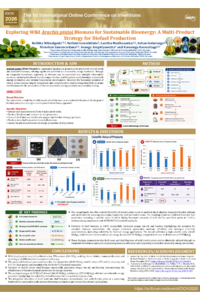
The global energy crisis and environmental concerns have intensified the search for sustainable alternatives. This study investigates the potential of Arachis pintoi (Pinto peanut) as a feedstock for biodiesel, biochar, and syngas production, assessing its suitability for renewable energy applications. The Free Fatty Acid (FFA) content of Pinto peanut oil was found to be exceptionally low at 0.612%, significantly below the 2% threshold for alkaline transesterification, eliminating the need for energy-intensive acid pretreatment. Biodiesel derived from this oil exhibited superior fuel properties, including a calorific value of 40.54 MJ/kg, optimal kinematic viscosity (4.7 mm²/s), and a high flash point (157.5°C), which surpasses ASTM D6751 standards. The syngas produced through pyrolysis at 430°C demonstrated moderate energy output with promising gas composition, though optimization could enhance hydrogen yields and reduce CO₂ emissions. The proximate and ultimate analysis of Pinto peanut shells revealed a high calorific value (16,790 kJ/kg) and favorable elemental composition, making them a viable energy source for combustion. Additionally, the pyrolysis of Pinto peanut shells yielded biochar with a calorific value of 25.235 MJ/kg, positioning it as a promising alternative for various industrial applications. The study highlights the potential of Pinto peanut-derived biofuels and biochar as sustainable alternatives to fossil fuels, with further optimization capable of improving yield and performance for broader energy applications.
Keywords
Pinto peanut biodiesel
pyrolysis
free fatty acid
biochar
circular bioeconomy
Poster
sciforum-175315.pdf
Strain-Invariant Atmospheric Micro-Gap Solar Thermal Membrane: Redefining Flexible High-Temperature Operation
Experimental Investigation of Optimal Wavelength Selection for Laser Power Beaming Using Silicon Solar Cells in UAV Charging Systems