Event submissions
Published
This submission belongs to the session S3. Energy system analysis and modelling of the event The 1st International Online Conference on Inventions
Published date
22 Jun, 2026
Academic Editor
'%3e%3cpath%20d='M12.6657%2010.9104C12.4185%2010.325%2012.0599%209.79327%2011.6097%209.34482C11.1609%208.89508%2010.6293%208.5365%2010.0442%208.28888C10.0389%208.28626%2010.0337%208.28495%2010.0285%208.28233C10.8446%207.69279%2011.3752%206.73249%2011.3752%205.64904C11.3752%203.8542%209.92103%202.39999%208.1262%202.39999C6.33136%202.39999%204.87715%203.8542%204.87715%205.64904C4.87715%206.73249%205.40774%207.69279%206.22393%208.28364C6.21869%208.28626%206.21345%208.28757%206.20821%208.29019C5.62129%208.5378%205.09463%208.89284%204.64265%209.34613C4.1929%209.79493%203.83432%2010.3266%203.58671%2010.9117C3.34345%2011.4845%203.21226%2012.0987%203.20023%2012.7209C3.19988%2012.7349%203.20233%2012.7488%203.20744%2012.7619C3.21255%2012.7749%203.22022%2012.7867%203.22998%2012.7968C3.23975%2012.8068%203.25142%2012.8147%203.26431%2012.8202C3.2772%2012.8256%203.29105%2012.8284%203.30504%2012.8284H4.09109C4.14874%2012.8284%204.19459%2012.7825%204.1959%2012.7262C4.2221%2011.7148%204.62823%2010.7676%205.34617%2010.0497C6.08899%209.30683%207.0755%208.89808%208.1262%208.89808C9.17689%208.89808%2010.1634%209.30683%2010.9062%2010.0497C11.6242%2010.7676%2012.0303%2011.7148%2012.0565%2012.7262C12.0578%2012.7838%2012.1037%2012.8284%2012.1613%2012.8284H12.9474C12.9613%2012.8284%2012.9752%2012.8256%2012.9881%2012.8202C13.001%2012.8147%2013.0126%2012.8068%2013.0224%2012.7968C13.0322%2012.7867%2013.0398%2012.7749%2013.0449%2012.7619C13.0501%2012.7488%2013.0525%2012.7349%2013.0522%2012.7209C13.0391%2012.0947%2012.9094%2011.4855%2012.6657%2010.9104ZM8.1262%207.9024C7.52486%207.9024%206.9589%207.6679%206.53312%207.24211C6.10733%206.81633%205.87283%206.25037%205.87283%205.64904C5.87283%205.0477%206.10733%204.48174%206.53312%204.05596C6.9589%203.63018%207.52486%203.39567%208.1262%203.39567C8.72753%203.39567%209.29349%203.63018%209.71927%204.05596C10.1451%204.48174%2010.3796%205.0477%2010.3796%205.64904C10.3796%206.25037%2010.1451%206.81633%209.71927%207.24211C9.29349%207.6679%208.72753%207.9024%208.1262%207.9024Z'%20fill='%235D1EE1'/%3e%3c/g%3e%3c/svg%3e) Eugen RUSU
Eugen RUSUCitation
Sardorjon Salimjon ugli Samiev, Shokhabbos Kulmurat ugli Doliev, Javlonbek Khoshim ugli Khamraev, Golibjon Kholmuminovich Makhmatqulov, Khurshid Normumin ugli Yusupov, Dynamic modeling analysis of a Doubly-Fed Induction Generator-based wind energy system, in Proceedings of The 1st International Online Conference on Inventions, 25 June–26 June 2026, MDPI: Basel, Switzerland
Share
Email
Facebook
Twitter
LinkedIn
Dynamic modeling analysis of a Doubly-Fed Induction Generator-based wind energy system

Sardorjon Salimjon ugli Samiev 1

Shokhabbos Kulmurat ugli Doliev 1
'%3e%3cpath%20d='M12.6647%2010.9104C12.4176%2010.325%2012.0589%209.7933%2011.6088%209.34485C11.16%208.89511%2010.6283%208.53653%2010.0432%208.28891C10.038%208.28629%2010.0327%208.28498%2010.0275%208.28236C10.8437%207.69282%2011.3743%206.73252%2011.3743%205.64907C11.3743%203.85423%209.92005%202.40002%208.12522%202.40002C6.33038%202.40002%204.87618%203.85423%204.87618%205.64907C4.87618%206.73252%205.40677%207.69282%206.22296%208.28367C6.21772%208.28629%206.21248%208.2876%206.20724%208.29022C5.62031%208.53783%205.09365%208.89287%204.64167%209.34616C4.19192%209.79496%203.83334%2010.3266%203.58573%2010.9117C3.34247%2011.4846%203.21128%2012.0987%203.19925%2012.721C3.1989%2012.735%203.20135%2012.7489%203.20646%2012.7619C3.21157%2012.7749%203.21924%2012.7868%203.22901%2012.7968C3.23877%2012.8068%203.25045%2012.8148%203.26334%2012.8202C3.27623%2012.8256%203.29007%2012.8284%203.30406%2012.8284H4.09012C4.14776%2012.8284%204.19362%2012.7825%204.19493%2012.7262C4.22113%2011.7148%204.62726%2010.7676%205.34519%2010.0497C6.08802%209.30686%207.07452%208.89811%208.12522%208.89811C9.17592%208.89811%2010.1624%209.30686%2010.9052%2010.0497C11.6232%2010.7676%2012.0293%2011.7148%2012.0555%2012.7262C12.0568%2012.7839%2012.1027%2012.8284%2012.1603%2012.8284H12.9464C12.9604%2012.8284%2012.9742%2012.8256%2012.9871%2012.8202C13%2012.8148%2013.0117%2012.8068%2013.0214%2012.7968C13.0312%2012.7868%2013.0389%2012.7749%2013.044%2012.7619C13.0491%2012.7489%2013.0515%2012.735%2013.0512%2012.721C13.0381%2012.0947%2012.9084%2011.4856%2012.6647%2010.9104ZM8.12522%207.90243C7.52388%207.90243%206.95792%207.66793%206.53214%207.24215C6.10636%206.81636%205.87185%206.2504%205.87185%205.64907C5.87185%205.04773%206.10636%204.48177%206.53214%204.05599C6.95792%203.63021%207.52388%203.3957%208.12522%203.3957C8.72655%203.3957%209.29252%203.63021%209.7183%204.05599C10.1441%204.48177%2010.3786%205.04773%2010.3786%205.64907C10.3786%206.2504%2010.1441%206.81636%209.7183%207.24215C9.29252%207.66793%208.72655%207.90243%208.12522%207.90243Z'%20fill='%235D1EE1'/%3e%3c/g%3e%3c/svg%3e)
Javlonbek Khoshim ugli Khamraev 1
Golibjon Kholmuminovich Makhmatqulov 2
Khurshid Normumin ugli Yusupov 1
1. Department of Information Technologies in Industry and Tourism, Shahrisabz Faculty of Food Engineering, Karshi State Technical University. Shahrizabz 181306. Uzbekistan.
2. Department of Economics, Faculty of Pedagogy, University of Economics and Pedagogy. Karshi 180100. Uzbekistan.
Abstract
The increasing integration of wind energy into modern power systems introduces significant challenges in maintaining frequency stability and power quality due to the stochastic nature of wind speed, particularly in microgrid environments. This study focuses on the modeling and control of a wind energy conversion system based on a Doubly-Fed Induction Generator (DFIG) operating in conjunction with an external power supply system. A comprehensive simulation model of the wind energy system was developed in MATLAB/Simulink, incorporating both the wind turbine and power converter subsystems. The control strategy is based on stator flux-oriented vector control, which enables independent regulation of active and reactive power, combined with space vector pulse-width modulation (SVPWM) to improve the performance of the power electronic converters. The system employs a dual-converter structure, where the rotor-side converter ensures bidirectional power flow and the grid-side converter maintains the DC-link voltage. The simulation results demonstrate that the proposed control system ensures fast dynamic response and stable operation under variable wind conditions. In particular, the stator current reaches steady state within 0,01 s, satisfying the specified technical requirement for transient performance. Additionally, the DC-link voltage is effectively stabilized at approximately 700 V, ensuring reliable operation of the converter system. The use of SVPWM contributes to improved switching performance and efficient synthesis of voltage vectors, enhancing overall system stability. The developed model also confirms stable operation of the wind energy system within a microgrid, ensuring coordinated interaction between system components under fluctuating wind conditions. Compared to conventional approaches, the applied vector control strategy provides effective decoupling of power components and improved dynamic characteristics for the system. The results obtained validate the effectiveness of the proposed modeling and control approach for small-scale wind energy systems and demonstrate its applicability for improving the stability and performance of renewable energy integration in modern power systems.
Keywords
DFIG
wind energy
vector control
frequency stability
virtual inertia
MATLAB/Simulink
renewable energy
dynamic modeling.
Poster
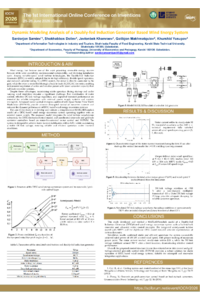
Poster sciforum-180040.pdf
Achieving Sustainable Integration of Renewable Energy via Smart Grids and Artificial Intelligence
Modeling and Forecasting Electricity Consumption and Its Determinants: Evidence from the Kashkadarya Region