Event submissions
Published
This submission belongs to the session S3. Energy system analysis and modelling of the event The 1st International Online Conference on Inventions
Published date
22 Jun, 2026
Academic Editor
'%3e%3cpath%20d='M12.6657%2010.9104C12.4185%2010.325%2012.0599%209.79327%2011.6097%209.34482C11.1609%208.89508%2010.6293%208.5365%2010.0442%208.28888C10.0389%208.28626%2010.0337%208.28495%2010.0285%208.28233C10.8446%207.69279%2011.3752%206.73249%2011.3752%205.64904C11.3752%203.8542%209.92103%202.39999%208.1262%202.39999C6.33136%202.39999%204.87715%203.8542%204.87715%205.64904C4.87715%206.73249%205.40774%207.69279%206.22393%208.28364C6.21869%208.28626%206.21345%208.28757%206.20821%208.29019C5.62129%208.5378%205.09463%208.89284%204.64265%209.34613C4.1929%209.79493%203.83432%2010.3266%203.58671%2010.9117C3.34345%2011.4845%203.21226%2012.0987%203.20023%2012.7209C3.19988%2012.7349%203.20233%2012.7488%203.20744%2012.7619C3.21255%2012.7749%203.22022%2012.7867%203.22998%2012.7968C3.23975%2012.8068%203.25142%2012.8147%203.26431%2012.8202C3.2772%2012.8256%203.29105%2012.8284%203.30504%2012.8284H4.09109C4.14874%2012.8284%204.19459%2012.7825%204.1959%2012.7262C4.2221%2011.7148%204.62823%2010.7676%205.34617%2010.0497C6.08899%209.30683%207.0755%208.89808%208.1262%208.89808C9.17689%208.89808%2010.1634%209.30683%2010.9062%2010.0497C11.6242%2010.7676%2012.0303%2011.7148%2012.0565%2012.7262C12.0578%2012.7838%2012.1037%2012.8284%2012.1613%2012.8284H12.9474C12.9613%2012.8284%2012.9752%2012.8256%2012.9881%2012.8202C13.001%2012.8147%2013.0126%2012.8068%2013.0224%2012.7968C13.0322%2012.7867%2013.0398%2012.7749%2013.0449%2012.7619C13.0501%2012.7488%2013.0525%2012.7349%2013.0522%2012.7209C13.0391%2012.0947%2012.9094%2011.4855%2012.6657%2010.9104ZM8.1262%207.9024C7.52486%207.9024%206.9589%207.6679%206.53312%207.24211C6.10733%206.81633%205.87283%206.25037%205.87283%205.64904C5.87283%205.0477%206.10733%204.48174%206.53312%204.05596C6.9589%203.63018%207.52486%203.39567%208.1262%203.39567C8.72753%203.39567%209.29349%203.63018%209.71927%204.05596C10.1451%204.48174%2010.3796%205.0477%2010.3796%205.64904C10.3796%206.25037%2010.1451%206.81633%209.71927%207.24211C9.29349%207.6679%208.72753%207.9024%208.1262%207.9024Z'%20fill='%235D1EE1'/%3e%3c/g%3e%3c/svg%3e) Eugen RUSU
Eugen RUSUCitation
Guido Soosaar, Tormi Lillerand, Causal Greedy Pair Scheduling for Residential Battery Storage under Day-Ahead Electricity Prices, in Proceedings of The 1st International Online Conference on Inventions, 25 June–26 June 2026, MDPI: Basel, Switzerland
Share
Email
Facebook
Twitter
LinkedIn
Causal Greedy Pair Scheduling for Residential Battery Storage under Day-Ahead Electricity Prices
'%3e%3cpath%20d='M12.6647%2010.9104C12.4176%2010.325%2012.0589%209.7933%2011.6088%209.34485C11.16%208.89511%2010.6283%208.53653%2010.0432%208.28891C10.038%208.28629%2010.0327%208.28498%2010.0275%208.28236C10.8437%207.69282%2011.3743%206.73252%2011.3743%205.64907C11.3743%203.85423%209.92005%202.40002%208.12522%202.40002C6.33038%202.40002%204.87618%203.85423%204.87618%205.64907C4.87618%206.73252%205.40677%207.69282%206.22296%208.28367C6.21772%208.28629%206.21248%208.2876%206.20724%208.29022C5.62031%208.53783%205.09365%208.89287%204.64167%209.34616C4.19192%209.79496%203.83334%2010.3266%203.58573%2010.9117C3.34247%2011.4846%203.21128%2012.0987%203.19925%2012.721C3.1989%2012.735%203.20135%2012.7489%203.20646%2012.7619C3.21157%2012.7749%203.21924%2012.7868%203.22901%2012.7968C3.23877%2012.8068%203.25045%2012.8148%203.26334%2012.8202C3.27623%2012.8256%203.29007%2012.8284%203.30406%2012.8284H4.09012C4.14776%2012.8284%204.19362%2012.7825%204.19493%2012.7262C4.22113%2011.7148%204.62726%2010.7676%205.34519%2010.0497C6.08802%209.30686%207.07452%208.89811%208.12522%208.89811C9.17592%208.89811%2010.1624%209.30686%2010.9052%2010.0497C11.6232%2010.7676%2012.0293%2011.7148%2012.0555%2012.7262C12.0568%2012.7839%2012.1027%2012.8284%2012.1603%2012.8284H12.9464C12.9604%2012.8284%2012.9742%2012.8256%2012.9871%2012.8202C13%2012.8148%2013.0117%2012.8068%2013.0214%2012.7968C13.0312%2012.7868%2013.0389%2012.7749%2013.044%2012.7619C13.0491%2012.7489%2013.0515%2012.735%2013.0512%2012.721C13.0381%2012.0947%2012.9084%2011.4856%2012.6647%2010.9104ZM8.12522%207.90243C7.52388%207.90243%206.95792%207.66793%206.53214%207.24215C6.10636%206.81636%205.87185%206.2504%205.87185%205.64907C5.87185%205.04773%206.10636%204.48177%206.53214%204.05599C6.95792%203.63021%207.52388%203.3957%208.12522%203.3957C8.72655%203.3957%209.29252%203.63021%209.7183%204.05599C10.1441%204.48177%2010.3786%205.04773%2010.3786%205.64907C10.3786%206.2504%2010.1441%206.81636%209.7183%207.24215C9.29252%207.66793%208.72655%207.90243%208.12522%207.90243Z'%20fill='%235D1EE1'/%3e%3c/g%3e%3c/svg%3e)
Guido Soosaar 1
Tormi Lillerand 1
1. Chair of Biosystems Engineering, Institute of Forestry and Engineering, Estonian University of Life Sciences, Tartu 51006, Estonia
Abstract
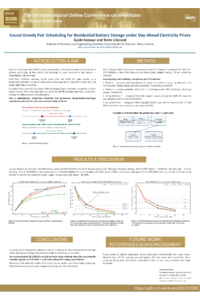
Residential batteries operated against day-ahead electricity prices require schedules that simultaneously respect battery physics and enforce charge-before-discharge causality. Naive price-ranking heuristics can violate this ordering in real time, converting apparently profitable arbitrage plans into partially infeasible execution. This study presents a deterministic causal greedy pair-matching heuristic that eliminates this failure mode by construction and evaluates it on a full-year measured dataset of 2025 Estonian household demand and spot-price data with mixed hourly and 15-minute resolution. After chronology repair, daylight-saving correction, and linear imputation of 165 sparse missing-price rows, the cleaned dataset covers exactly 8760 hours and serves as a common input for all simulations. Under the canonical 24-hour non-overlapping planning horizon with no grid export, a 10 kWh battery reduces the ex-VAT spot-energy bill from €1095.91 to €648.53, saving €447.38 per year (40.82%), while a 30 kWh battery saves €629.91 per year. The marginal value of added capacity declines sharply: the first kilowatt-hour delivers €79.04 per year and the thirtieth only €2.67 per year, confirming strong diminishing returns. Across the four tested planning horizons, the 24-hour window performs best for small-to-mid capacities, while the 48-hour window marginally surpasses it only above 25 kWh. Against an exact matched-constraint mixed-integer linear program benchmark, the heuristic recovers 95.65% of optimal value at 10 kWh and approximately 97.95% at 20–30 kWh, with an annual gap below €21 in the mid-to-large capacity range. A descriptive event-study around the February 2025 Baltic synchronization shows no immediate reduction in intraday price spread or heuristic savings. The results demonstrate that a causally valid, computationally lightweight scheduler can capture the large majority of available arbitrage value on real household data without requiring optimization solvers.
Keywords
residential battery energy storage
greedy heuristic
battery scheduling
household load data
capacity sensitivity
Poster
Soosaar_Lillerand_Poster.pdf
Metaheuristic-Based Photovoltaic Parameter Identification Using a Dynamic Elite Cooperative Artificial Circulatory System Algorithm
Web-Based Energy Yield Modeling Tool for Prototype Movable Photovoltaic Power Plants in Agricultural Automation