Event submissions
Published

This submission belongs to the session B. Chemical Sensors of the event 2nd International Electronic Conference on Sensors and Applications
Published date
12 Nov, 2015
Citation
Amélie Wannebroucq, Jean-Moïse Suisse, Marcel Bouvet, Molecular Semiconductors — Doped Insulator (MSDI) heterojunctions as new conductometric devices for chemosensing in wet atmosphere., in Proceedings of 2nd International Electronic Conference on Sensors and Applications, 15 November–30 November 2015, MDPI: Basel, Switzerland, doi: 10.3390/ecsa-2-B002
Share
Email
Facebook
Twitter
LinkedIn
Molecular Semiconductors — Doped Insulator (MSDI) heterojunctions as new conductometric devices for chemosensing in wet atmosphere.
'%3e%3cpath%20d='M12.6647%2010.9104C12.4176%2010.325%2012.0589%209.7933%2011.6088%209.34485C11.16%208.89511%2010.6283%208.53653%2010.0432%208.28891C10.038%208.28629%2010.0327%208.28498%2010.0275%208.28236C10.8437%207.69282%2011.3743%206.73252%2011.3743%205.64907C11.3743%203.85423%209.92005%202.40002%208.12522%202.40002C6.33038%202.40002%204.87618%203.85423%204.87618%205.64907C4.87618%206.73252%205.40677%207.69282%206.22296%208.28367C6.21772%208.28629%206.21248%208.2876%206.20724%208.29022C5.62031%208.53783%205.09365%208.89287%204.64167%209.34616C4.19192%209.79496%203.83334%2010.3266%203.58573%2010.9117C3.34247%2011.4846%203.21128%2012.0987%203.19925%2012.721C3.1989%2012.735%203.20135%2012.7489%203.20646%2012.7619C3.21157%2012.7749%203.21924%2012.7868%203.22901%2012.7968C3.23877%2012.8068%203.25045%2012.8148%203.26334%2012.8202C3.27623%2012.8256%203.29007%2012.8284%203.30406%2012.8284H4.09012C4.14776%2012.8284%204.19362%2012.7825%204.19493%2012.7262C4.22113%2011.7148%204.62726%2010.7676%205.34519%2010.0497C6.08802%209.30686%207.07452%208.89811%208.12522%208.89811C9.17592%208.89811%2010.1624%209.30686%2010.9052%2010.0497C11.6232%2010.7676%2012.0293%2011.7148%2012.0555%2012.7262C12.0568%2012.7839%2012.1027%2012.8284%2012.1603%2012.8284H12.9464C12.9604%2012.8284%2012.9742%2012.8256%2012.9871%2012.8202C13%2012.8148%2013.0117%2012.8068%2013.0214%2012.7968C13.0312%2012.7868%2013.0389%2012.7749%2013.044%2012.7619C13.0491%2012.7489%2013.0515%2012.735%2013.0512%2012.721C13.0381%2012.0947%2012.9084%2011.4856%2012.6647%2010.9104ZM8.12522%207.90243C7.52388%207.90243%206.95792%207.66793%206.53214%207.24215C6.10636%206.81636%205.87185%206.2504%205.87185%205.64907C5.87185%205.04773%206.10636%204.48177%206.53214%204.05599C6.95792%203.63021%207.52388%203.3957%208.12522%203.3957C8.72655%203.3957%209.29252%203.63021%209.7183%204.05599C10.1441%204.48177%2010.3786%205.04773%2010.3786%205.64907C10.3786%206.2504%2010.1441%206.81636%209.7183%207.24215C9.29252%207.66793%208.72655%207.90243%208.12522%207.90243Z'%20fill='%235D1EE1'/%3e%3c/g%3e%3c/svg%3e)
Amélie Wannebroucq 1
Jean-Moïse Suisse 1

Marcel Bouvet 1
1. Institut de Chimie Moléculaire de l’Université de Bourgogne (ICMUB), Université de Bourgogne Franche-Comté, 9 avenue Alain Savary, BP 47870, 21078 Dijon Cedex, France
Abstract
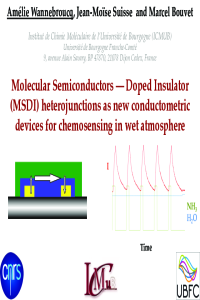
Most of the gas sensors are based on resistors with inorganic materials and more rarely on other conductometric devices (diodes or transistors). Conductometric sensors have also been designed with molecular materials. Thus, in 2009, Molecular Semiconductor — Doped-insulator (MSDI) heterojunctions were built around a heterojunction between a molecular semiconductor (MS) and a doped-insulator (DI). The MS must be more conductive than the sublayer to take advantage of the heterojunction. The MS is generally of p-type and DI can be of p-type (p-MSDI) or n-type (n-MSDI) material. The energy barrier at the interface depends on the difference in the charge carrier density in the two layers, leading to a variable extent of the plateau in the current-voltage characteristics, according to materials. We use this new transducer to detect different gases. We studied, in particular, the response of MSDIs to ammonia in a broad range of relative humidity (rh). A n-MSDI exhibits a positive response to ammonia (electron donating species) and a negative response to ozone (oxidizing species). Whereas the only material in contact with the gas is a p-type MS (LuPc2), these responses are opposite to those of a resistor prepared by only this material (LuPc2). The better stability toward humidity was obtained with Cu(F16Pc) as n-type sublayer. Thus, for Cu(F16Pc)/LuPc2 MSDI (50 nm/50 nm), the relative response to NH3 is almost not affected by the variation of rh in the 20-80 % range.
Keywords
Conductometric
Gas Sensor
Ammonia
Humidity
MSDI
Heterojunction
Manuscript
6095-4th revision.pdf
Poster
6095-presentation-revised.pdf
Data mining and non-invasive proximal sensing for precision viticulture
Smart Coat with a Textile Antenna for Electromagnetic Energy Harvesting