Event submissions
Published
This submission belongs to the session S3. Energy system analysis and modelling of the event The 1st International Online Conference on Inventions
Published date
22 Jun, 2026
Academic Editor
'%3e%3cpath%20d='M12.6657%2010.9104C12.4185%2010.325%2012.0599%209.79327%2011.6097%209.34482C11.1609%208.89508%2010.6293%208.5365%2010.0442%208.28888C10.0389%208.28626%2010.0337%208.28495%2010.0285%208.28233C10.8446%207.69279%2011.3752%206.73249%2011.3752%205.64904C11.3752%203.8542%209.92103%202.39999%208.1262%202.39999C6.33136%202.39999%204.87715%203.8542%204.87715%205.64904C4.87715%206.73249%205.40774%207.69279%206.22393%208.28364C6.21869%208.28626%206.21345%208.28757%206.20821%208.29019C5.62129%208.5378%205.09463%208.89284%204.64265%209.34613C4.1929%209.79493%203.83432%2010.3266%203.58671%2010.9117C3.34345%2011.4845%203.21226%2012.0987%203.20023%2012.7209C3.19988%2012.7349%203.20233%2012.7488%203.20744%2012.7619C3.21255%2012.7749%203.22022%2012.7867%203.22998%2012.7968C3.23975%2012.8068%203.25142%2012.8147%203.26431%2012.8202C3.2772%2012.8256%203.29105%2012.8284%203.30504%2012.8284H4.09109C4.14874%2012.8284%204.19459%2012.7825%204.1959%2012.7262C4.2221%2011.7148%204.62823%2010.7676%205.34617%2010.0497C6.08899%209.30683%207.0755%208.89808%208.1262%208.89808C9.17689%208.89808%2010.1634%209.30683%2010.9062%2010.0497C11.6242%2010.7676%2012.0303%2011.7148%2012.0565%2012.7262C12.0578%2012.7838%2012.1037%2012.8284%2012.1613%2012.8284H12.9474C12.9613%2012.8284%2012.9752%2012.8256%2012.9881%2012.8202C13.001%2012.8147%2013.0126%2012.8068%2013.0224%2012.7968C13.0322%2012.7867%2013.0398%2012.7749%2013.0449%2012.7619C13.0501%2012.7488%2013.0525%2012.7349%2013.0522%2012.7209C13.0391%2012.0947%2012.9094%2011.4855%2012.6657%2010.9104ZM8.1262%207.9024C7.52486%207.9024%206.9589%207.6679%206.53312%207.24211C6.10733%206.81633%205.87283%206.25037%205.87283%205.64904C5.87283%205.0477%206.10733%204.48174%206.53312%204.05596C6.9589%203.63018%207.52486%203.39567%208.1262%203.39567C8.72753%203.39567%209.29349%203.63018%209.71927%204.05596C10.1451%204.48174%2010.3796%205.0477%2010.3796%205.64904C10.3796%206.25037%2010.1451%206.81633%209.71927%207.24211C9.29349%207.6679%208.72753%207.9024%208.1262%207.9024Z'%20fill='%235D1EE1'/%3e%3c/g%3e%3c/svg%3e) Eugen RUSU
Eugen RUSUCitation
Abhishek Bajirao Katkar, AI-Driven Affinely Adjustable Robust Many-Objective Scheduling Framework for Flexibility-Oriented Power Systems with High Renewable Penetration, in Proceedings of The 1st International Online Conference on Inventions, 25 June–26 June 2026, MDPI: Basel, Switzerland
Share
Email
Facebook
Twitter
LinkedIn
AI-Driven Affinely Adjustable Robust Many-Objective Scheduling Framework for Flexibility-Oriented Power Systems with High Renewable Penetration
'%3e%3cpath%20d='M12.6647%2010.9104C12.4176%2010.325%2012.0589%209.7933%2011.6088%209.34485C11.16%208.89511%2010.6283%208.53653%2010.0432%208.28891C10.038%208.28629%2010.0327%208.28498%2010.0275%208.28236C10.8437%207.69282%2011.3743%206.73252%2011.3743%205.64907C11.3743%203.85423%209.92005%202.40002%208.12522%202.40002C6.33038%202.40002%204.87618%203.85423%204.87618%205.64907C4.87618%206.73252%205.40677%207.69282%206.22296%208.28367C6.21772%208.28629%206.21248%208.2876%206.20724%208.29022C5.62031%208.53783%205.09365%208.89287%204.64167%209.34616C4.19192%209.79496%203.83334%2010.3266%203.58573%2010.9117C3.34247%2011.4846%203.21128%2012.0987%203.19925%2012.721C3.1989%2012.735%203.20135%2012.7489%203.20646%2012.7619C3.21157%2012.7749%203.21924%2012.7868%203.22901%2012.7968C3.23877%2012.8068%203.25045%2012.8148%203.26334%2012.8202C3.27623%2012.8256%203.29007%2012.8284%203.30406%2012.8284H4.09012C4.14776%2012.8284%204.19362%2012.7825%204.19493%2012.7262C4.22113%2011.7148%204.62726%2010.7676%205.34519%2010.0497C6.08802%209.30686%207.07452%208.89811%208.12522%208.89811C9.17592%208.89811%2010.1624%209.30686%2010.9052%2010.0497C11.6232%2010.7676%2012.0293%2011.7148%2012.0555%2012.7262C12.0568%2012.7839%2012.1027%2012.8284%2012.1603%2012.8284H12.9464C12.9604%2012.8284%2012.9742%2012.8256%2012.9871%2012.8202C13%2012.8148%2013.0117%2012.8068%2013.0214%2012.7968C13.0312%2012.7868%2013.0389%2012.7749%2013.044%2012.7619C13.0491%2012.7489%2013.0515%2012.735%2013.0512%2012.721C13.0381%2012.0947%2012.9084%2011.4856%2012.6647%2010.9104ZM8.12522%207.90243C7.52388%207.90243%206.95792%207.66793%206.53214%207.24215C6.10636%206.81636%205.87185%206.2504%205.87185%205.64907C5.87185%205.04773%206.10636%204.48177%206.53214%204.05599C6.95792%203.63021%207.52388%203.3957%208.12522%203.3957C8.72655%203.3957%209.29252%203.63021%209.7183%204.05599C10.1441%204.48177%2010.3786%205.04773%2010.3786%205.64907C10.3786%206.2504%2010.1441%206.81636%209.7183%207.24215C9.29252%207.66793%208.72655%207.90243%208.12522%207.90243Z'%20fill='%235D1EE1'/%3e%3c/g%3e%3c/svg%3e)
Abhishek Bajirao Katkar 1
1. Electrical Engineering, Government Polytechnic, An Autonomous Institute of Government of Maharashtra, Government Polytechnic, Kolhapur 416004, India
Abstract
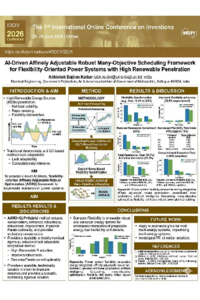
The increasing penetration of renewable energy sources (RESs) has fundamentally transformed modern power system operation, introducing significant challenges associated with net-load volatility, rapid ramping events, and flexibility supply–demand imbalance. Traditional deterministic scheduling approaches lack adaptability to renewable uncertainty, while conventional unit commitment (UC)-based flexibility assessment methods, although accurate, are computationally intensive and unsuitable for large-scale scenario-rich environments. To overcome these limitations, this paper proposes a novel AI-driven, flexibility-oriented Affinely Adjustable Robust Optimization (AARO) framework integrated with Generalized Linear Polyhedron (GLP)-based uncertainty modeling and a hybrid MOABC–NSGA-III many-objective optimization strategy. The proposed architecture uniquely combines probabilistic residual load forecasting, spatiotemporal renewable correlation modeling, explicit ramp-based flexibility quantification, and robust many-objective scheduling within a unified and computationally efficient framework. Extensive simulation studies conducted on modified IEEE 30-, 57-, and 118-bus systems demonstrate clear superiority over state-of-the-art deterministic and UC-based methods. At 60% renewable penetration, the flexibility gap is reduced from 10.3% to 2.8%, representing a 72.8% improvement in flexibility adequacy. Renewable curtailment decreases by 58%, while the Flexibility Risk Index (FRI) is reduced by approximately 78%, indicating significantly enhanced reliability under uncertainty. Additionally, total operational cost and carbon emissions are reduced by 10.7% and 13.8%, respectively. From a computational perspective, the proposed framework achieves more than 80% reduction in execution time compared to classical UC-based flexibility studies. These results confirm that the proposed method effectively reduces conservatism, enhances robustness, improves Pareto optimality, and provides a scalable, technically rigorous solution for next-generation renewable-dominated power systems.
Keywords
Power system flexibility
renewable energy integration
affinely adjustable robust optimization
generalized linear polyhedron
artificial intelligence forecasting
many-objective optimization
flexibility risk index
virtual power plant scheduling.
Poster
one.pdf
Hazard Detection in Transmission Corridors Based on the Task-aligned One-stage Object Detection
Process-Oriented Evaluation and Thermodynamic Modeling of Adsorption-Based Regeneration of Contaminated MDEA Solvents in Gas Sweetening Units