Event submissions
Published
This submission belongs to the session S3. Energy system analysis and modelling of the event The 1st International Online Conference on Inventions
Published date
22 Jun, 2026
Academic Editor
'%3e%3cpath%20d='M12.6657%2010.9104C12.4185%2010.325%2012.0599%209.79327%2011.6097%209.34482C11.1609%208.89508%2010.6293%208.5365%2010.0442%208.28888C10.0389%208.28626%2010.0337%208.28495%2010.0285%208.28233C10.8446%207.69279%2011.3752%206.73249%2011.3752%205.64904C11.3752%203.8542%209.92103%202.39999%208.1262%202.39999C6.33136%202.39999%204.87715%203.8542%204.87715%205.64904C4.87715%206.73249%205.40774%207.69279%206.22393%208.28364C6.21869%208.28626%206.21345%208.28757%206.20821%208.29019C5.62129%208.5378%205.09463%208.89284%204.64265%209.34613C4.1929%209.79493%203.83432%2010.3266%203.58671%2010.9117C3.34345%2011.4845%203.21226%2012.0987%203.20023%2012.7209C3.19988%2012.7349%203.20233%2012.7488%203.20744%2012.7619C3.21255%2012.7749%203.22022%2012.7867%203.22998%2012.7968C3.23975%2012.8068%203.25142%2012.8147%203.26431%2012.8202C3.2772%2012.8256%203.29105%2012.8284%203.30504%2012.8284H4.09109C4.14874%2012.8284%204.19459%2012.7825%204.1959%2012.7262C4.2221%2011.7148%204.62823%2010.7676%205.34617%2010.0497C6.08899%209.30683%207.0755%208.89808%208.1262%208.89808C9.17689%208.89808%2010.1634%209.30683%2010.9062%2010.0497C11.6242%2010.7676%2012.0303%2011.7148%2012.0565%2012.7262C12.0578%2012.7838%2012.1037%2012.8284%2012.1613%2012.8284H12.9474C12.9613%2012.8284%2012.9752%2012.8256%2012.9881%2012.8202C13.001%2012.8147%2013.0126%2012.8068%2013.0224%2012.7968C13.0322%2012.7867%2013.0398%2012.7749%2013.0449%2012.7619C13.0501%2012.7488%2013.0525%2012.7349%2013.0522%2012.7209C13.0391%2012.0947%2012.9094%2011.4855%2012.6657%2010.9104ZM8.1262%207.9024C7.52486%207.9024%206.9589%207.6679%206.53312%207.24211C6.10733%206.81633%205.87283%206.25037%205.87283%205.64904C5.87283%205.0477%206.10733%204.48174%206.53312%204.05596C6.9589%203.63018%207.52486%203.39567%208.1262%203.39567C8.72753%203.39567%209.29349%203.63018%209.71927%204.05596C10.1451%204.48174%2010.3796%205.0477%2010.3796%205.64904C10.3796%206.25037%2010.1451%206.81633%209.71927%207.24211C9.29349%207.6679%208.72753%207.9024%208.1262%207.9024Z'%20fill='%235D1EE1'/%3e%3c/g%3e%3c/svg%3e) Eugen RUSU
Eugen RUSUCitation
Sara Hiba Khemmoudj, Said Aoughellanet, Ilyes Ben Lemkherbeche, Optimizing Grid-Tied Inverters Through Efficiency and Harmonic Distortion Analysis of Pulse-Width Modulation Controllers, in Proceedings of The 1st International Online Conference on Inventions, 25 June–26 June 2026, MDPI: Basel, Switzerland
Share
Email
Facebook
Twitter
LinkedIn
Optimizing Grid-Tied Inverters Through Efficiency and Harmonic Distortion Analysis of Pulse-Width Modulation Controllers
'%3e%3cpath%20d='M12.6647%2010.9104C12.4176%2010.325%2012.0589%209.7933%2011.6088%209.34485C11.16%208.89511%2010.6283%208.53653%2010.0432%208.28891C10.038%208.28629%2010.0327%208.28498%2010.0275%208.28236C10.8437%207.69282%2011.3743%206.73252%2011.3743%205.64907C11.3743%203.85423%209.92005%202.40002%208.12522%202.40002C6.33038%202.40002%204.87618%203.85423%204.87618%205.64907C4.87618%206.73252%205.40677%207.69282%206.22296%208.28367C6.21772%208.28629%206.21248%208.2876%206.20724%208.29022C5.62031%208.53783%205.09365%208.89287%204.64167%209.34616C4.19192%209.79496%203.83334%2010.3266%203.58573%2010.9117C3.34247%2011.4846%203.21128%2012.0987%203.19925%2012.721C3.1989%2012.735%203.20135%2012.7489%203.20646%2012.7619C3.21157%2012.7749%203.21924%2012.7868%203.22901%2012.7968C3.23877%2012.8068%203.25045%2012.8148%203.26334%2012.8202C3.27623%2012.8256%203.29007%2012.8284%203.30406%2012.8284H4.09012C4.14776%2012.8284%204.19362%2012.7825%204.19493%2012.7262C4.22113%2011.7148%204.62726%2010.7676%205.34519%2010.0497C6.08802%209.30686%207.07452%208.89811%208.12522%208.89811C9.17592%208.89811%2010.1624%209.30686%2010.9052%2010.0497C11.6232%2010.7676%2012.0293%2011.7148%2012.0555%2012.7262C12.0568%2012.7839%2012.1027%2012.8284%2012.1603%2012.8284H12.9464C12.9604%2012.8284%2012.9742%2012.8256%2012.9871%2012.8202C13%2012.8148%2013.0117%2012.8068%2013.0214%2012.7968C13.0312%2012.7868%2013.0389%2012.7749%2013.044%2012.7619C13.0491%2012.7489%2013.0515%2012.735%2013.0512%2012.721C13.0381%2012.0947%2012.9084%2011.4856%2012.6647%2010.9104ZM8.12522%207.90243C7.52388%207.90243%206.95792%207.66793%206.53214%207.24215C6.10636%206.81636%205.87185%206.2504%205.87185%205.64907C5.87185%205.04773%206.10636%204.48177%206.53214%204.05599C6.95792%203.63021%207.52388%203.3957%208.12522%203.3957C8.72655%203.3957%209.29252%203.63021%209.7183%204.05599C10.1441%204.48177%2010.3786%205.04773%2010.3786%205.64907C10.3786%206.2504%2010.1441%206.81636%209.7183%207.24215C9.29252%207.66793%208.72655%207.90243%208.12522%207.90243Z'%20fill='%235D1EE1'/%3e%3c/g%3e%3c/svg%3e)
Sara Hiba Khemmoudj 1
Said Aoughellanet 1
Ilyes Ben Lemkherbeche 2
1. Department of Electronics, Faculty of Technology, University of Batna 2 – Mostefa Ben Boulaïd, Fesdis, Batna 05078, Algeria
2. Department of Electrical Engineering, Faculty of Technology, University of Batna 2 – Mostefa Ben Boulaïd, Fesdis, Batna, 05078, Algeria
Abstract
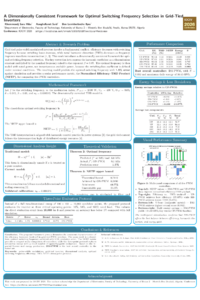
This work presents a comprehensive framework for analyzing and optimizing grid-tied inverters with a focus on the combined consideration of efficiency and harmonic distortion in their output waveforms. Using dimensional analysis, a physically consistent model for total harmonic distortion is developed, enabling accurate prediction of the optimal switching frequency for pulse-width modulation controllers with a prediction error of only 1.5% compared to full-scale numerical simulations. The study introduces a theoretical upper bound for the combined efficiency and distortion performance, quantifies unavoidable losses arising from filter inductance and magnetic core components, and evaluates five different pulse-width modulation controllers, comparing their efficiency, total harmonic distortion, daily energy delivery, and overall performance scores. Among the controllers tested, the best-performing solution achieves an overall performance score of 0.992 and delivers daily energy savings of 0.160 kWh, corresponding to a 0.97% improvement over the baseline. To address the high computational cost of conventional simulation sweeps, a three-point evaluation protocol is proposed, reducing the number of required simulations from 10,000 to 3, representing a 97% reduction while maintaining less than 1% deviation from full simulation results. The results demonstrate that the framework not only provides accurate, dimensionally consistent predictions of optimal switching frequencies and performance bounds but also enables quantitative assessment of efficiency–distortion trade-offs, practical guidance for controller selection, and substantial reductions in design and computational effort. This approach offers both theoretical insight and practical methodology for the design and optimization of high-performance grid-connected inverters using pulse-width modulation strategies, highlighting achievable gains in energy efficiency, waveform quality, and computational efficiency.
Keywords
Grid-tied inverters
Pulse-width modulation controllers
Efficiency optimization
Harmonic distortion
Dimensional analysis
Poster
Conf_IOVIC_Sara.pdf
Grid Resilience under Ultra-High Renewable Penetration
A Machine Learning–Enabled Energy Management Tool for Flexible Port Operations and DER Integration