Event submissions
Published
This submission belongs to the session S3. Energy system analysis and modelling of the event The 1st International Online Conference on Inventions
Published date
22 Jun, 2026
Academic Editor
'%3e%3cpath%20d='M12.6657%2010.9104C12.4185%2010.325%2012.0599%209.79327%2011.6097%209.34482C11.1609%208.89508%2010.6293%208.5365%2010.0442%208.28888C10.0389%208.28626%2010.0337%208.28495%2010.0285%208.28233C10.8446%207.69279%2011.3752%206.73249%2011.3752%205.64904C11.3752%203.8542%209.92103%202.39999%208.1262%202.39999C6.33136%202.39999%204.87715%203.8542%204.87715%205.64904C4.87715%206.73249%205.40774%207.69279%206.22393%208.28364C6.21869%208.28626%206.21345%208.28757%206.20821%208.29019C5.62129%208.5378%205.09463%208.89284%204.64265%209.34613C4.1929%209.79493%203.83432%2010.3266%203.58671%2010.9117C3.34345%2011.4845%203.21226%2012.0987%203.20023%2012.7209C3.19988%2012.7349%203.20233%2012.7488%203.20744%2012.7619C3.21255%2012.7749%203.22022%2012.7867%203.22998%2012.7968C3.23975%2012.8068%203.25142%2012.8147%203.26431%2012.8202C3.2772%2012.8256%203.29105%2012.8284%203.30504%2012.8284H4.09109C4.14874%2012.8284%204.19459%2012.7825%204.1959%2012.7262C4.2221%2011.7148%204.62823%2010.7676%205.34617%2010.0497C6.08899%209.30683%207.0755%208.89808%208.1262%208.89808C9.17689%208.89808%2010.1634%209.30683%2010.9062%2010.0497C11.6242%2010.7676%2012.0303%2011.7148%2012.0565%2012.7262C12.0578%2012.7838%2012.1037%2012.8284%2012.1613%2012.8284H12.9474C12.9613%2012.8284%2012.9752%2012.8256%2012.9881%2012.8202C13.001%2012.8147%2013.0126%2012.8068%2013.0224%2012.7968C13.0322%2012.7867%2013.0398%2012.7749%2013.0449%2012.7619C13.0501%2012.7488%2013.0525%2012.7349%2013.0522%2012.7209C13.0391%2012.0947%2012.9094%2011.4855%2012.6657%2010.9104ZM8.1262%207.9024C7.52486%207.9024%206.9589%207.6679%206.53312%207.24211C6.10733%206.81633%205.87283%206.25037%205.87283%205.64904C5.87283%205.0477%206.10733%204.48174%206.53312%204.05596C6.9589%203.63018%207.52486%203.39567%208.1262%203.39567C8.72753%203.39567%209.29349%203.63018%209.71927%204.05596C10.1451%204.48174%2010.3796%205.0477%2010.3796%205.64904C10.3796%206.25037%2010.1451%206.81633%209.71927%207.24211C9.29349%207.6679%208.72753%207.9024%208.1262%207.9024Z'%20fill='%235D1EE1'/%3e%3c/g%3e%3c/svg%3e) El Manaa Barhoumi
El Manaa BarhoumiCitation
María Jesús Millas Soria, Lina Montuori, Holistic Conceptualization of a Novel AI-Based Building Energy Management System for Positive Energy District Development, in Proceedings of The 1st International Online Conference on Inventions, 25 June–26 June 2026, MDPI: Basel, Switzerland
Share
Email
Facebook
Twitter
LinkedIn
Holistic Conceptualization of a Novel AI-Based Building Energy Management System for Positive Energy District Development

María Jesús Millas Soria 1

Lina Montuori 1
1. Institute for Energy Engineering, Universitat Politècnica de València, València, Spain
Abstract
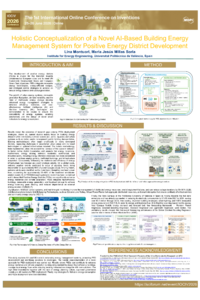
The development of positive energy districts (PEDs) is crucial for the transition towards climate-neutral European cities and meeting UN Sustainable Development Goals, European Green Deal objectives, the Mission on Carbon-Neutral and Smart Cities, and the Renovation Wave. PEDs integrate renewable energy technologies, energy-efficient designs, and intelligent control strategies to achieve an annual energy balance and surplus generation.
The growth of urban energy systems, renewable generation fluctuation, demand variability, and the need orf multi-scale energy storage requires advanced energy management strategies to enhance efficiency, resilience, and cost-effectiveness. Artificial intelligence (AI) techniques are demonstrated to be crucial to ensure the compatibility of energy systems, enabling automations and the design of novel smart indicators for energy consumption.
This study explores AI's role ino enhancing energy management systems, promoting PED development and identifying solutions to challenges. The holistic conceptualization of a novel AI-based Building Energy Management System (BEMS) was carried out. The tool provides an interactive platform to analyze and predict end-users’ patterns and promote social engagement in sustainability. It was carried out at the Vera Campus of the UPV. The designed conceptual framework was applied in 60 buildings among classrooms, offices, laboratories, data center, sport facilities, and one greenhouse. This campus hosts an academic community of more than 35,000 people, students, and staff. The main indicators for all kinds of energy consumption (electrical, natural gas, water consumption, and waste reuse) have been identified and calculated. The results show that the Vera Campus reduced its electricity consumption by 27.4% from 2021 to 2024, saving over €2.3 million through LEDs, free cooling, improved building envelopes, smart lighting, and 100% renewable energy procurement. Finally, key strategies for Net-zero energy consumption and PEDs have been identified.
Funded with Aid to First Research Projects (PAID-06-25) financed by the Vice-Rectorate for Research of the Universitat Politècnica de València (UPV)
Keywords
Positive Energy Districts (PED)
Artificial Intelligence (AI)
Building Energy Management System (BEMS)
Methodology
Energy consumption
Poster
ID 169631_Poster_Lina Monturi, Maria Jesus Millas_S3_250626.pdf
A Machine Learning–Enabled Energy Management Tool for Flexible Port Operations and DER Integration
Solar Energy Potential of Offshore Floating Photovoltaic Systems in the Black Sea and Its Application to Green Hydrogen Production