Event submissions
EventsThe 3rd International Online Conference on Corrosion and Materials Degradation
Published
This submission belongs to the session S1. Electrochemical Corrosion Mechanism at the Interface (Localized, Crevice, Advanced Characterization Techniques, EAC, Nanoscale) of the event The 3rd International Online Conference on Corrosion and Materials Degradation
Published date
25 Jun, 2026
Academic Editor
'%3e%3cpath%20d='M12.6657%2010.9104C12.4185%2010.325%2012.0599%209.79327%2011.6097%209.34482C11.1609%208.89508%2010.6293%208.5365%2010.0442%208.28888C10.0389%208.28626%2010.0337%208.28495%2010.0285%208.28233C10.8446%207.69279%2011.3752%206.73249%2011.3752%205.64904C11.3752%203.8542%209.92103%202.39999%208.1262%202.39999C6.33136%202.39999%204.87715%203.8542%204.87715%205.64904C4.87715%206.73249%205.40774%207.69279%206.22393%208.28364C6.21869%208.28626%206.21345%208.28757%206.20821%208.29019C5.62129%208.5378%205.09463%208.89284%204.64265%209.34613C4.1929%209.79493%203.83432%2010.3266%203.58671%2010.9117C3.34345%2011.4845%203.21226%2012.0987%203.20023%2012.7209C3.19988%2012.7349%203.20233%2012.7488%203.20744%2012.7619C3.21255%2012.7749%203.22022%2012.7867%203.22998%2012.7968C3.23975%2012.8068%203.25142%2012.8147%203.26431%2012.8202C3.2772%2012.8256%203.29105%2012.8284%203.30504%2012.8284H4.09109C4.14874%2012.8284%204.19459%2012.7825%204.1959%2012.7262C4.2221%2011.7148%204.62823%2010.7676%205.34617%2010.0497C6.08899%209.30683%207.0755%208.89808%208.1262%208.89808C9.17689%208.89808%2010.1634%209.30683%2010.9062%2010.0497C11.6242%2010.7676%2012.0303%2011.7148%2012.0565%2012.7262C12.0578%2012.7838%2012.1037%2012.8284%2012.1613%2012.8284H12.9474C12.9613%2012.8284%2012.9752%2012.8256%2012.9881%2012.8202C13.001%2012.8147%2013.0126%2012.8068%2013.0224%2012.7968C13.0322%2012.7867%2013.0398%2012.7749%2013.0449%2012.7619C13.0501%2012.7488%2013.0525%2012.7349%2013.0522%2012.7209C13.0391%2012.0947%2012.9094%2011.4855%2012.6657%2010.9104ZM8.1262%207.9024C7.52486%207.9024%206.9589%207.6679%206.53312%207.24211C6.10733%206.81633%205.87283%206.25037%205.87283%205.64904C5.87283%205.0477%206.10733%204.48174%206.53312%204.05596C6.9589%203.63018%207.52486%203.39567%208.1262%203.39567C8.72753%203.39567%209.29349%203.63018%209.71927%204.05596C10.1451%204.48174%2010.3796%205.0477%2010.3796%205.64904C10.3796%206.25037%2010.1451%206.81633%209.71927%207.24211C9.29349%207.6679%208.72753%207.9024%208.1262%207.9024Z'%20fill='%235D1EE1'/%3e%3c/g%3e%3c/svg%3e) David M. Bastidas
David M. BastidasCitation
Heshani Balasooriya, Shuhao Li, Chunqing Li, Feng Wang, Role of Surface Vacancies in Chloride‑Induced Corrosion of Fe(100), in Proceedings of The 3rd International Online Conference on Corrosion and Materials Degradation, 30 June–2 July 2026, MDPI: Basel, Switzerland
Share
Email
Facebook
Twitter
LinkedIn
Role of Surface Vacancies in Chloride‑Induced Corrosion of Fe(100)
'%3e%3cpath%20d='M12.6647%2010.9104C12.4176%2010.325%2012.0589%209.7933%2011.6088%209.34485C11.16%208.89511%2010.6283%208.53653%2010.0432%208.28891C10.038%208.28629%2010.0327%208.28498%2010.0275%208.28236C10.8437%207.69282%2011.3743%206.73252%2011.3743%205.64907C11.3743%203.85423%209.92005%202.40002%208.12522%202.40002C6.33038%202.40002%204.87618%203.85423%204.87618%205.64907C4.87618%206.73252%205.40677%207.69282%206.22296%208.28367C6.21772%208.28629%206.21248%208.2876%206.20724%208.29022C5.62031%208.53783%205.09365%208.89287%204.64167%209.34616C4.19192%209.79496%203.83334%2010.3266%203.58573%2010.9117C3.34247%2011.4846%203.21128%2012.0987%203.19925%2012.721C3.1989%2012.735%203.20135%2012.7489%203.20646%2012.7619C3.21157%2012.7749%203.21924%2012.7868%203.22901%2012.7968C3.23877%2012.8068%203.25045%2012.8148%203.26334%2012.8202C3.27623%2012.8256%203.29007%2012.8284%203.30406%2012.8284H4.09012C4.14776%2012.8284%204.19362%2012.7825%204.19493%2012.7262C4.22113%2011.7148%204.62726%2010.7676%205.34519%2010.0497C6.08802%209.30686%207.07452%208.89811%208.12522%208.89811C9.17592%208.89811%2010.1624%209.30686%2010.9052%2010.0497C11.6232%2010.7676%2012.0293%2011.7148%2012.0555%2012.7262C12.0568%2012.7839%2012.1027%2012.8284%2012.1603%2012.8284H12.9464C12.9604%2012.8284%2012.9742%2012.8256%2012.9871%2012.8202C13%2012.8148%2013.0117%2012.8068%2013.0214%2012.7968C13.0312%2012.7868%2013.0389%2012.7749%2013.044%2012.7619C13.0491%2012.7489%2013.0515%2012.735%2013.0512%2012.721C13.0381%2012.0947%2012.9084%2011.4856%2012.6647%2010.9104ZM8.12522%207.90243C7.52388%207.90243%206.95792%207.66793%206.53214%207.24215C6.10636%206.81636%205.87185%206.2504%205.87185%205.64907C5.87185%205.04773%206.10636%204.48177%206.53214%204.05599C6.95792%203.63021%207.52388%203.3957%208.12522%203.3957C8.72655%203.3957%209.29252%203.63021%209.7183%204.05599C10.1441%204.48177%2010.3786%205.04773%2010.3786%205.64907C10.3786%206.2504%2010.1441%206.81636%209.7183%207.24215C9.29252%207.66793%208.72655%207.90243%208.12522%207.90243Z'%20fill='%235D1EE1'/%3e%3c/g%3e%3c/svg%3e)
Heshani Balasooriya 1
Shuhao Li 1

Chunqing Li 2

Feng Wang 1
1. School of Science, Computing and Emerging Technologies, Swinburne University of Technology, Melbourne, Victoria 3122, Australia
2. School of Engineering, RMIT University, Melbourne, Vic 3000, Australia.
Abstract
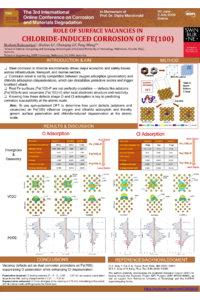
Steel corrosion presents significant economic, environmental, and safety challenges, particularly in chloride‑rich environments. At the atomic level, corrosion arises from competition between protective oxygen adsorption and chloride‑driven depassivation. Although these processes are well characterised on ideal Fe surfaces, the role of surface defects in modulating this balance remains poorly understood. In this study, spin‑polarised density functional theory (DFT) calculations were used to systematically examine defect-controlled corrosion reactivity on the Fe(100) surface. Three surface models are considered: pristine Fe(100) (Fe(100)-P), adatom‑modified Fe(100) (Fe(100)-A), and vacancy‑defective Fe(100) (Fe(100)-V). Adsorption energies and electronic structures are computed to quantify defect-driven changes in O‑ and Cl‑binding at the most stable sites. Oxygen adsorption is found to be strongest on the pristine surface, consistent with effective passivation (Fe(100)-P > Fe(100)-A > Fe(100)-V). Vacancy defects markedly weaken O binding, suppressing protective oxide film formation, while adatoms have only a minor influence. In contrast, Cl adsorption is significantly enhanced at vacancy sites (Fe(100)-V > Fe(100)-P > Fe(100)-A), identifying vacancies as preferential Cl‑accumulation sites that accelerate passive‑film breakdown. These findings establish vacancy defects as dual corrosion promoters that simultaneously hinder passivation and enhance Cl‑induced depassivation. Detailed atomistic and mechanistic analysis of these defect effects will be presented, offering practical guidance for defect-engineered alloy design and advanced surface treatment strategies to achieve superior corrosion resistance.
Keywords
Steel corrosion
Surface defects
Chloride induced depassivation
Density functional theory (DFT)
and Vacancy defects
Poster
Poster PPT_CMD.pdf
Size-Dependent Structural Evolution of Fe(OH)3 Oligomers from Dimer to Decamer: A Quantum Mechanical Search toward Early Corrosion Products
Mo-Driven Transition in Passivation and Localized Corrosion of Fe–9Cr–xMo Alloys: From Enhanced Film Stability to Heterogeneity-Assisted Breakdown