Event submissions
EventsThe 3rd International Online Conference on Corrosion and Materials Degradation
Published
This submission belongs to the session S3. Surface Treatments and Coatings for Corrosion Protection of the event The 3rd International Online Conference on Corrosion and Materials Degradation
Published date
25 Jun, 2026
Academic Editor
'%3e%3cpath%20d='M12.6657%2010.9104C12.4185%2010.325%2012.0599%209.79327%2011.6097%209.34482C11.1609%208.89508%2010.6293%208.5365%2010.0442%208.28888C10.0389%208.28626%2010.0337%208.28495%2010.0285%208.28233C10.8446%207.69279%2011.3752%206.73249%2011.3752%205.64904C11.3752%203.8542%209.92103%202.39999%208.1262%202.39999C6.33136%202.39999%204.87715%203.8542%204.87715%205.64904C4.87715%206.73249%205.40774%207.69279%206.22393%208.28364C6.21869%208.28626%206.21345%208.28757%206.20821%208.29019C5.62129%208.5378%205.09463%208.89284%204.64265%209.34613C4.1929%209.79493%203.83432%2010.3266%203.58671%2010.9117C3.34345%2011.4845%203.21226%2012.0987%203.20023%2012.7209C3.19988%2012.7349%203.20233%2012.7488%203.20744%2012.7619C3.21255%2012.7749%203.22022%2012.7867%203.22998%2012.7968C3.23975%2012.8068%203.25142%2012.8147%203.26431%2012.8202C3.2772%2012.8256%203.29105%2012.8284%203.30504%2012.8284H4.09109C4.14874%2012.8284%204.19459%2012.7825%204.1959%2012.7262C4.2221%2011.7148%204.62823%2010.7676%205.34617%2010.0497C6.08899%209.30683%207.0755%208.89808%208.1262%208.89808C9.17689%208.89808%2010.1634%209.30683%2010.9062%2010.0497C11.6242%2010.7676%2012.0303%2011.7148%2012.0565%2012.7262C12.0578%2012.7838%2012.1037%2012.8284%2012.1613%2012.8284H12.9474C12.9613%2012.8284%2012.9752%2012.8256%2012.9881%2012.8202C13.001%2012.8147%2013.0126%2012.8068%2013.0224%2012.7968C13.0322%2012.7867%2013.0398%2012.7749%2013.0449%2012.7619C13.0501%2012.7488%2013.0525%2012.7349%2013.0522%2012.7209C13.0391%2012.0947%2012.9094%2011.4855%2012.6657%2010.9104ZM8.1262%207.9024C7.52486%207.9024%206.9589%207.6679%206.53312%207.24211C6.10733%206.81633%205.87283%206.25037%205.87283%205.64904C5.87283%205.0477%206.10733%204.48174%206.53312%204.05596C6.9589%203.63018%207.52486%203.39567%208.1262%203.39567C8.72753%203.39567%209.29349%203.63018%209.71927%204.05596C10.1451%204.48174%2010.3796%205.0477%2010.3796%205.64904C10.3796%206.25037%2010.1451%206.81633%209.71927%207.24211C9.29349%207.6679%208.72753%207.9024%208.1262%207.9024Z'%20fill='%235D1EE1'/%3e%3c/g%3e%3c/svg%3e) Viswanathan Saji
Viswanathan SajiCitation
Raja Naveen Varma Kucharlapati, Susanta Sinha Roy, Electrochemical Impedance Spectroscopy Study of Corrosion Resistance of RF-Sputtered Titania Thin-Film-Coated SS316 in 3.5 wt.% NaCl, in Proceedings of The 3rd International Online Conference on Corrosion and Materials Degradation, 30 June–2 July 2026, MDPI: Basel, Switzerland
Share
Email
Facebook
Twitter
LinkedIn
Electrochemical Impedance Spectroscopy Study of Corrosion Resistance of RF-Sputtered Titania Thin-Film-Coated SS316 in 3.5 wt.% NaCl

Raja Naveen Varma Kucharlapati 1
'%3e%3cpath%20d='M12.6647%2010.9104C12.4176%2010.325%2012.0589%209.7933%2011.6088%209.34485C11.16%208.89511%2010.6283%208.53653%2010.0432%208.28891C10.038%208.28629%2010.0327%208.28498%2010.0275%208.28236C10.8437%207.69282%2011.3743%206.73252%2011.3743%205.64907C11.3743%203.85423%209.92005%202.40002%208.12522%202.40002C6.33038%202.40002%204.87618%203.85423%204.87618%205.64907C4.87618%206.73252%205.40677%207.69282%206.22296%208.28367C6.21772%208.28629%206.21248%208.2876%206.20724%208.29022C5.62031%208.53783%205.09365%208.89287%204.64167%209.34616C4.19192%209.79496%203.83334%2010.3266%203.58573%2010.9117C3.34247%2011.4846%203.21128%2012.0987%203.19925%2012.721C3.1989%2012.735%203.20135%2012.7489%203.20646%2012.7619C3.21157%2012.7749%203.21924%2012.7868%203.22901%2012.7968C3.23877%2012.8068%203.25045%2012.8148%203.26334%2012.8202C3.27623%2012.8256%203.29007%2012.8284%203.30406%2012.8284H4.09012C4.14776%2012.8284%204.19362%2012.7825%204.19493%2012.7262C4.22113%2011.7148%204.62726%2010.7676%205.34519%2010.0497C6.08802%209.30686%207.07452%208.89811%208.12522%208.89811C9.17592%208.89811%2010.1624%209.30686%2010.9052%2010.0497C11.6232%2010.7676%2012.0293%2011.7148%2012.0555%2012.7262C12.0568%2012.7839%2012.1027%2012.8284%2012.1603%2012.8284H12.9464C12.9604%2012.8284%2012.9742%2012.8256%2012.9871%2012.8202C13%2012.8148%2013.0117%2012.8068%2013.0214%2012.7968C13.0312%2012.7868%2013.0389%2012.7749%2013.044%2012.7619C13.0491%2012.7489%2013.0515%2012.735%2013.0512%2012.721C13.0381%2012.0947%2012.9084%2011.4856%2012.6647%2010.9104ZM8.12522%207.90243C7.52388%207.90243%206.95792%207.66793%206.53214%207.24215C6.10636%206.81636%205.87185%206.2504%205.87185%205.64907C5.87185%205.04773%206.10636%204.48177%206.53214%204.05599C6.95792%203.63021%207.52388%203.3957%208.12522%203.3957C8.72655%203.3957%209.29252%203.63021%209.7183%204.05599C10.1441%204.48177%2010.3786%205.04773%2010.3786%205.64907C10.3786%206.2504%2010.1441%206.81636%209.7183%207.24215C9.29252%207.66793%208.72655%207.90243%208.12522%207.90243Z'%20fill='%235D1EE1'/%3e%3c/g%3e%3c/svg%3e)
Susanta Sinha Roy 2
1. Rohrback Cosasco Systems Inc, Santa Fe Springs, CA 90650, USA
2. Department of Physics, School of Natural Sciences, Shiv Nadar Institution of Eminence (SNIoE), Greater Noida 201314, Uttar Pradesh, India
Abstract
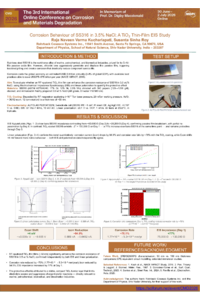
Corrosion of stainless steel in chloride-containing environments remains a critical challenge for industrial applications, particularly in marine, chemical processing, and oil and gas systems, necessitating durable protection strategies. In this study, the corrosion behavior of AISI SS316 in 3.5 wt.% NaCl solution was investigated before and after application of titanium dioxide (TiO₂) thin-film coatings deposited using radiofrequency sputtering. The objective of this work was to evaluate the influence of a thin-film barrier on the electrochemical response and corrosion kinetics of stainless steel exposed to a simulated seawater environment.
Electrochemical Impedance Spectroscopy (EIS) and linear polarization techniques were employed to assess corrosion resistance and mechanisms of bare and coated specimens. Impedance measurements were conducted over a frequency range of 0.1 Hz to 1 MHz to evaluate coating integrity, charge transfer resistance, and capacitive behavior at the metal–electrolyte interface. Corrosion rates were determined using polarization resistance measurements and Tafel extrapolation methods to quantify kinetic parameters.
The EIS results demonstrated a significant increase in impedance and charge transfer resistance for TiO₂-coated SS316 compared to the uncoated substrate, indicating improved barrier properties and reduced electrochemical activity in chloride-rich solution. Linear polarization data confirmed a reduction in corrosion rate for coated specimens, validating the protective effectiveness of TiO₂ thin-film. Enhanced corrosion resistance is attributed to the formation of a dense and chemically inert TiO₂ layer that restricts electrolyte penetration and suppresses anodic and cathodic reactions on the stainless steel surface. The TiO₂ thin film also acts as a diffusion barrier limiting oxygen transport to the metal surface, reducing electrochemical activity at the metal–electrolyte interface. This behavior is relevant in chloride environments where localized corrosion mechanisms, including crevice corrosion, may be influenced by oxygen availability.
These findings highlight the potential of RF-sputtered TiO₂ thin-film coatings as a durable corrosion protection strategy for stainless steel components operating in chloride-containing environments.
Keywords
Stainless steel 316
TiO₂ thin film coating
Corrosion resistance
Electrochemical impedance spectroscopy
Linear polarization
Chloride environment
Poster
173601.pdf
Investigation of Binary and Ternary Ni-Based Alloys for High-Temperature Petrochemical Coating Applications
Research Progress on LDHs@MXene Self-healing Composite Coatings