Event submissions
EventsThe 3rd International Online Conference on Corrosion and Materials Degradation
Published
This submission belongs to the session S3. Surface Treatments and Coatings for Corrosion Protection of the event The 3rd International Online Conference on Corrosion and Materials Degradation
Published date
25 Jun, 2026
Academic Editor
'%3e%3cpath%20d='M12.6657%2010.9104C12.4185%2010.325%2012.0599%209.79327%2011.6097%209.34482C11.1609%208.89508%2010.6293%208.5365%2010.0442%208.28888C10.0389%208.28626%2010.0337%208.28495%2010.0285%208.28233C10.8446%207.69279%2011.3752%206.73249%2011.3752%205.64904C11.3752%203.8542%209.92103%202.39999%208.1262%202.39999C6.33136%202.39999%204.87715%203.8542%204.87715%205.64904C4.87715%206.73249%205.40774%207.69279%206.22393%208.28364C6.21869%208.28626%206.21345%208.28757%206.20821%208.29019C5.62129%208.5378%205.09463%208.89284%204.64265%209.34613C4.1929%209.79493%203.83432%2010.3266%203.58671%2010.9117C3.34345%2011.4845%203.21226%2012.0987%203.20023%2012.7209C3.19988%2012.7349%203.20233%2012.7488%203.20744%2012.7619C3.21255%2012.7749%203.22022%2012.7867%203.22998%2012.7968C3.23975%2012.8068%203.25142%2012.8147%203.26431%2012.8202C3.2772%2012.8256%203.29105%2012.8284%203.30504%2012.8284H4.09109C4.14874%2012.8284%204.19459%2012.7825%204.1959%2012.7262C4.2221%2011.7148%204.62823%2010.7676%205.34617%2010.0497C6.08899%209.30683%207.0755%208.89808%208.1262%208.89808C9.17689%208.89808%2010.1634%209.30683%2010.9062%2010.0497C11.6242%2010.7676%2012.0303%2011.7148%2012.0565%2012.7262C12.0578%2012.7838%2012.1037%2012.8284%2012.1613%2012.8284H12.9474C12.9613%2012.8284%2012.9752%2012.8256%2012.9881%2012.8202C13.001%2012.8147%2013.0126%2012.8068%2013.0224%2012.7968C13.0322%2012.7867%2013.0398%2012.7749%2013.0449%2012.7619C13.0501%2012.7488%2013.0525%2012.7349%2013.0522%2012.7209C13.0391%2012.0947%2012.9094%2011.4855%2012.6657%2010.9104ZM8.1262%207.9024C7.52486%207.9024%206.9589%207.6679%206.53312%207.24211C6.10733%206.81633%205.87283%206.25037%205.87283%205.64904C5.87283%205.0477%206.10733%204.48174%206.53312%204.05596C6.9589%203.63018%207.52486%203.39567%208.1262%203.39567C8.72753%203.39567%209.29349%203.63018%209.71927%204.05596C10.1451%204.48174%2010.3796%205.0477%2010.3796%205.64904C10.3796%206.25037%2010.1451%206.81633%209.71927%207.24211C9.29349%207.6679%208.72753%207.9024%208.1262%207.9024Z'%20fill='%235D1EE1'/%3e%3c/g%3e%3c/svg%3e) Viswanathan Saji
Viswanathan SajiCitation
Svetlana Boshnakova, Pitting Corrosion Restoration Solution for Thick Pipe by Additive Manufacturing , in Proceedings of The 3rd International Online Conference on Corrosion and Materials Degradation, 30 June–2 July 2026, MDPI: Basel, Switzerland
Share
Email
Facebook
Twitter
LinkedIn
Pitting Corrosion Restoration Solution for Thick Pipe by Additive Manufacturing
'%3e%3cpath%20d='M12.6647%2010.9104C12.4176%2010.325%2012.0589%209.7933%2011.6088%209.34485C11.16%208.89511%2010.6283%208.53653%2010.0432%208.28891C10.038%208.28629%2010.0327%208.28498%2010.0275%208.28236C10.8437%207.69282%2011.3743%206.73252%2011.3743%205.64907C11.3743%203.85423%209.92005%202.40002%208.12522%202.40002C6.33038%202.40002%204.87618%203.85423%204.87618%205.64907C4.87618%206.73252%205.40677%207.69282%206.22296%208.28367C6.21772%208.28629%206.21248%208.2876%206.20724%208.29022C5.62031%208.53783%205.09365%208.89287%204.64167%209.34616C4.19192%209.79496%203.83334%2010.3266%203.58573%2010.9117C3.34247%2011.4846%203.21128%2012.0987%203.19925%2012.721C3.1989%2012.735%203.20135%2012.7489%203.20646%2012.7619C3.21157%2012.7749%203.21924%2012.7868%203.22901%2012.7968C3.23877%2012.8068%203.25045%2012.8148%203.26334%2012.8202C3.27623%2012.8256%203.29007%2012.8284%203.30406%2012.8284H4.09012C4.14776%2012.8284%204.19362%2012.7825%204.19493%2012.7262C4.22113%2011.7148%204.62726%2010.7676%205.34519%2010.0497C6.08802%209.30686%207.07452%208.89811%208.12522%208.89811C9.17592%208.89811%2010.1624%209.30686%2010.9052%2010.0497C11.6232%2010.7676%2012.0293%2011.7148%2012.0555%2012.7262C12.0568%2012.7839%2012.1027%2012.8284%2012.1603%2012.8284H12.9464C12.9604%2012.8284%2012.9742%2012.8256%2012.9871%2012.8202C13%2012.8148%2013.0117%2012.8068%2013.0214%2012.7968C13.0312%2012.7868%2013.0389%2012.7749%2013.044%2012.7619C13.0491%2012.7489%2013.0515%2012.735%2013.0512%2012.721C13.0381%2012.0947%2012.9084%2011.4856%2012.6647%2010.9104ZM8.12522%207.90243C7.52388%207.90243%206.95792%207.66793%206.53214%207.24215C6.10636%206.81636%205.87185%206.2504%205.87185%205.64907C5.87185%205.04773%206.10636%204.48177%206.53214%204.05599C6.95792%203.63021%207.52388%203.3957%208.12522%203.3957C8.72655%203.3957%209.29252%203.63021%209.7183%204.05599C10.1441%204.48177%2010.3786%205.04773%2010.3786%205.64907C10.3786%206.2504%2010.1441%206.81636%209.7183%207.24215C9.29252%207.66793%208.72655%207.90243%208.12522%207.90243Z'%20fill='%235D1EE1'/%3e%3c/g%3e%3c/svg%3e)
Svetlana Boshnakova 1
1. Center of Competence “Intelligent Mechatronic, Eco- and Energy-Saving Systems and Technologies”, Technical University Sofia, branch Plovdiv, 4000 Plovdiv, Bulgaria.
Abstract
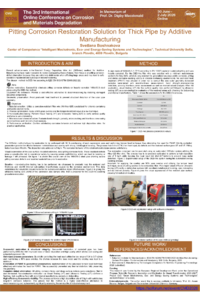
Introduction: Recent advancements in the Directed Energy Deposition Wire Arc (DED-Arc) method for Additive Manufacturing have made it possible to restore damaged surfaces of pipes. Main focus is on pitting corrosion defect elimination because they are extremely detrimental when affecting large areas and may lead to safe operation impairment and subsequent decommissioning.
Method: A pipe made of 14MoV6-3 (1.7715 according to EN 10027) material sustained pitting and was heavily corroded. For the DED-Arc, filler wire was selected with a minimum molybdenum content (Ni-Alloy 625), which is very resistant to generalized aqueous acidic corrosion, pitting and stress corrosion cracking (SCC) in chloride-containing environments. No post-weld heat treatment (PWHT) was allowed in order not to corrupt the pipe outer geometry. Extracted samples were tested with microhardness measurement: bond strength, microcracking detection, porosity, interface zones assessment as well as microstructural analysis. After the application, visual testing (VT) for the surface quality was performed followed by ultrasonic testing (UT) as a non-destructive evaluation of the restored areas with checking for disbonding and internal imperfections.
Results: The DED-Arc method allows the restoration to be performed with 50 % overlapping of each successive pass and performing temper beat technique thus eliminating the need for PWHT. Strictly controlled parameters provide low dilution between material base and overlay with strong metallurgical bonding. The process has 0.4 to 0.7 KJ/mm heat input, no defects and the restored surface pass UT and VT. Pitting holes have been filled in. The deposition rate achieved is 5 kg/h. The corrosion behavior of the obtained cladded pipe proves satisfactory.
Conclusion: Successful restoration of corroded pipe has been performed by DED-Arc with improved rates of metal deposition and high quality which allow cost saving and extended equipment life.
Funding: The author acknowledges support from project BG16RFPR002-1.014-0005.
Keywords
Additive Manufacturing
Directed Energy Deposition
Corrosion
Poster
Svetlana Boshnakova.pdf
Nanosecond Laser Texturing of Triple-Scale Surface Structuring for Robust Pitting Corrosion Resistance in AA6061
Multifunctional Ionic Polymer Coatings with Self-Healing and Photocatalytic Activity for Aluminum Alloy Corrosion Protection