Event submissions
EventsThe 3rd International Online Conference on Corrosion and Materials Degradation
Published
This submission belongs to the session S3. Surface Treatments and Coatings for Corrosion Protection of the event The 3rd International Online Conference on Corrosion and Materials Degradation
Published date
25 Jun, 2026
Academic Editor
'%3e%3cpath%20d='M12.6657%2010.9104C12.4185%2010.325%2012.0599%209.79327%2011.6097%209.34482C11.1609%208.89508%2010.6293%208.5365%2010.0442%208.28888C10.0389%208.28626%2010.0337%208.28495%2010.0285%208.28233C10.8446%207.69279%2011.3752%206.73249%2011.3752%205.64904C11.3752%203.8542%209.92103%202.39999%208.1262%202.39999C6.33136%202.39999%204.87715%203.8542%204.87715%205.64904C4.87715%206.73249%205.40774%207.69279%206.22393%208.28364C6.21869%208.28626%206.21345%208.28757%206.20821%208.29019C5.62129%208.5378%205.09463%208.89284%204.64265%209.34613C4.1929%209.79493%203.83432%2010.3266%203.58671%2010.9117C3.34345%2011.4845%203.21226%2012.0987%203.20023%2012.7209C3.19988%2012.7349%203.20233%2012.7488%203.20744%2012.7619C3.21255%2012.7749%203.22022%2012.7867%203.22998%2012.7968C3.23975%2012.8068%203.25142%2012.8147%203.26431%2012.8202C3.2772%2012.8256%203.29105%2012.8284%203.30504%2012.8284H4.09109C4.14874%2012.8284%204.19459%2012.7825%204.1959%2012.7262C4.2221%2011.7148%204.62823%2010.7676%205.34617%2010.0497C6.08899%209.30683%207.0755%208.89808%208.1262%208.89808C9.17689%208.89808%2010.1634%209.30683%2010.9062%2010.0497C11.6242%2010.7676%2012.0303%2011.7148%2012.0565%2012.7262C12.0578%2012.7838%2012.1037%2012.8284%2012.1613%2012.8284H12.9474C12.9613%2012.8284%2012.9752%2012.8256%2012.9881%2012.8202C13.001%2012.8147%2013.0126%2012.8068%2013.0224%2012.7968C13.0322%2012.7867%2013.0398%2012.7749%2013.0449%2012.7619C13.0501%2012.7488%2013.0525%2012.7349%2013.0522%2012.7209C13.0391%2012.0947%2012.9094%2011.4855%2012.6657%2010.9104ZM8.1262%207.9024C7.52486%207.9024%206.9589%207.6679%206.53312%207.24211C6.10733%206.81633%205.87283%206.25037%205.87283%205.64904C5.87283%205.0477%206.10733%204.48174%206.53312%204.05596C6.9589%203.63018%207.52486%203.39567%208.1262%203.39567C8.72753%203.39567%209.29349%203.63018%209.71927%204.05596C10.1451%204.48174%2010.3796%205.0477%2010.3796%205.64904C10.3796%206.25037%2010.1451%206.81633%209.71927%207.24211C9.29349%207.6679%208.72753%207.9024%208.1262%207.9024Z'%20fill='%235D1EE1'/%3e%3c/g%3e%3c/svg%3e) Viswanathan Saji
Viswanathan SajiCitation
Yutao Tian, Zhengxun Zhou, Hongming Gu, Huaxian Feng, Pengji Li, Sixing Guo, Zehan Chen, Dapeng Zhang, Surface Treatments and Coatings for Corrosion Protection in Deep-Sea Marine Ranching Equipment, in Proceedings of The 3rd International Online Conference on Corrosion and Materials Degradation, 30 June–2 July 2026, MDPI: Basel, Switzerland
Share
Email
Facebook
Twitter
LinkedIn
Surface Treatments and Coatings for Corrosion Protection in Deep-Sea Marine Ranching Equipment
'%3e%3cpath%20d='M12.6647%2010.9104C12.4176%2010.325%2012.0589%209.7933%2011.6088%209.34485C11.16%208.89511%2010.6283%208.53653%2010.0432%208.28891C10.038%208.28629%2010.0327%208.28498%2010.0275%208.28236C10.8437%207.69282%2011.3743%206.73252%2011.3743%205.64907C11.3743%203.85423%209.92005%202.40002%208.12522%202.40002C6.33038%202.40002%204.87618%203.85423%204.87618%205.64907C4.87618%206.73252%205.40677%207.69282%206.22296%208.28367C6.21772%208.28629%206.21248%208.2876%206.20724%208.29022C5.62031%208.53783%205.09365%208.89287%204.64167%209.34616C4.19192%209.79496%203.83334%2010.3266%203.58573%2010.9117C3.34247%2011.4846%203.21128%2012.0987%203.19925%2012.721C3.1989%2012.735%203.20135%2012.7489%203.20646%2012.7619C3.21157%2012.7749%203.21924%2012.7868%203.22901%2012.7968C3.23877%2012.8068%203.25045%2012.8148%203.26334%2012.8202C3.27623%2012.8256%203.29007%2012.8284%203.30406%2012.8284H4.09012C4.14776%2012.8284%204.19362%2012.7825%204.19493%2012.7262C4.22113%2011.7148%204.62726%2010.7676%205.34519%2010.0497C6.08802%209.30686%207.07452%208.89811%208.12522%208.89811C9.17592%208.89811%2010.1624%209.30686%2010.9052%2010.0497C11.6232%2010.7676%2012.0293%2011.7148%2012.0555%2012.7262C12.0568%2012.7839%2012.1027%2012.8284%2012.1603%2012.8284H12.9464C12.9604%2012.8284%2012.9742%2012.8256%2012.9871%2012.8202C13%2012.8148%2013.0117%2012.8068%2013.0214%2012.7968C13.0312%2012.7868%2013.0389%2012.7749%2013.044%2012.7619C13.0491%2012.7489%2013.0515%2012.735%2013.0512%2012.721C13.0381%2012.0947%2012.9084%2011.4856%2012.6647%2010.9104ZM8.12522%207.90243C7.52388%207.90243%206.95792%207.66793%206.53214%207.24215C6.10636%206.81636%205.87185%206.2504%205.87185%205.64907C5.87185%205.04773%206.10636%204.48177%206.53214%204.05599C6.95792%203.63021%207.52388%203.3957%208.12522%203.3957C8.72655%203.3957%209.29252%203.63021%209.7183%204.05599C10.1441%204.48177%2010.3786%205.04773%2010.3786%205.64907C10.3786%206.2504%2010.1441%206.81636%209.7183%207.24215C9.29252%207.66793%208.72655%207.90243%208.12522%207.90243Z'%20fill='%235D1EE1'/%3e%3c/g%3e%3c/svg%3e)
Yutao Tian 1
Zhengxun Zhou 1
Hongming Gu 1
Huaxian Feng 1
Pengji Li 2
Sixing Guo 1
Zehan Chen 1
Dapeng Zhang 1
1. Ship and Maritime College, Guangdong Ocean University, Guangdong, Zhanjiang, 524088, China
2. College of Ocean Engineering and Energy, Guangdong Ocean University, Guangdong, Zhanjiang, 524088, China
Abstract
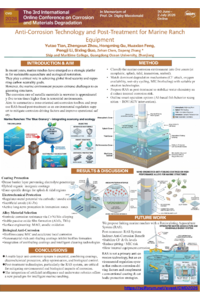
With the intensification of coastal water pollution and the increasing pressure on nearshore resources, marine aquaculture is gradually shifting toward offshore and deep-sea environments. Deep-sea aquaculture facilities are required to operate for extended periods under complex marine conditions, including high salinity, fluctuating dissolved oxygen levels, and severe biofouling. Therefore, the development of effective structural corrosion protection technologies for deep and far-sea aquaculture equipment is of critical importance. Among these technologies, surface treatment and protective coating systems play a pivotal role in mitigating and delaying corrosion-related degradation at material surfaces and interfaces, which govern most corrosion phenomena. Studies have shown that corrosion mechanisms and rates vary significantly with water depth and environmental conditions. In deep-water zones, reduced dissolved oxygen concentrations may inhibit oxygen-dependent electrochemical corrosion processes, while simultaneously promoting sulfide-induced corrosion. Under anaerobic conditions, the activity of microorganisms, such as sulfate-reducing bacteria, is enhanced, posing a serious threat to coating integrity and interfacial stability. In contrast, nearshore environments are more susceptible to photochemical reactions and intense biofouling due to higher light availability, which accelerates coating degradation and increases the risk of localized corrosion at surface defects. In response to these challenges, this study focuses on surface treatment strategies and advanced coating technologies for deep-sea aquaculture equipment, along with a comprehensive discussion of complementary corrosion protection methods. The aim of this paper is to develop an integrated corrosion prevention strategy based on coating protection in conjunction with other protective techniques, thereby reducing corrosion damage to marine ranching facilities and addressing the harmful by-products generated during corrosion processes. By systematically analyzing the surface and interfacial degradation behaviors of marine aquaculture equipment, this research provides practical guidance for the design of durable and environmentally adaptive surface protection systems, contributing to the sustainable development of deep-sea aquaculture infrastructure.
Keywords
Deep-sea aquaculture facilities
Structural corrosion protection
Surface treatment
Coating protection
Poster
Postertyt (1).pdf
Corrosion Resistance and Functional Properties of Particle-Modified Plasma Electrolytic Oxidation Coatings on Metals
Forged and nitrided 316L stainless steel to mitigate corrosion in heat exchangers for water purification processes.