Event submissions
EventsThe 3rd International Online Conference on Corrosion and Materials Degradation
Published
This submission belongs to the session S5. Corrosion in Biomedical Implants of the event The 3rd International Online Conference on Corrosion and Materials Degradation
Published date
25 Jun, 2026
Academic Editor
'%3e%3cpath%20d='M12.6657%2010.9104C12.4185%2010.325%2012.0599%209.79327%2011.6097%209.34482C11.1609%208.89508%2010.6293%208.5365%2010.0442%208.28888C10.0389%208.28626%2010.0337%208.28495%2010.0285%208.28233C10.8446%207.69279%2011.3752%206.73249%2011.3752%205.64904C11.3752%203.8542%209.92103%202.39999%208.1262%202.39999C6.33136%202.39999%204.87715%203.8542%204.87715%205.64904C4.87715%206.73249%205.40774%207.69279%206.22393%208.28364C6.21869%208.28626%206.21345%208.28757%206.20821%208.29019C5.62129%208.5378%205.09463%208.89284%204.64265%209.34613C4.1929%209.79493%203.83432%2010.3266%203.58671%2010.9117C3.34345%2011.4845%203.21226%2012.0987%203.20023%2012.7209C3.19988%2012.7349%203.20233%2012.7488%203.20744%2012.7619C3.21255%2012.7749%203.22022%2012.7867%203.22998%2012.7968C3.23975%2012.8068%203.25142%2012.8147%203.26431%2012.8202C3.2772%2012.8256%203.29105%2012.8284%203.30504%2012.8284H4.09109C4.14874%2012.8284%204.19459%2012.7825%204.1959%2012.7262C4.2221%2011.7148%204.62823%2010.7676%205.34617%2010.0497C6.08899%209.30683%207.0755%208.89808%208.1262%208.89808C9.17689%208.89808%2010.1634%209.30683%2010.9062%2010.0497C11.6242%2010.7676%2012.0303%2011.7148%2012.0565%2012.7262C12.0578%2012.7838%2012.1037%2012.8284%2012.1613%2012.8284H12.9474C12.9613%2012.8284%2012.9752%2012.8256%2012.9881%2012.8202C13.001%2012.8147%2013.0126%2012.8068%2013.0224%2012.7968C13.0322%2012.7867%2013.0398%2012.7749%2013.0449%2012.7619C13.0501%2012.7488%2013.0525%2012.7349%2013.0522%2012.7209C13.0391%2012.0947%2012.9094%2011.4855%2012.6657%2010.9104ZM8.1262%207.9024C7.52486%207.9024%206.9589%207.6679%206.53312%207.24211C6.10733%206.81633%205.87283%206.25037%205.87283%205.64904C5.87283%205.0477%206.10733%204.48174%206.53312%204.05596C6.9589%203.63018%207.52486%203.39567%208.1262%203.39567C8.72753%203.39567%209.29349%203.63018%209.71927%204.05596C10.1451%204.48174%2010.3796%205.0477%2010.3796%205.64904C10.3796%206.25037%2010.1451%206.81633%209.71927%207.24211C9.29349%207.6679%208.72753%207.9024%208.1262%207.9024Z'%20fill='%235D1EE1'/%3e%3c/g%3e%3c/svg%3e) Angeliki G. Lekatou
Angeliki G. LekatouCitation
Fatemeh Akhlaghi, Nader Parvin, Ahmad Bahmani, Bahzad Nayebi, Investigation of Biodegradability of Wrought Mg-Ca-Mn Alloy as a Potential Material for Urological Applications, in Proceedings of The 3rd International Online Conference on Corrosion and Materials Degradation, 30 June–2 July 2026, MDPI: Basel, Switzerland
Share
Email
Facebook
Twitter
LinkedIn
Investigation of Biodegradability of Wrought Mg-Ca-Mn Alloy as a Potential Material for Urological Applications
'%3e%3cpath%20d='M12.6647%2010.9104C12.4176%2010.325%2012.0589%209.7933%2011.6088%209.34485C11.16%208.89511%2010.6283%208.53653%2010.0432%208.28891C10.038%208.28629%2010.0327%208.28498%2010.0275%208.28236C10.8437%207.69282%2011.3743%206.73252%2011.3743%205.64907C11.3743%203.85423%209.92005%202.40002%208.12522%202.40002C6.33038%202.40002%204.87618%203.85423%204.87618%205.64907C4.87618%206.73252%205.40677%207.69282%206.22296%208.28367C6.21772%208.28629%206.21248%208.2876%206.20724%208.29022C5.62031%208.53783%205.09365%208.89287%204.64167%209.34616C4.19192%209.79496%203.83334%2010.3266%203.58573%2010.9117C3.34247%2011.4846%203.21128%2012.0987%203.19925%2012.721C3.1989%2012.735%203.20135%2012.7489%203.20646%2012.7619C3.21157%2012.7749%203.21924%2012.7868%203.22901%2012.7968C3.23877%2012.8068%203.25045%2012.8148%203.26334%2012.8202C3.27623%2012.8256%203.29007%2012.8284%203.30406%2012.8284H4.09012C4.14776%2012.8284%204.19362%2012.7825%204.19493%2012.7262C4.22113%2011.7148%204.62726%2010.7676%205.34519%2010.0497C6.08802%209.30686%207.07452%208.89811%208.12522%208.89811C9.17592%208.89811%2010.1624%209.30686%2010.9052%2010.0497C11.6232%2010.7676%2012.0293%2011.7148%2012.0555%2012.7262C12.0568%2012.7839%2012.1027%2012.8284%2012.1603%2012.8284H12.9464C12.9604%2012.8284%2012.9742%2012.8256%2012.9871%2012.8202C13%2012.8148%2013.0117%2012.8068%2013.0214%2012.7968C13.0312%2012.7868%2013.0389%2012.7749%2013.044%2012.7619C13.0491%2012.7489%2013.0515%2012.735%2013.0512%2012.721C13.0381%2012.0947%2012.9084%2011.4856%2012.6647%2010.9104ZM8.12522%207.90243C7.52388%207.90243%206.95792%207.66793%206.53214%207.24215C6.10636%206.81636%205.87185%206.2504%205.87185%205.64907C5.87185%205.04773%206.10636%204.48177%206.53214%204.05599C6.95792%203.63021%207.52388%203.3957%208.12522%203.3957C8.72655%203.3957%209.29252%203.63021%209.7183%204.05599C10.1441%204.48177%2010.3786%205.04773%2010.3786%205.64907C10.3786%206.2504%2010.1441%206.81636%209.7183%207.24215C9.29252%207.66793%208.72655%207.90243%208.12522%207.90243Z'%20fill='%235D1EE1'/%3e%3c/g%3e%3c/svg%3e)
Fatemeh Akhlaghi 1
Nader Parvin 1
Ahmad Bahmani 2
Bahzad Nayebi 3
1. Department of Materials and Metallurgical Engineering, Amirkabir University of Technology, Tehran, Iran
2. Department of Advanced Materials and Renewable Energy, Iranian Research Organization for Science and Technology, Tehran 3313193685, Iran
3. Department of Mining and Metallurgy Engineering, Amirkabir University of Technology (Tehran Polytechnic), Tehran, Iran
Abstract
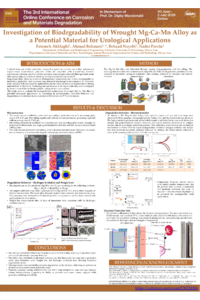
After numerous surgeries in the urinary system, stenting is often required to ensure complete urine discharge, prevent urine from flowing back into the kidneys, and maintain proper urine flow to avoid renal failure. The stents currently used in medical centers are primarily polymeric. Over time, the surface of these stents becomes covered with a crystalline layer and bacterial colonies, which, without secondary care, leads to reduced mechanical properties and potential infection. To address these issues, biodegradable stents have been introduced as an alternative. This research investigates the magnesium alloy, specifically the Mg-Ca-Mn alloy, as a biodegradable material for this purpose. Given the limited formability of magnesium alloys, rolling was selected as the fabrication method for the stents. Samples were rolled from an initial thickness of 5.0 mm down to 0.4 mm with a preheating duration of 10 minutes. The grain size of the specimens after rolling was significantly reduced from 200 ± 30 µm to 17 ± 5 µm. This reduction in grain size resulted in a notable increase in yield and ultimate tensile strength, from 108.30 ± 3.60 MPa to 231.45 ± 17.17 MPa. The microstructure and texture of the material were evaluated using optical microscopy, X-ray diffraction, and electron backscatter diffraction. The results indicate a significant reduction in grain size following rolling, along with changes in dislocation density and texture, as revealed by EBSD data. These factors contribute to a higher surface potential, leading to a higher corrosion rate in the initial seconds of the corrosion process. Nevertheless, a protective layer forms rapidly, thereby controlling the corrosion rate sooner and resulting in lower rates over time. The average corrosion rates calculated from hydrogen evolution and weight loss studies in artificial urine over 14 days, and from polarization assessments, were 0.889 mm/y, 1.616 mm/y, and 2.402 mm/y, respectively. Consequently, the stent produced through this process is expected to fully degrade within 10-12 weeks.
Keywords
Ureteral Stent
Biodegradation
Magnesium Alloy
Corrosion Rate
Biomedical Implants
Poster
Fatemeh Akhlaghi.pdf
Improving Corrosion Resistance of AZ31 Alloy using Zr/Si Sol–Gel Coating in Simulated Body Fluid
A comprehensive assessment of the effect of bovine serum albumin on the stress corrosion cracking and corrosion behaviour of Mg-Ca alloy