Event submissions
EventsThe 3rd International Online Conference on Corrosion and Materials Degradation
Published
This submission belongs to the session S6. Corrosion and Integrity Management in Energy Infrastructure of the event The 3rd International Online Conference on Corrosion and Materials Degradation
Published date
25 Jun, 2026
Academic Editor
'%3e%3cpath%20d='M12.6657%2010.9104C12.4185%2010.325%2012.0599%209.79327%2011.6097%209.34482C11.1609%208.89508%2010.6293%208.5365%2010.0442%208.28888C10.0389%208.28626%2010.0337%208.28495%2010.0285%208.28233C10.8446%207.69279%2011.3752%206.73249%2011.3752%205.64904C11.3752%203.8542%209.92103%202.39999%208.1262%202.39999C6.33136%202.39999%204.87715%203.8542%204.87715%205.64904C4.87715%206.73249%205.40774%207.69279%206.22393%208.28364C6.21869%208.28626%206.21345%208.28757%206.20821%208.29019C5.62129%208.5378%205.09463%208.89284%204.64265%209.34613C4.1929%209.79493%203.83432%2010.3266%203.58671%2010.9117C3.34345%2011.4845%203.21226%2012.0987%203.20023%2012.7209C3.19988%2012.7349%203.20233%2012.7488%203.20744%2012.7619C3.21255%2012.7749%203.22022%2012.7867%203.22998%2012.7968C3.23975%2012.8068%203.25142%2012.8147%203.26431%2012.8202C3.2772%2012.8256%203.29105%2012.8284%203.30504%2012.8284H4.09109C4.14874%2012.8284%204.19459%2012.7825%204.1959%2012.7262C4.2221%2011.7148%204.62823%2010.7676%205.34617%2010.0497C6.08899%209.30683%207.0755%208.89808%208.1262%208.89808C9.17689%208.89808%2010.1634%209.30683%2010.9062%2010.0497C11.6242%2010.7676%2012.0303%2011.7148%2012.0565%2012.7262C12.0578%2012.7838%2012.1037%2012.8284%2012.1613%2012.8284H12.9474C12.9613%2012.8284%2012.9752%2012.8256%2012.9881%2012.8202C13.001%2012.8147%2013.0126%2012.8068%2013.0224%2012.7968C13.0322%2012.7867%2013.0398%2012.7749%2013.0449%2012.7619C13.0501%2012.7488%2013.0525%2012.7349%2013.0522%2012.7209C13.0391%2012.0947%2012.9094%2011.4855%2012.6657%2010.9104ZM8.1262%207.9024C7.52486%207.9024%206.9589%207.6679%206.53312%207.24211C6.10733%206.81633%205.87283%206.25037%205.87283%205.64904C5.87283%205.0477%206.10733%204.48174%206.53312%204.05596C6.9589%203.63018%207.52486%203.39567%208.1262%203.39567C8.72753%203.39567%209.29349%203.63018%209.71927%204.05596C10.1451%204.48174%2010.3796%205.0477%2010.3796%205.64904C10.3796%206.25037%2010.1451%206.81633%209.71927%207.24211C9.29349%207.6679%208.72753%207.9024%208.1262%207.9024Z'%20fill='%235D1EE1'/%3e%3c/g%3e%3c/svg%3e) Raman R. K. Singh
Raman R. K. SinghCitation
Barathkumar Krishnan, Failure Investigation of a Duplex Stainless Steel Flange: Role of Improper Heat Treatment and Sigma Phase Embrittlement, in Proceedings of The 3rd International Online Conference on Corrosion and Materials Degradation, 30 June–2 July 2026, MDPI: Basel, Switzerland
Share
Email
Facebook
Twitter
LinkedIn
Failure Investigation of a Duplex Stainless Steel Flange: Role of Improper Heat Treatment and Sigma Phase Embrittlement
'%3e%3cpath%20d='M12.6647%2010.9104C12.4176%2010.325%2012.0589%209.7933%2011.6088%209.34485C11.16%208.89511%2010.6283%208.53653%2010.0432%208.28891C10.038%208.28629%2010.0327%208.28498%2010.0275%208.28236C10.8437%207.69282%2011.3743%206.73252%2011.3743%205.64907C11.3743%203.85423%209.92005%202.40002%208.12522%202.40002C6.33038%202.40002%204.87618%203.85423%204.87618%205.64907C4.87618%206.73252%205.40677%207.69282%206.22296%208.28367C6.21772%208.28629%206.21248%208.2876%206.20724%208.29022C5.62031%208.53783%205.09365%208.89287%204.64167%209.34616C4.19192%209.79496%203.83334%2010.3266%203.58573%2010.9117C3.34247%2011.4846%203.21128%2012.0987%203.19925%2012.721C3.1989%2012.735%203.20135%2012.7489%203.20646%2012.7619C3.21157%2012.7749%203.21924%2012.7868%203.22901%2012.7968C3.23877%2012.8068%203.25045%2012.8148%203.26334%2012.8202C3.27623%2012.8256%203.29007%2012.8284%203.30406%2012.8284H4.09012C4.14776%2012.8284%204.19362%2012.7825%204.19493%2012.7262C4.22113%2011.7148%204.62726%2010.7676%205.34519%2010.0497C6.08802%209.30686%207.07452%208.89811%208.12522%208.89811C9.17592%208.89811%2010.1624%209.30686%2010.9052%2010.0497C11.6232%2010.7676%2012.0293%2011.7148%2012.0555%2012.7262C12.0568%2012.7839%2012.1027%2012.8284%2012.1603%2012.8284H12.9464C12.9604%2012.8284%2012.9742%2012.8256%2012.9871%2012.8202C13%2012.8148%2013.0117%2012.8068%2013.0214%2012.7968C13.0312%2012.7868%2013.0389%2012.7749%2013.044%2012.7619C13.0491%2012.7489%2013.0515%2012.735%2013.0512%2012.721C13.0381%2012.0947%2012.9084%2011.4856%2012.6647%2010.9104ZM8.12522%207.90243C7.52388%207.90243%206.95792%207.66793%206.53214%207.24215C6.10636%206.81636%205.87185%206.2504%205.87185%205.64907C5.87185%205.04773%206.10636%204.48177%206.53214%204.05599C6.95792%203.63021%207.52388%203.3957%208.12522%203.3957C8.72655%203.3957%209.29252%203.63021%209.7183%204.05599C10.1441%204.48177%2010.3786%205.04773%2010.3786%205.64907C10.3786%206.2504%2010.1441%206.81636%209.7183%207.24215C9.29252%207.66793%208.72655%207.90243%208.12522%207.90243Z'%20fill='%235D1EE1'/%3e%3c/g%3e%3c/svg%3e)
Barathkumar Krishnan 1
1. Asset Integrity & Process Safety (AIPS), Abu Dhabi National Oil Company (ADNOC), Dhabi P.O. Box 898, United Arab Emirates
Abstract
Duplex stainless steels (DSSs) are widely used in pressure-retaining components due to their high strength, toughness, and corrosion resistance arising from a balanced ferrite–austenite microstructure. However, exposure to inappropriate thermal conditions during fabrication or heat treatment can promote precipitation of intermetallic phases, particularly sigma (σ) phase, which severely degrades fracture toughness and corrosion performance. This study presents a detailed failure investigation of a DSS flange that fractured during hydrostatic pressure testing.
The failure investigation comprised visual examination, fractography, optical microscopy, scanning electron microscopy (SEM) with energy-dispersive spectroscopy (EDS), hardness mapping, ferrite content measurement, Charpy V-notch impact testing, and ASTM G48 corrosion testing. Material traceability records were reviewed to correlate metallurgical observations and property variations across different heat numbers supplied for identical service conditions.
Microstructural analysis revealed extensive sigma phase precipitation along ferrite–austenite interfaces in the failed flange, accompanied by chromium and molybdenum segregation consistent with intermetallic phase formation. Ferrite measurements indicated deviation from the recommended phase balance for DSS. Charpy impact testing showed a pronounced reduction in absorbed energy, confirming severe embrittlement, while ASTM G48 testing demonstrated localized corrosion attack associated with chromium-depleted regions. Fractographic examination revealed chevron patterns characteristic of rapid brittle fracture, with crack initiation associated with sigma-rich embrittled regions and unstable propagation during hydrostatic loading. Comparative assessment across multiple heat numbers demonstrated that these degradations were confined to a single material batch, whereas components from other heats exhibited acceptable microstructure, toughness, and corrosion resistance.
The combined evidence of intermetallic precipitation, microchemical segregation, mechanical embrittlement, corrosion susceptibility, and batch-specific occurrence indicates improper thermal exposure during heat treatment of the affected heat number as the root cause of failure. Sigma phase–induced embrittlement significantly reduced fracture toughness, causing brittle failure during hydrotesting. The findings highlight the critical importance of strict thermal process control, heat number traceability, and phase balance verification.
Keywords
Duplex stainless steel
Sigma phase precipitation
Britle fracture
Hydrostatic testing
Failure investigation
Heat treatment control
Poster
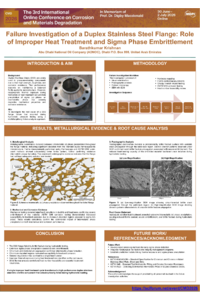
Failure Investigation of a Duplex Stainless Steel Flange- Role of Improper Heat Treatment and Sigma Phase Embrittlement.pdf
Electrochemical Corrosion Assessment of Steels with Varying Chromium Content in NO2-containing Phase-Transition Environments in CCUS Infrastructure
Comparative Study on SRB-Induced Corrosion of 90/10 Copper-Nickel Alloy Welded Joints: Anaerobic Bulk Immersion vs. Thin Liquid Film Environments