Event submissions
EventsThe 3rd International Online Conference on Corrosion and Materials Degradation
Published
This submission belongs to the session S6. Corrosion and Integrity Management in Energy Infrastructure of the event The 3rd International Online Conference on Corrosion and Materials Degradation
Published date
25 Jun, 2026
Academic Editor
'%3e%3cpath%20d='M12.6657%2010.9104C12.4185%2010.325%2012.0599%209.79327%2011.6097%209.34482C11.1609%208.89508%2010.6293%208.5365%2010.0442%208.28888C10.0389%208.28626%2010.0337%208.28495%2010.0285%208.28233C10.8446%207.69279%2011.3752%206.73249%2011.3752%205.64904C11.3752%203.8542%209.92103%202.39999%208.1262%202.39999C6.33136%202.39999%204.87715%203.8542%204.87715%205.64904C4.87715%206.73249%205.40774%207.69279%206.22393%208.28364C6.21869%208.28626%206.21345%208.28757%206.20821%208.29019C5.62129%208.5378%205.09463%208.89284%204.64265%209.34613C4.1929%209.79493%203.83432%2010.3266%203.58671%2010.9117C3.34345%2011.4845%203.21226%2012.0987%203.20023%2012.7209C3.19988%2012.7349%203.20233%2012.7488%203.20744%2012.7619C3.21255%2012.7749%203.22022%2012.7867%203.22998%2012.7968C3.23975%2012.8068%203.25142%2012.8147%203.26431%2012.8202C3.2772%2012.8256%203.29105%2012.8284%203.30504%2012.8284H4.09109C4.14874%2012.8284%204.19459%2012.7825%204.1959%2012.7262C4.2221%2011.7148%204.62823%2010.7676%205.34617%2010.0497C6.08899%209.30683%207.0755%208.89808%208.1262%208.89808C9.17689%208.89808%2010.1634%209.30683%2010.9062%2010.0497C11.6242%2010.7676%2012.0303%2011.7148%2012.0565%2012.7262C12.0578%2012.7838%2012.1037%2012.8284%2012.1613%2012.8284H12.9474C12.9613%2012.8284%2012.9752%2012.8256%2012.9881%2012.8202C13.001%2012.8147%2013.0126%2012.8068%2013.0224%2012.7968C13.0322%2012.7867%2013.0398%2012.7749%2013.0449%2012.7619C13.0501%2012.7488%2013.0525%2012.7349%2013.0522%2012.7209C13.0391%2012.0947%2012.9094%2011.4855%2012.6657%2010.9104ZM8.1262%207.9024C7.52486%207.9024%206.9589%207.6679%206.53312%207.24211C6.10733%206.81633%205.87283%206.25037%205.87283%205.64904C5.87283%205.0477%206.10733%204.48174%206.53312%204.05596C6.9589%203.63018%207.52486%203.39567%208.1262%203.39567C8.72753%203.39567%209.29349%203.63018%209.71927%204.05596C10.1451%204.48174%2010.3796%205.0477%2010.3796%205.64904C10.3796%206.25037%2010.1451%206.81633%209.71927%207.24211C9.29349%207.6679%208.72753%207.9024%208.1262%207.9024Z'%20fill='%235D1EE1'/%3e%3c/g%3e%3c/svg%3e) Frank Cheng
Frank ChengCitation
Lyudmila Ivanivna Nyrkova, Goncharenko Valerianivna Larysa, Svetlana Oleksiivna Osadchuk, Yulia Oleksiivna Kharchenko, SUSCEPTIBILITY TO STRESS-CORROSION CRACKING OF LONG-OPERATED GAS PIPELINE STEEL IN A MODEL SOIL ELECTROLYTE, in Proceedings of The 3rd International Online Conference on Corrosion and Materials Degradation, 30 June–2 July 2026, MDPI: Basel, Switzerland
Share
Email
Facebook
Twitter
LinkedIn
SUSCEPTIBILITY TO STRESS-CORROSION CRACKING OF LONG-OPERATED GAS PIPELINE STEEL IN A MODEL SOIL ELECTROLYTE
'%3e%3cpath%20d='M12.6647%2010.9104C12.4176%2010.325%2012.0589%209.7933%2011.6088%209.34485C11.16%208.89511%2010.6283%208.53653%2010.0432%208.28891C10.038%208.28629%2010.0327%208.28498%2010.0275%208.28236C10.8437%207.69282%2011.3743%206.73252%2011.3743%205.64907C11.3743%203.85423%209.92005%202.40002%208.12522%202.40002C6.33038%202.40002%204.87618%203.85423%204.87618%205.64907C4.87618%206.73252%205.40677%207.69282%206.22296%208.28367C6.21772%208.28629%206.21248%208.2876%206.20724%208.29022C5.62031%208.53783%205.09365%208.89287%204.64167%209.34616C4.19192%209.79496%203.83334%2010.3266%203.58573%2010.9117C3.34247%2011.4846%203.21128%2012.0987%203.19925%2012.721C3.1989%2012.735%203.20135%2012.7489%203.20646%2012.7619C3.21157%2012.7749%203.21924%2012.7868%203.22901%2012.7968C3.23877%2012.8068%203.25045%2012.8148%203.26334%2012.8202C3.27623%2012.8256%203.29007%2012.8284%203.30406%2012.8284H4.09012C4.14776%2012.8284%204.19362%2012.7825%204.19493%2012.7262C4.22113%2011.7148%204.62726%2010.7676%205.34519%2010.0497C6.08802%209.30686%207.07452%208.89811%208.12522%208.89811C9.17592%208.89811%2010.1624%209.30686%2010.9052%2010.0497C11.6232%2010.7676%2012.0293%2011.7148%2012.0555%2012.7262C12.0568%2012.7839%2012.1027%2012.8284%2012.1603%2012.8284H12.9464C12.9604%2012.8284%2012.9742%2012.8256%2012.9871%2012.8202C13%2012.8148%2013.0117%2012.8068%2013.0214%2012.7968C13.0312%2012.7868%2013.0389%2012.7749%2013.044%2012.7619C13.0491%2012.7489%2013.0515%2012.735%2013.0512%2012.721C13.0381%2012.0947%2012.9084%2011.4856%2012.6647%2010.9104ZM8.12522%207.90243C7.52388%207.90243%206.95792%207.66793%206.53214%207.24215C6.10636%206.81636%205.87185%206.2504%205.87185%205.64907C5.87185%205.04773%206.10636%204.48177%206.53214%204.05599C6.95792%203.63021%207.52388%203.3957%208.12522%203.3957C8.72655%203.3957%209.29252%203.63021%209.7183%204.05599C10.1441%204.48177%2010.3786%205.04773%2010.3786%205.64907C10.3786%206.2504%2010.1441%206.81636%209.7183%207.24215C9.29252%207.66793%208.72655%207.90243%208.12522%207.90243Z'%20fill='%235D1EE1'/%3e%3c/g%3e%3c/svg%3e)
Lyudmila Ivanivna Nyrkova 1
Goncharenko Valerianivna Larysa 1
Svetlana Oleksiivna Osadchuk 1
Yulia Oleksiivna Kharchenko 1
1. Department of Welding of gas and oil pipes, E.O. Paton Electric Welding Institute of the National Academy of Sciences of Ukraine, 03150, Kyiv, Ukraine
Abstract
Pipe steels after long-term operation under the combined influence of anti-corrosion protection and mechanical stress may demonstrate property degradation, which leads to a deterioration in their service characteristics.
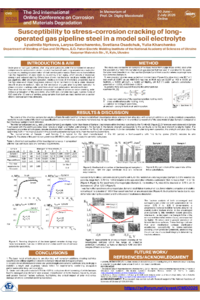
Comparative studies of stress-corrosion cracking of the parent metal of a main gas pipeline with a diameter of 1020 mm made of X60 steel after operation for 50 years, from an undamaged section and a section where a fracture site was detected, were conducted. Investigations were carried out in an NS4 solution under cathodic polarization. Spectrometry, optical metallography, mechanical testing, the slow-rate test method, and scanning electron microscopy methods were used.
The study’s results established that the mechanical properties of undamaged and damaged pipes are at the level of the values specified in the pipe certificates. The microstructure is typical for the steel manufactured in the XX century—ferritic–pearlitic with fine ferrite grains (20-25) microns in size. The share of the pearlite component was 50-60% and is approximately the same for both pipes.
The susceptibility to stress-corrosion cracking was estimated by the dimensionless coefficient KS, which was calculated as the ratio of the relative narrowing of the specimens in air to the relative narrowing in the solution.
KS for the metal of an undamaged pipe at the polarization potential range from -0.75 V to -1.05 V (relative to the saturated silver chloride electrode) in NS4 increases from 1.14 to 1.18. For specimens of damaged pipe, the maximum KS value of 1.5 is observed at -0.75 V, and it decreases to 1.27 at -1.05 V. It was found that specimens of damaged pipe demonstrated higher maximum stress, lower relative elongation, and relative narrowing at the potential of -1.05 V than specimens from an undamaged pipe. Such patterns may be due to pipe deformation during the accident and the influence of local anodic dissolution.
Keywords
long-term operated
gas pipeline
slow-strain rate test
SEM
stress-corrosion cracking
Poster
POSTER_Nyrkova.pdf
Corrosion-Resistant and Conductive Coatings for Metal Bipolar Plates in Proton Exchange Membrane Fuel Cells
Mechanisms of Early-Stage Stress Corrosion Cracking