Event submissions
EventsThe 3rd International Online Conference on Corrosion and Materials Degradation
Published
This submission belongs to the session S8. AI and ML Tools and Digital Twins for Corrosion Prediction of the event The 3rd International Online Conference on Corrosion and Materials Degradation
Published date
25 Jun, 2026
Academic Editor
'%3e%3cpath%20d='M12.6657%2010.9104C12.4185%2010.325%2012.0599%209.79327%2011.6097%209.34482C11.1609%208.89508%2010.6293%208.5365%2010.0442%208.28888C10.0389%208.28626%2010.0337%208.28495%2010.0285%208.28233C10.8446%207.69279%2011.3752%206.73249%2011.3752%205.64904C11.3752%203.8542%209.92103%202.39999%208.1262%202.39999C6.33136%202.39999%204.87715%203.8542%204.87715%205.64904C4.87715%206.73249%205.40774%207.69279%206.22393%208.28364C6.21869%208.28626%206.21345%208.28757%206.20821%208.29019C5.62129%208.5378%205.09463%208.89284%204.64265%209.34613C4.1929%209.79493%203.83432%2010.3266%203.58671%2010.9117C3.34345%2011.4845%203.21226%2012.0987%203.20023%2012.7209C3.19988%2012.7349%203.20233%2012.7488%203.20744%2012.7619C3.21255%2012.7749%203.22022%2012.7867%203.22998%2012.7968C3.23975%2012.8068%203.25142%2012.8147%203.26431%2012.8202C3.2772%2012.8256%203.29105%2012.8284%203.30504%2012.8284H4.09109C4.14874%2012.8284%204.19459%2012.7825%204.1959%2012.7262C4.2221%2011.7148%204.62823%2010.7676%205.34617%2010.0497C6.08899%209.30683%207.0755%208.89808%208.1262%208.89808C9.17689%208.89808%2010.1634%209.30683%2010.9062%2010.0497C11.6242%2010.7676%2012.0303%2011.7148%2012.0565%2012.7262C12.0578%2012.7838%2012.1037%2012.8284%2012.1613%2012.8284H12.9474C12.9613%2012.8284%2012.9752%2012.8256%2012.9881%2012.8202C13.001%2012.8147%2013.0126%2012.8068%2013.0224%2012.7968C13.0322%2012.7867%2013.0398%2012.7749%2013.0449%2012.7619C13.0501%2012.7488%2013.0525%2012.7349%2013.0522%2012.7209C13.0391%2012.0947%2012.9094%2011.4855%2012.6657%2010.9104ZM8.1262%207.9024C7.52486%207.9024%206.9589%207.6679%206.53312%207.24211C6.10733%206.81633%205.87283%206.25037%205.87283%205.64904C5.87283%205.0477%206.10733%204.48174%206.53312%204.05596C6.9589%203.63018%207.52486%203.39567%208.1262%203.39567C8.72753%203.39567%209.29349%203.63018%209.71927%204.05596C10.1451%204.48174%2010.3796%205.0477%2010.3796%205.64904C10.3796%206.25037%2010.1451%206.81633%209.71927%207.24211C9.29349%207.6679%208.72753%207.9024%208.1262%207.9024Z'%20fill='%235D1EE1'/%3e%3c/g%3e%3c/svg%3e) Alankar Alankar
Alankar AlankarCitation
Johnny MUHINDO BAHAVIRA, Papy KABADI LELO ODIMBA, Aristote Zenga Anselme, Michael Paluku Lukumbi, Junior Lukoo Mitsindo, Machine learning-based prediction of carbonation-induced reinforcement corrosion initiation risk in reinforced concrete under Kinshasa climate conditions, in Proceedings of The 3rd International Online Conference on Corrosion and Materials Degradation, 30 June–2 July 2026, MDPI: Basel, Switzerland
Share
Email
Facebook
Twitter
LinkedIn
Machine learning-based prediction of carbonation-induced reinforcement corrosion initiation risk in reinforced concrete under Kinshasa climate conditions

Johnny MUHINDO BAHAVIRA 1
'%3e%3cpath%20d='M12.6647%2010.9104C12.4176%2010.325%2012.0589%209.7933%2011.6088%209.34485C11.16%208.89511%2010.6283%208.53653%2010.0432%208.28891C10.038%208.28629%2010.0327%208.28498%2010.0275%208.28236C10.8437%207.69282%2011.3743%206.73252%2011.3743%205.64907C11.3743%203.85423%209.92005%202.40002%208.12522%202.40002C6.33038%202.40002%204.87618%203.85423%204.87618%205.64907C4.87618%206.73252%205.40677%207.69282%206.22296%208.28367C6.21772%208.28629%206.21248%208.2876%206.20724%208.29022C5.62031%208.53783%205.09365%208.89287%204.64167%209.34616C4.19192%209.79496%203.83334%2010.3266%203.58573%2010.9117C3.34247%2011.4846%203.21128%2012.0987%203.19925%2012.721C3.1989%2012.735%203.20135%2012.7489%203.20646%2012.7619C3.21157%2012.7749%203.21924%2012.7868%203.22901%2012.7968C3.23877%2012.8068%203.25045%2012.8148%203.26334%2012.8202C3.27623%2012.8256%203.29007%2012.8284%203.30406%2012.8284H4.09012C4.14776%2012.8284%204.19362%2012.7825%204.19493%2012.7262C4.22113%2011.7148%204.62726%2010.7676%205.34519%2010.0497C6.08802%209.30686%207.07452%208.89811%208.12522%208.89811C9.17592%208.89811%2010.1624%209.30686%2010.9052%2010.0497C11.6232%2010.7676%2012.0293%2011.7148%2012.0555%2012.7262C12.0568%2012.7839%2012.1027%2012.8284%2012.1603%2012.8284H12.9464C12.9604%2012.8284%2012.9742%2012.8256%2012.9871%2012.8202C13%2012.8148%2013.0117%2012.8068%2013.0214%2012.7968C13.0312%2012.7868%2013.0389%2012.7749%2013.044%2012.7619C13.0491%2012.7489%2013.0515%2012.735%2013.0512%2012.721C13.0381%2012.0947%2012.9084%2011.4856%2012.6647%2010.9104ZM8.12522%207.90243C7.52388%207.90243%206.95792%207.66793%206.53214%207.24215C6.10636%206.81636%205.87185%206.2504%205.87185%205.64907C5.87185%205.04773%206.10636%204.48177%206.53214%204.05599C6.95792%203.63021%207.52388%203.3957%208.12522%203.3957C8.72655%203.3957%209.29252%203.63021%209.7183%204.05599C10.1441%204.48177%2010.3786%205.04773%2010.3786%205.64907C10.3786%206.2504%2010.1441%206.81636%209.7183%207.24215C9.29252%207.66793%208.72655%207.90243%208.12522%207.90243Z'%20fill='%235D1EE1'/%3e%3c/g%3e%3c/svg%3e)
Papy KABADI LELO ODIMBA 2
Aristote Zenga Anselme 2
Michael Paluku Lukumbi 3

Junior Lukoo Mitsindo 3
1. Department of Building and Public works, National Institute of Building and Public Works, Kinshasa, P.O. box.4731, Democratic Republic of Congo
2. Department of Rural Engineering, National Institute of Building and Public Works, Kinshasa, P.O. box.4731, Democratic Republic of Congo.
3. Higher Technical School of Civil Engineers, Canals and Ports, Polytechnic University of Madrid, 28040 Madrid, Spain
Abstract
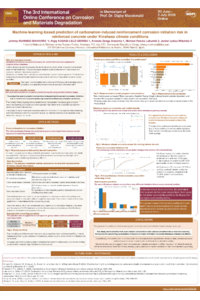
Natural carbonation of reinforced concrete is a major mechanism of steel depassivation and may lead to corrosion initiation once the carbonation front reaches the reinforcement, making it a critical durability issue for structures exposed to tropical urban climates. This study developed a machine learning framework to predict carbonation-induced reinforcement corrosion initiation risk under climate conditions representative of Kinshasa. The workflow combined a RILEM natural carbonation database containing 1,744 records, including 863 mix-level observations and 6,879 time-series measurements, with Kinshasa climate descriptors based on temperature, relative humidity, and an atmospheric CO₂ proxy. After filtering, 847 observations contained usable numerical climate information for model training. Four models were evaluated, namely Ridge regression, Random Forest, Gradient Boosting, and a median-based dummy baseline. Gradient Boosting achieved the best performance, with grouped cross-validation by reference yielding an RMSE of 0.0737 and an R² of 0.6101, while the reference-based holdout test produced an RMSE of 0.0668, an MAE of 0.0510, and an R² of 0.6488. For a 25 mm concrete cover, the median estimated time for the carbonation front to reach the reinforcement level was 18.30 years under a typical dry Kinshasa climate scenario and 16.05 years under an annual mean Kinshasa climate scenario; at 30 years, the proportion of profiles reaching corrosion initiation was 70.72% and 74.26%, respectively. These results show that an open-data, machine learning-based framework can provide a first quantitative estimate of carbonation-driven corrosion initiation risk in Kinshasa, while also highlighting the need for future local validation and improved representation of the most humid exposure conditions.
Keywords
natural carbonation
reinforcement corrosion
reinforced concrete
machine learning
corrosion prediction
corrosion initiation
service life
tropical urban climate
Kinshasa
Poster
pdf_Poster_johnnyMuhindoBahavira_CMD2026.pdf
Detection of Pitting Corrosion in Stainless Steel Sheet Pile Walls using Deep Learning
Evaluation of the applicability of dose–response functions incorporating time of wetness: Analysis of outdoor exposure test data for carbon steel and zinc across multiple countries