Event submissions
Events2026 International Online Conference on Tropical Medicine and Infectious Disease
Published
This submission belongs to the session S1. Vector-Borne Diseases of the event 2026 International Online Conference on Tropical Medicine and Infectious Disease
Published date
26 Jun, 2026
Academic Editor
'%3e%3cpath%20d='M12.6657%2010.9104C12.4185%2010.325%2012.0599%209.79327%2011.6097%209.34482C11.1609%208.89508%2010.6293%208.5365%2010.0442%208.28888C10.0389%208.28626%2010.0337%208.28495%2010.0285%208.28233C10.8446%207.69279%2011.3752%206.73249%2011.3752%205.64904C11.3752%203.8542%209.92103%202.39999%208.1262%202.39999C6.33136%202.39999%204.87715%203.8542%204.87715%205.64904C4.87715%206.73249%205.40774%207.69279%206.22393%208.28364C6.21869%208.28626%206.21345%208.28757%206.20821%208.29019C5.62129%208.5378%205.09463%208.89284%204.64265%209.34613C4.1929%209.79493%203.83432%2010.3266%203.58671%2010.9117C3.34345%2011.4845%203.21226%2012.0987%203.20023%2012.7209C3.19988%2012.7349%203.20233%2012.7488%203.20744%2012.7619C3.21255%2012.7749%203.22022%2012.7867%203.22998%2012.7968C3.23975%2012.8068%203.25142%2012.8147%203.26431%2012.8202C3.2772%2012.8256%203.29105%2012.8284%203.30504%2012.8284H4.09109C4.14874%2012.8284%204.19459%2012.7825%204.1959%2012.7262C4.2221%2011.7148%204.62823%2010.7676%205.34617%2010.0497C6.08899%209.30683%207.0755%208.89808%208.1262%208.89808C9.17689%208.89808%2010.1634%209.30683%2010.9062%2010.0497C11.6242%2010.7676%2012.0303%2011.7148%2012.0565%2012.7262C12.0578%2012.7838%2012.1037%2012.8284%2012.1613%2012.8284H12.9474C12.9613%2012.8284%2012.9752%2012.8256%2012.9881%2012.8202C13.001%2012.8147%2013.0126%2012.8068%2013.0224%2012.7968C13.0322%2012.7867%2013.0398%2012.7749%2013.0449%2012.7619C13.0501%2012.7488%2013.0525%2012.7349%2013.0522%2012.7209C13.0391%2012.0947%2012.9094%2011.4855%2012.6657%2010.9104ZM8.1262%207.9024C7.52486%207.9024%206.9589%207.6679%206.53312%207.24211C6.10733%206.81633%205.87283%206.25037%205.87283%205.64904C5.87283%205.0477%206.10733%204.48174%206.53312%204.05596C6.9589%203.63018%207.52486%203.39567%208.1262%203.39567C8.72753%203.39567%209.29349%203.63018%209.71927%204.05596C10.1451%204.48174%2010.3796%205.0477%2010.3796%205.64904C10.3796%206.25037%2010.1451%206.81633%209.71927%207.24211C9.29349%207.6679%208.72753%207.9024%208.1262%207.9024Z'%20fill='%235D1EE1'/%3e%3c/g%3e%3c/svg%3e) Basil Brooke
Basil BrookeCitation
Marília Andreza da Silva Ferreira, Letícia dos Santos Querino, Thiemmy de Souza Almeida, Temporal dynamics of Aedes aegypti in a semi-arid urban environment in Northeastern Brazil, in Proceedings of 2026 International Online Conference on Tropical Medicine and Infectious Disease, 1 July–2 July 2026, MDPI: Basel, Switzerland
Share
Email
Facebook
Twitter
LinkedIn
Temporal dynamics of Aedes aegypti in a semi-arid urban environment in Northeastern Brazil

Marília Andreza da Silva Ferreira 1
'%3e%3cpath%20d='M12.6647%2010.9104C12.4176%2010.325%2012.0589%209.7933%2011.6088%209.34485C11.16%208.89511%2010.6283%208.53653%2010.0432%208.28891C10.038%208.28629%2010.0327%208.28498%2010.0275%208.28236C10.8437%207.69282%2011.3743%206.73252%2011.3743%205.64907C11.3743%203.85423%209.92005%202.40002%208.12522%202.40002C6.33038%202.40002%204.87618%203.85423%204.87618%205.64907C4.87618%206.73252%205.40677%207.69282%206.22296%208.28367C6.21772%208.28629%206.21248%208.2876%206.20724%208.29022C5.62031%208.53783%205.09365%208.89287%204.64167%209.34616C4.19192%209.79496%203.83334%2010.3266%203.58573%2010.9117C3.34247%2011.4846%203.21128%2012.0987%203.19925%2012.721C3.1989%2012.735%203.20135%2012.7489%203.20646%2012.7619C3.21157%2012.7749%203.21924%2012.7868%203.22901%2012.7968C3.23877%2012.8068%203.25045%2012.8148%203.26334%2012.8202C3.27623%2012.8256%203.29007%2012.8284%203.30406%2012.8284H4.09012C4.14776%2012.8284%204.19362%2012.7825%204.19493%2012.7262C4.22113%2011.7148%204.62726%2010.7676%205.34519%2010.0497C6.08802%209.30686%207.07452%208.89811%208.12522%208.89811C9.17592%208.89811%2010.1624%209.30686%2010.9052%2010.0497C11.6232%2010.7676%2012.0293%2011.7148%2012.0555%2012.7262C12.0568%2012.7839%2012.1027%2012.8284%2012.1603%2012.8284H12.9464C12.9604%2012.8284%2012.9742%2012.8256%2012.9871%2012.8202C13%2012.8148%2013.0117%2012.8068%2013.0214%2012.7968C13.0312%2012.7868%2013.0389%2012.7749%2013.044%2012.7619C13.0491%2012.7489%2013.0515%2012.735%2013.0512%2012.721C13.0381%2012.0947%2012.9084%2011.4856%2012.6647%2010.9104ZM8.12522%207.90243C7.52388%207.90243%206.95792%207.66793%206.53214%207.24215C6.10636%206.81636%205.87185%206.2504%205.87185%205.64907C5.87185%205.04773%206.10636%204.48177%206.53214%204.05599C6.95792%203.63021%207.52388%203.3957%208.12522%203.3957C8.72655%203.3957%209.29252%203.63021%209.7183%204.05599C10.1441%204.48177%2010.3786%205.04773%2010.3786%205.64907C10.3786%206.2504%2010.1441%206.81636%209.7183%207.24215C9.29252%207.66793%208.72655%207.90243%208.12522%207.90243Z'%20fill='%235D1EE1'/%3e%3c/g%3e%3c/svg%3e)
Letícia dos Santos Querino 2
Thiemmy de Souza Almeida 3
1. Academic Unit of Dentistry, Center for Rural Health and Technology, Federal University of Campina Grande, Patos, 58708-110, Brazil
2. Academic Unit of Natural Sciences, Center for Teacher Training, Federal University of Campina Grande, Cajazeiras, 59000-000, Brazil
3. Oswaldo Cruz Foundation - Virtual Campus, Health Surveillance Unit of the Alcides Carneiro University Hospital, Campina Grande, 58432-767, Brazil
Abstract
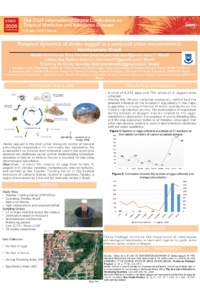
Introduction: Aedes aegypti is the main urban mosquito vector of several arboviruses responsible for outbreaks and epidemics. Its adaptability to diverse environmental conditions promotes dispersal and challenges vector control. Understanding oviposition dynamics in relation to climatic factors is essential for improving entomological surveillance.
Objective: To relate the density of eggs from female A. aegypti with climatic variables (temperature, relative humidity, and rainfall) at the Teacher Training Center of the Federal University of Campina Grande, located in Cajazeiras, Paraíba, a region characterized by a hot and dry semi-arid climate in Brazil.
Materials and Methods: Fifty-one ovitraps were installed across the campus, distributed according to the mosquitoes' environmental preferences, and remained in the field from June 2019 to March 2020. During this period, 39 weekly inspections were carried out, recording the number of eggs and larvae present in the traps. Rainfall, temperature, and relative humidity data were obtained from the National Institute of Meteorology and the Executive Agency for Water Management of the State of Paraíba.
Results and Conclusion: A total of 6,296 eggs and 759 larvae of A. aegypti were collected. The highest values of the Ovitrap Positivity Index occurred between January and March, while the Egg Density Index was highest in February, March, and June. Among the climatic variables evaluated, rainfall had the greatest influence on the increase in egg density in the traps, suggesting a strong influence of water availability on the vector's reproductive activity. The maintenance of oviposition during periods of drought may be related to the eggs' resistance to desiccation, the presence of cryptic breeding sites, and the skip oviposition behavior of females—strategies that allow reproductive continuity even in environmental conditions with low water availability. These findings reinforce the importance of continuous entomological monitoring in semi-arid regions to guide more effective vector control strategies.
Keywords
Aedes aegypti
Ovitraps
Health Public
Poster
sciforum-17864 Poster.pdf
Vertical habitat use and larvitrap efficiency for arbovirus vector mosquitoes (Diptera: Culicidae) in an Amazonian rural settlement.
Detection, Isolation, and In Vitro Cultivation of Balamuthia mandrillaris: A Systematic Review of Current Laboratory Approaches and Evidence