Event submissions
Events2026 International Online Conference on Tropical Medicine and Infectious Disease
Published
This submission belongs to the session S2. One Health – Zoonotic Diseases of the event 2026 International Online Conference on Tropical Medicine and Infectious Disease
Published date
26 Jun, 2026
Academic Editor
'%3e%3cpath%20d='M12.6657%2010.9104C12.4185%2010.325%2012.0599%209.79327%2011.6097%209.34482C11.1609%208.89508%2010.6293%208.5365%2010.0442%208.28888C10.0389%208.28626%2010.0337%208.28495%2010.0285%208.28233C10.8446%207.69279%2011.3752%206.73249%2011.3752%205.64904C11.3752%203.8542%209.92103%202.39999%208.1262%202.39999C6.33136%202.39999%204.87715%203.8542%204.87715%205.64904C4.87715%206.73249%205.40774%207.69279%206.22393%208.28364C6.21869%208.28626%206.21345%208.28757%206.20821%208.29019C5.62129%208.5378%205.09463%208.89284%204.64265%209.34613C4.1929%209.79493%203.83432%2010.3266%203.58671%2010.9117C3.34345%2011.4845%203.21226%2012.0987%203.20023%2012.7209C3.19988%2012.7349%203.20233%2012.7488%203.20744%2012.7619C3.21255%2012.7749%203.22022%2012.7867%203.22998%2012.7968C3.23975%2012.8068%203.25142%2012.8147%203.26431%2012.8202C3.2772%2012.8256%203.29105%2012.8284%203.30504%2012.8284H4.09109C4.14874%2012.8284%204.19459%2012.7825%204.1959%2012.7262C4.2221%2011.7148%204.62823%2010.7676%205.34617%2010.0497C6.08899%209.30683%207.0755%208.89808%208.1262%208.89808C9.17689%208.89808%2010.1634%209.30683%2010.9062%2010.0497C11.6242%2010.7676%2012.0303%2011.7148%2012.0565%2012.7262C12.0578%2012.7838%2012.1037%2012.8284%2012.1613%2012.8284H12.9474C12.9613%2012.8284%2012.9752%2012.8256%2012.9881%2012.8202C13.001%2012.8147%2013.0126%2012.8068%2013.0224%2012.7968C13.0322%2012.7867%2013.0398%2012.7749%2013.0449%2012.7619C13.0501%2012.7488%2013.0525%2012.7349%2013.0522%2012.7209C13.0391%2012.0947%2012.9094%2011.4855%2012.6657%2010.9104ZM8.1262%207.9024C7.52486%207.9024%206.9589%207.6679%206.53312%207.24211C6.10733%206.81633%205.87283%206.25037%205.87283%205.64904C5.87283%205.0477%206.10733%204.48174%206.53312%204.05596C6.9589%203.63018%207.52486%203.39567%208.1262%203.39567C8.72753%203.39567%209.29349%203.63018%209.71927%204.05596C10.1451%204.48174%2010.3796%205.0477%2010.3796%205.64904C10.3796%206.25037%2010.1451%206.81633%209.71927%207.24211C9.29349%207.6679%208.72753%207.9024%208.1262%207.9024Z'%20fill='%235D1EE1'/%3e%3c/g%3e%3c/svg%3e) John Frean
John FreanCitation
David Garcia de Alcaraz Conti, Re-emergence of Leptospirosis in Urban Tropical Settings: A Systematic Review of Climate, Environmental, and Socioeconomic Drivers, in Proceedings of 2026 International Online Conference on Tropical Medicine and Infectious Disease, 1 July–2 July 2026, MDPI: Basel, Switzerland
Share
Email
Facebook
Twitter
LinkedIn
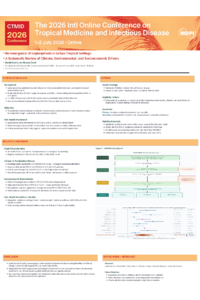
Re-emergence of Leptospirosis in Urban Tropical Settings: A Systematic Review of Climate, Environmental, and Socioeconomic Drivers
'%3e%3cpath%20d='M12.6647%2010.9104C12.4176%2010.325%2012.0589%209.7933%2011.6088%209.34485C11.16%208.89511%2010.6283%208.53653%2010.0432%208.28891C10.038%208.28629%2010.0327%208.28498%2010.0275%208.28236C10.8437%207.69282%2011.3743%206.73252%2011.3743%205.64907C11.3743%203.85423%209.92005%202.40002%208.12522%202.40002C6.33038%202.40002%204.87618%203.85423%204.87618%205.64907C4.87618%206.73252%205.40677%207.69282%206.22296%208.28367C6.21772%208.28629%206.21248%208.2876%206.20724%208.29022C5.62031%208.53783%205.09365%208.89287%204.64167%209.34616C4.19192%209.79496%203.83334%2010.3266%203.58573%2010.9117C3.34247%2011.4846%203.21128%2012.0987%203.19925%2012.721C3.1989%2012.735%203.20135%2012.7489%203.20646%2012.7619C3.21157%2012.7749%203.21924%2012.7868%203.22901%2012.7968C3.23877%2012.8068%203.25045%2012.8148%203.26334%2012.8202C3.27623%2012.8256%203.29007%2012.8284%203.30406%2012.8284H4.09012C4.14776%2012.8284%204.19362%2012.7825%204.19493%2012.7262C4.22113%2011.7148%204.62726%2010.7676%205.34519%2010.0497C6.08802%209.30686%207.07452%208.89811%208.12522%208.89811C9.17592%208.89811%2010.1624%209.30686%2010.9052%2010.0497C11.6232%2010.7676%2012.0293%2011.7148%2012.0555%2012.7262C12.0568%2012.7839%2012.1027%2012.8284%2012.1603%2012.8284H12.9464C12.9604%2012.8284%2012.9742%2012.8256%2012.9871%2012.8202C13%2012.8148%2013.0117%2012.8068%2013.0214%2012.7968C13.0312%2012.7868%2013.0389%2012.7749%2013.044%2012.7619C13.0491%2012.7489%2013.0515%2012.735%2013.0512%2012.721C13.0381%2012.0947%2012.9084%2011.4856%2012.6647%2010.9104ZM8.12522%207.90243C7.52388%207.90243%206.95792%207.66793%206.53214%207.24215C6.10636%206.81636%205.87185%206.2504%205.87185%205.64907C5.87185%205.04773%206.10636%204.48177%206.53214%204.05599C6.95792%203.63021%207.52388%203.3957%208.12522%203.3957C8.72655%203.3957%209.29252%203.63021%209.7183%204.05599C10.1441%204.48177%2010.3786%205.04773%2010.3786%205.64907C10.3786%206.2504%2010.1441%206.81636%209.7183%207.24215C9.29252%207.66793%208.72655%207.90243%208.12522%207.90243Z'%20fill='%235D1EE1'/%3e%3c/g%3e%3c/svg%3e)
David Garcia de Alcaraz Conti 1
1. Faculdade de Medicina do ABC, Centro Universitário FMABC, Av. Lauro Gomes, 2000 – Vila Sacadura Cabral, Santo André, São Paulo (SP), 09060-870, Brazil
Abstract
Introduction
Leptospirosis is a neglected zoonotic disease with increasing global incidence, particularly in tropical urban environments. Rapid urbanization, climate change, inadequate sanitation, and expanding rodent populations have driven the re-emergence of leptospirosis, leading to recurrent outbreaks and substantial morbidity and mortality. We conducted a systematic review to synthesize current evidence on the climatic, environmental, and socioeconomic determinants of urban leptospirosis.
Methods
A systematic search of PubMed, Embase, Web of Science, and Scopus was conducted from January 2000 to December 2025 following PRISMA guidelines. Eligible studies included observational, ecological, and modeling studies evaluating environmental, climatic, and social drivers of leptospirosis transmission in urban settings. Primary outcomes were incidence, outbreak occurrence, and mortality. Secondary outcomes included environmental risk factors and socioeconomic vulnerability indicators. Qualitative synthesis and random-effects meta-analysis were performed when feasible.
Results
Forty-eight studies from 32 countries were included. Heavy rainfall, flooding events, and elevated temperatures were consistently associated with increased leptospirosis incidence, with pooled relative risks ranging from 1.6 to 3.4 following extreme precipitation events. Informal housing, poor sanitation infrastructure, high rodent density, and occupational exposure were major socioeconomic determinants. Urban slums accounted for a disproportionate burden of severe disease and mortality. Climate anomalies, including El Niño-related rainfall surges, were strongly linked to large-scale outbreaks. Integrative One Health surveillance models demonstrated improved outbreak prediction and early warning capacity.
Conclusions
Leptospirosis is rapidly re-emerging in urban tropical environments due to the synergistic effects of climate change, environmental degradation, and social vulnerability. Integrated One Health approaches combining environmental monitoring, rodent control, infrastructure investment, and climate-adaptive public health policies are urgently needed to reduce disease burden and prevent future epidemics.
Keywords
Leptospirosis
One Health
Urban health
Climate change
Zoonotic diseases
Systematic review
Poster
leptospirosis_poster.pdf
Detection, Isolation, and In Vitro Cultivation of Balamuthia mandrillaris: A Systematic Review of Current Laboratory Approaches and Evidence
Extreme Rainfall, Flooding Events and Leptospirosis Incidence: A Decade-Long Ecological Analysis in Southern Brazil