Event submissions
Events2026 International Online Conference on Tropical Medicine and Infectious Disease
Published
This submission belongs to the session S2. One Health – Zoonotic Diseases of the event 2026 International Online Conference on Tropical Medicine and Infectious Disease
Published date
26 Jun, 2026
Academic Editor
'%3e%3cpath%20d='M12.6657%2010.9104C12.4185%2010.325%2012.0599%209.79327%2011.6097%209.34482C11.1609%208.89508%2010.6293%208.5365%2010.0442%208.28888C10.0389%208.28626%2010.0337%208.28495%2010.0285%208.28233C10.8446%207.69279%2011.3752%206.73249%2011.3752%205.64904C11.3752%203.8542%209.92103%202.39999%208.1262%202.39999C6.33136%202.39999%204.87715%203.8542%204.87715%205.64904C4.87715%206.73249%205.40774%207.69279%206.22393%208.28364C6.21869%208.28626%206.21345%208.28757%206.20821%208.29019C5.62129%208.5378%205.09463%208.89284%204.64265%209.34613C4.1929%209.79493%203.83432%2010.3266%203.58671%2010.9117C3.34345%2011.4845%203.21226%2012.0987%203.20023%2012.7209C3.19988%2012.7349%203.20233%2012.7488%203.20744%2012.7619C3.21255%2012.7749%203.22022%2012.7867%203.22998%2012.7968C3.23975%2012.8068%203.25142%2012.8147%203.26431%2012.8202C3.2772%2012.8256%203.29105%2012.8284%203.30504%2012.8284H4.09109C4.14874%2012.8284%204.19459%2012.7825%204.1959%2012.7262C4.2221%2011.7148%204.62823%2010.7676%205.34617%2010.0497C6.08899%209.30683%207.0755%208.89808%208.1262%208.89808C9.17689%208.89808%2010.1634%209.30683%2010.9062%2010.0497C11.6242%2010.7676%2012.0303%2011.7148%2012.0565%2012.7262C12.0578%2012.7838%2012.1037%2012.8284%2012.1613%2012.8284H12.9474C12.9613%2012.8284%2012.9752%2012.8256%2012.9881%2012.8202C13.001%2012.8147%2013.0126%2012.8068%2013.0224%2012.7968C13.0322%2012.7867%2013.0398%2012.7749%2013.0449%2012.7619C13.0501%2012.7488%2013.0525%2012.7349%2013.0522%2012.7209C13.0391%2012.0947%2012.9094%2011.4855%2012.6657%2010.9104ZM8.1262%207.9024C7.52486%207.9024%206.9589%207.6679%206.53312%207.24211C6.10733%206.81633%205.87283%206.25037%205.87283%205.64904C5.87283%205.0477%206.10733%204.48174%206.53312%204.05596C6.9589%203.63018%207.52486%203.39567%208.1262%203.39567C8.72753%203.39567%209.29349%203.63018%209.71927%204.05596C10.1451%204.48174%2010.3796%205.0477%2010.3796%205.64904C10.3796%206.25037%2010.1451%206.81633%209.71927%207.24211C9.29349%207.6679%208.72753%207.9024%208.1262%207.9024Z'%20fill='%235D1EE1'/%3e%3c/g%3e%3c/svg%3e) John Frean
John FreanCitation
Beatriz Almeida Moreira de Souza, Mateus de Souza Ribeiro Mioni, Matheus Porto Cortezi, Bruna Lindolfo da Silva, Ricardo Shoiti Ichikawa, João Pessoa de Araújo Junior, Co-circulation of Chlamydia psittaci, C. gallinacea, and Chlamydiaceae DNA in Brazilian Wild Birds and Reptiles, in Proceedings of 2026 International Online Conference on Tropical Medicine and Infectious Disease, 1 July–2 July 2026, MDPI: Basel, Switzerland
Share
Email
Facebook
Twitter
LinkedIn
Co-circulation of Chlamydia psittaci, C. gallinacea, and Chlamydiaceae DNA in Brazilian Wild Birds and Reptiles
'%3e%3cpath%20d='M12.6647%2010.9104C12.4176%2010.325%2012.0589%209.7933%2011.6088%209.34485C11.16%208.89511%2010.6283%208.53653%2010.0432%208.28891C10.038%208.28629%2010.0327%208.28498%2010.0275%208.28236C10.8437%207.69282%2011.3743%206.73252%2011.3743%205.64907C11.3743%203.85423%209.92005%202.40002%208.12522%202.40002C6.33038%202.40002%204.87618%203.85423%204.87618%205.64907C4.87618%206.73252%205.40677%207.69282%206.22296%208.28367C6.21772%208.28629%206.21248%208.2876%206.20724%208.29022C5.62031%208.53783%205.09365%208.89287%204.64167%209.34616C4.19192%209.79496%203.83334%2010.3266%203.58573%2010.9117C3.34247%2011.4846%203.21128%2012.0987%203.19925%2012.721C3.1989%2012.735%203.20135%2012.7489%203.20646%2012.7619C3.21157%2012.7749%203.21924%2012.7868%203.22901%2012.7968C3.23877%2012.8068%203.25045%2012.8148%203.26334%2012.8202C3.27623%2012.8256%203.29007%2012.8284%203.30406%2012.8284H4.09012C4.14776%2012.8284%204.19362%2012.7825%204.19493%2012.7262C4.22113%2011.7148%204.62726%2010.7676%205.34519%2010.0497C6.08802%209.30686%207.07452%208.89811%208.12522%208.89811C9.17592%208.89811%2010.1624%209.30686%2010.9052%2010.0497C11.6232%2010.7676%2012.0293%2011.7148%2012.0555%2012.7262C12.0568%2012.7839%2012.1027%2012.8284%2012.1603%2012.8284H12.9464C12.9604%2012.8284%2012.9742%2012.8256%2012.9871%2012.8202C13%2012.8148%2013.0117%2012.8068%2013.0214%2012.7968C13.0312%2012.7868%2013.0389%2012.7749%2013.044%2012.7619C13.0491%2012.7489%2013.0515%2012.735%2013.0512%2012.721C13.0381%2012.0947%2012.9084%2011.4856%2012.6647%2010.9104ZM8.12522%207.90243C7.52388%207.90243%206.95792%207.66793%206.53214%207.24215C6.10636%206.81636%205.87185%206.2504%205.87185%205.64907C5.87185%205.04773%206.10636%204.48177%206.53214%204.05599C6.95792%203.63021%207.52388%203.3957%208.12522%203.3957C8.72655%203.3957%209.29252%203.63021%209.7183%204.05599C10.1441%204.48177%2010.3786%205.04773%2010.3786%205.64907C10.3786%206.2504%2010.1441%206.81636%209.7183%207.24215C9.29252%207.66793%208.72655%207.90243%208.12522%207.90243Z'%20fill='%235D1EE1'/%3e%3c/g%3e%3c/svg%3e)
Beatriz Almeida Moreira de Souza 1
Mateus de Souza Ribeiro Mioni 1
Matheus Porto Cortezi 1
Bruna Lindolfo da Silva 1
Ricardo Shoiti Ichikawa 1
João Pessoa de Araújo Junior 1
1. Faculty of Veterinary Medicine and Animal Science (FMVZ) - Botucatu campus, São Paulo State University, Botucatu, 18618-681, Brazil
Abstract
The Chlamydiaceae family includes zoonotic pathogens like Chlamydia psittaci, with wild animals acting as reservoirs. As chlamydial diversity expands, surveillance in rehabilitation centers is vital to assess pathogen prevalence and mitigate potential occupational risks under a One Health approach. We analyzed 158 swabs from 105 animals—88 birds (139 swabs) and 17 reptiles (19 swabs)—admitted to CEMPAS (Botucatu, Brazil). Samples were screened using a 23S rRNA Chlamydiaceae real-time PCR. Positive samples underwent species-specific qPCRs for C. psittaci, C. avium, C. gallinacea, C. abortus, Ca. C. testudinis, C. pecorum, and Ca. C. emydidae. Chlamydiaceae DNA was detected in nine animals, resulting in an overall prevalence of 8.5% (9/105). When analyzed by group, reptiles showed a higher positivity rate of 35.3% (6/17) compared to 3.4% (3/88) in birds. C. psittaci was identified in a Zenaida auriculata and C. gallinacea in a Ramphastos toco. All PCR-positive reptile samples tested negative for the targeted species. While this may suggest uncharacterized chlamydial agents—common in chelonians—it could also reflect low DNA load or primer incompatibility; thus, sequencing is required for confirmation. Our findings for birds (3.4%) are below the 16.5% average for South American birds, while the reptile prevalence (35.3%) exceeds the global estimate of 23.5% (Inchuai et al., 2021). The identification of C. psittaci and C. gallinacea aligns with the emerging diversity reported in wild fauna (Zhang et al., 2021). These results indicate a potential occupational risk for veterinarians and staff. Although no human exposure data was collected, the presence of these pathogens highlights the need for strict biosafety protocols and personal protective equipment (PPE) to prevent spillover at the human–wildlife interface.
Keywords
Chlamydia psittaci
Zoonoses
Wildlife
One Health
Occupational Risk
Poster
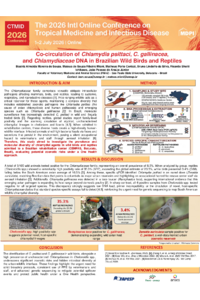
Poster - Co-circulation of Chlamydia psittaci, C. gallinacea, and Chlamydiaceae DNA in Brazilian Wild Birds and Reptiles.pdf
Extreme Rainfall, Flooding Events and Leptospirosis Incidence: A Decade-Long Ecological Analysis in Southern Brazil
Molecular detection of Coxiella burnetii in wild birds and the importance of surveillance.