Event submissions
Events2026 International Online Conference on Tropical Medicine and Infectious Disease
Published
This submission belongs to the session S3. Neglected Tropical Diseases of the event 2026 International Online Conference on Tropical Medicine and Infectious Disease
Published date
26 Jun, 2026
Academic Editor
'%3e%3cpath%20d='M12.6657%2010.9104C12.4185%2010.325%2012.0599%209.79327%2011.6097%209.34482C11.1609%208.89508%2010.6293%208.5365%2010.0442%208.28888C10.0389%208.28626%2010.0337%208.28495%2010.0285%208.28233C10.8446%207.69279%2011.3752%206.73249%2011.3752%205.64904C11.3752%203.8542%209.92103%202.39999%208.1262%202.39999C6.33136%202.39999%204.87715%203.8542%204.87715%205.64904C4.87715%206.73249%205.40774%207.69279%206.22393%208.28364C6.21869%208.28626%206.21345%208.28757%206.20821%208.29019C5.62129%208.5378%205.09463%208.89284%204.64265%209.34613C4.1929%209.79493%203.83432%2010.3266%203.58671%2010.9117C3.34345%2011.4845%203.21226%2012.0987%203.20023%2012.7209C3.19988%2012.7349%203.20233%2012.7488%203.20744%2012.7619C3.21255%2012.7749%203.22022%2012.7867%203.22998%2012.7968C3.23975%2012.8068%203.25142%2012.8147%203.26431%2012.8202C3.2772%2012.8256%203.29105%2012.8284%203.30504%2012.8284H4.09109C4.14874%2012.8284%204.19459%2012.7825%204.1959%2012.7262C4.2221%2011.7148%204.62823%2010.7676%205.34617%2010.0497C6.08899%209.30683%207.0755%208.89808%208.1262%208.89808C9.17689%208.89808%2010.1634%209.30683%2010.9062%2010.0497C11.6242%2010.7676%2012.0303%2011.7148%2012.0565%2012.7262C12.0578%2012.7838%2012.1037%2012.8284%2012.1613%2012.8284H12.9474C12.9613%2012.8284%2012.9752%2012.8256%2012.9881%2012.8202C13.001%2012.8147%2013.0126%2012.8068%2013.0224%2012.7968C13.0322%2012.7867%2013.0398%2012.7749%2013.0449%2012.7619C13.0501%2012.7488%2013.0525%2012.7349%2013.0522%2012.7209C13.0391%2012.0947%2012.9094%2011.4855%2012.6657%2010.9104ZM8.1262%207.9024C7.52486%207.9024%206.9589%207.6679%206.53312%207.24211C6.10733%206.81633%205.87283%206.25037%205.87283%205.64904C5.87283%205.0477%206.10733%204.48174%206.53312%204.05596C6.9589%203.63018%207.52486%203.39567%208.1262%203.39567C8.72753%203.39567%209.29349%203.63018%209.71927%204.05596C10.1451%204.48174%2010.3796%205.0477%2010.3796%205.64904C10.3796%206.25037%2010.1451%206.81633%209.71927%207.24211C9.29349%207.6679%208.72753%207.9024%208.1262%207.9024Z'%20fill='%235D1EE1'/%3e%3c/g%3e%3c/svg%3e) Archie Clements
Archie ClementsCitation
João Carlos Silva de Oliveira, Ulysses Carvalho Barbosa, Luiz Rodrigo Simoes de Oliveira, Ellen Cristine Rebelo da Silva Simões, Patrícia Moura Sousa, Emanuelle Sousa Farias, Uziel Ferreira Suwa, Enide Luciana Belmont Montefusco, Cláudia Patrícia Mendes Araújo, Maria Eduarda Carneiro Zane, Thamyres Mendes Souza, James Lee Crainey, Molecular analysis of individually laser-dissected microfilariae reveals Acanthocheilonema reconditum disguised as Dirofilaria immitis., in Proceedings of 2026 International Online Conference on Tropical Medicine and Infectious Disease, 1 July–2 July 2026, MDPI: Basel, Switzerland
Share
Email
Facebook
Twitter
LinkedIn
Molecular analysis of individually laser-dissected microfilariae reveals Acanthocheilonema reconditum disguised as Dirofilaria immitis.
'%3e%3cpath%20d='M12.6647%2010.9104C12.4176%2010.325%2012.0589%209.7933%2011.6088%209.34485C11.16%208.89511%2010.6283%208.53653%2010.0432%208.28891C10.038%208.28629%2010.0327%208.28498%2010.0275%208.28236C10.8437%207.69282%2011.3743%206.73252%2011.3743%205.64907C11.3743%203.85423%209.92005%202.40002%208.12522%202.40002C6.33038%202.40002%204.87618%203.85423%204.87618%205.64907C4.87618%206.73252%205.40677%207.69282%206.22296%208.28367C6.21772%208.28629%206.21248%208.2876%206.20724%208.29022C5.62031%208.53783%205.09365%208.89287%204.64167%209.34616C4.19192%209.79496%203.83334%2010.3266%203.58573%2010.9117C3.34247%2011.4846%203.21128%2012.0987%203.19925%2012.721C3.1989%2012.735%203.20135%2012.7489%203.20646%2012.7619C3.21157%2012.7749%203.21924%2012.7868%203.22901%2012.7968C3.23877%2012.8068%203.25045%2012.8148%203.26334%2012.8202C3.27623%2012.8256%203.29007%2012.8284%203.30406%2012.8284H4.09012C4.14776%2012.8284%204.19362%2012.7825%204.19493%2012.7262C4.22113%2011.7148%204.62726%2010.7676%205.34519%2010.0497C6.08802%209.30686%207.07452%208.89811%208.12522%208.89811C9.17592%208.89811%2010.1624%209.30686%2010.9052%2010.0497C11.6232%2010.7676%2012.0293%2011.7148%2012.0555%2012.7262C12.0568%2012.7839%2012.1027%2012.8284%2012.1603%2012.8284H12.9464C12.9604%2012.8284%2012.9742%2012.8256%2012.9871%2012.8202C13%2012.8148%2013.0117%2012.8068%2013.0214%2012.7968C13.0312%2012.7868%2013.0389%2012.7749%2013.044%2012.7619C13.0491%2012.7489%2013.0515%2012.735%2013.0512%2012.721C13.0381%2012.0947%2012.9084%2011.4856%2012.6647%2010.9104ZM8.12522%207.90243C7.52388%207.90243%206.95792%207.66793%206.53214%207.24215C6.10636%206.81636%205.87185%206.2504%205.87185%205.64907C5.87185%205.04773%206.10636%204.48177%206.53214%204.05599C6.95792%203.63021%207.52388%203.3957%208.12522%203.3957C8.72655%203.3957%209.29252%203.63021%209.7183%204.05599C10.1441%204.48177%2010.3786%205.04773%2010.3786%205.64907C10.3786%206.2504%2010.1441%206.81636%209.7183%207.24215C9.29252%207.66793%208.72655%207.90243%208.12522%207.90243Z'%20fill='%235D1EE1'/%3e%3c/g%3e%3c/svg%3e)
João Carlos Silva de Oliveira 1
Ulysses Carvalho Barbosa 2
Luiz Rodrigo Simoes de Oliveira 1
Ellen Cristine Rebelo da Silva Simões 1
Patrícia Moura Sousa 1
Emanuelle Sousa Farias 1
Uziel Ferreira Suwa 1
Enide Luciana Belmont Montefusco 1
Cláudia Patrícia Mendes Araújo 1
Maria Eduarda Carneiro Zane 1
Thamyres Mendes Souza 1

James Lee Crainey 1
1. Fiocruz ILMD, Manaus, Brazil
2. Laboratório de Etnoepidemiologia, Coordenação de Sociedade Ambiente e Saúde, Instituto Nacional de Pesquisas da Amazônia, Manaus 69067-375, Amazonas, Brazil
Abstract
Introduction
Canine filarial parasites, including Dirofilaria immitis and Acanthocheilonema reconditum, can cause zoonotic infections in humans. Dirofilaria immitis and Acanthocheilonema reconditum, however, respond differently to drug treatments and, therefore, it is necessary to discriminate between these two parasites during diagnosis.
Methods
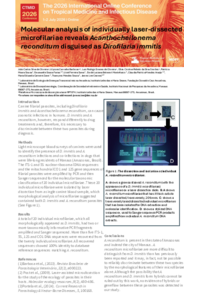
Light microscope blood surveys of canines were used to identify the presence of D. immitis and A. reconditum infections and co-infections in dogs that were life-long residents of Manaus (Amazonas, Brazil). The ITS-1 and 5S nuclear ribosomal DNA sequences and the mitochondrial CO1 and 12S gene sequences of filarial parasites were amplified by PCR and then Sanger sequenced for the molecular taxonomic classification of 20 individual microfilariae. These 20 individual microfilariae were isolated by laser dissection from a single canine blood sample, which morphological analysis of microfilariae suggested contained both D. immitis and A. reconditum parasites.
Results
A total of 20 individual microfilariae, which all morphologically appeared as Dirofilaria immitis, had two or more taxonomically informative PCR fragments amplified and Sanger sequenced. More than five ITS-1, 5S, 12S and CO1 DNA sequences were recovered from the twenty individual microfilariae. All recovered sequences showed 100% identity to database reference sequences matching A. reconditum.
Conclusions
Acanthocheilonema reconditum is present in the state of Amazonas and indeed the city of Manaus. Acanthocheilonema reconditum microfilariae are more difficult to distinguish from D. immitis than has previously been reported and it may, in fact, not be possible to reliably discriminate between these two species by the morphological features of their microfilariae alone. Although the possibility that A. reconditum and D. immitis form hybrids cannot be ruled out by this work, no evidence of hybrids or geneflow between these parasites was detected in our study.
Keywords
Acanthocheilonema reconditum
Dirofilaria immitis
laser dissection
microfilariae
molecular identification
Poster
Joao conference FINAL vii2026 AQUI.pdf
Clinical Phenotypes, Temporal Dynamics, and Early Cardiac Risk in Orally Transmitted Acute Chagas Disease: A Longitudinal Outbreak Cohort from Colombia
EPIDEMIOLOGY OF CRYPTOSPORIDIUM INFECTIONS IN CHILDREN UNDER FIVE YEARS OF AGE AND YOUNG LIVESTOCK IN EASTERN ETHIOPIA: A ONE HEALTH APPROACH