Event submissions
Events2026 International Online Conference on Tropical Medicine and Infectious Disease
Published
This submission belongs to the session S3. Neglected Tropical Diseases of the event 2026 International Online Conference on Tropical Medicine and Infectious Disease
Published date
26 Jun, 2026
Academic Editor
'%3e%3cpath%20d='M12.6657%2010.9104C12.4185%2010.325%2012.0599%209.79327%2011.6097%209.34482C11.1609%208.89508%2010.6293%208.5365%2010.0442%208.28888C10.0389%208.28626%2010.0337%208.28495%2010.0285%208.28233C10.8446%207.69279%2011.3752%206.73249%2011.3752%205.64904C11.3752%203.8542%209.92103%202.39999%208.1262%202.39999C6.33136%202.39999%204.87715%203.8542%204.87715%205.64904C4.87715%206.73249%205.40774%207.69279%206.22393%208.28364C6.21869%208.28626%206.21345%208.28757%206.20821%208.29019C5.62129%208.5378%205.09463%208.89284%204.64265%209.34613C4.1929%209.79493%203.83432%2010.3266%203.58671%2010.9117C3.34345%2011.4845%203.21226%2012.0987%203.20023%2012.7209C3.19988%2012.7349%203.20233%2012.7488%203.20744%2012.7619C3.21255%2012.7749%203.22022%2012.7867%203.22998%2012.7968C3.23975%2012.8068%203.25142%2012.8147%203.26431%2012.8202C3.2772%2012.8256%203.29105%2012.8284%203.30504%2012.8284H4.09109C4.14874%2012.8284%204.19459%2012.7825%204.1959%2012.7262C4.2221%2011.7148%204.62823%2010.7676%205.34617%2010.0497C6.08899%209.30683%207.0755%208.89808%208.1262%208.89808C9.17689%208.89808%2010.1634%209.30683%2010.9062%2010.0497C11.6242%2010.7676%2012.0303%2011.7148%2012.0565%2012.7262C12.0578%2012.7838%2012.1037%2012.8284%2012.1613%2012.8284H12.9474C12.9613%2012.8284%2012.9752%2012.8256%2012.9881%2012.8202C13.001%2012.8147%2013.0126%2012.8068%2013.0224%2012.7968C13.0322%2012.7867%2013.0398%2012.7749%2013.0449%2012.7619C13.0501%2012.7488%2013.0525%2012.7349%2013.0522%2012.7209C13.0391%2012.0947%2012.9094%2011.4855%2012.6657%2010.9104ZM8.1262%207.9024C7.52486%207.9024%206.9589%207.6679%206.53312%207.24211C6.10733%206.81633%205.87283%206.25037%205.87283%205.64904C5.87283%205.0477%206.10733%204.48174%206.53312%204.05596C6.9589%203.63018%207.52486%203.39567%208.1262%203.39567C8.72753%203.39567%209.29349%203.63018%209.71927%204.05596C10.1451%204.48174%2010.3796%205.0477%2010.3796%205.64904C10.3796%206.25037%2010.1451%206.81633%209.71927%207.24211C9.29349%207.6679%208.72753%207.9024%208.1262%207.9024Z'%20fill='%235D1EE1'/%3e%3c/g%3e%3c/svg%3e) Archie Clements
Archie ClementsCitation
Sharif Alhassan Abdullahi, Hauwa'u Barde Abdullahi, Abdulsalami Yayo Manu, Maryam Lawal Faragai, Na'ima Abubakar Adam, Zainab Ali Adamu, Mansur Aliyu, Muhammad Ibrahim Getso, Al-Mukhtar Yahuza Adamu, Iman Maikano Khalid, Hannatu Salisu Ladan, IMPACT OF MASS TREATMENT WITH PRAZIQAUNTEL AMONG STUDENTS OF TSANGAYA SCHOOLS IN KURA LOCAL GOVERMENT, KANO STATE, in Proceedings of 2026 International Online Conference on Tropical Medicine and Infectious Disease, 1 July–2 July 2026, MDPI: Basel, Switzerland
Share
Email
Facebook
Twitter
LinkedIn
IMPACT OF MASS TREATMENT WITH PRAZIQAUNTEL AMONG STUDENTS OF TSANGAYA SCHOOLS IN KURA LOCAL GOVERMENT, KANO STATE
'%3e%3cpath%20d='M12.6647%2010.9104C12.4176%2010.325%2012.0589%209.7933%2011.6088%209.34485C11.16%208.89511%2010.6283%208.53653%2010.0432%208.28891C10.038%208.28629%2010.0327%208.28498%2010.0275%208.28236C10.8437%207.69282%2011.3743%206.73252%2011.3743%205.64907C11.3743%203.85423%209.92005%202.40002%208.12522%202.40002C6.33038%202.40002%204.87618%203.85423%204.87618%205.64907C4.87618%206.73252%205.40677%207.69282%206.22296%208.28367C6.21772%208.28629%206.21248%208.2876%206.20724%208.29022C5.62031%208.53783%205.09365%208.89287%204.64167%209.34616C4.19192%209.79496%203.83334%2010.3266%203.58573%2010.9117C3.34247%2011.4846%203.21128%2012.0987%203.19925%2012.721C3.1989%2012.735%203.20135%2012.7489%203.20646%2012.7619C3.21157%2012.7749%203.21924%2012.7868%203.22901%2012.7968C3.23877%2012.8068%203.25045%2012.8148%203.26334%2012.8202C3.27623%2012.8256%203.29007%2012.8284%203.30406%2012.8284H4.09012C4.14776%2012.8284%204.19362%2012.7825%204.19493%2012.7262C4.22113%2011.7148%204.62726%2010.7676%205.34519%2010.0497C6.08802%209.30686%207.07452%208.89811%208.12522%208.89811C9.17592%208.89811%2010.1624%209.30686%2010.9052%2010.0497C11.6232%2010.7676%2012.0293%2011.7148%2012.0555%2012.7262C12.0568%2012.7839%2012.1027%2012.8284%2012.1603%2012.8284H12.9464C12.9604%2012.8284%2012.9742%2012.8256%2012.9871%2012.8202C13%2012.8148%2013.0117%2012.8068%2013.0214%2012.7968C13.0312%2012.7868%2013.0389%2012.7749%2013.044%2012.7619C13.0491%2012.7489%2013.0515%2012.735%2013.0512%2012.721C13.0381%2012.0947%2012.9084%2011.4856%2012.6647%2010.9104ZM8.12522%207.90243C7.52388%207.90243%206.95792%207.66793%206.53214%207.24215C6.10636%206.81636%205.87185%206.2504%205.87185%205.64907C5.87185%205.04773%206.10636%204.48177%206.53214%204.05599C6.95792%203.63021%207.52388%203.3957%208.12522%203.3957C8.72655%203.3957%209.29252%203.63021%209.7183%204.05599C10.1441%204.48177%2010.3786%205.04773%2010.3786%205.64907C10.3786%206.2504%2010.1441%206.81636%209.7183%207.24215C9.29252%207.66793%208.72655%207.90243%208.12522%207.90243Z'%20fill='%235D1EE1'/%3e%3c/g%3e%3c/svg%3e)
Sharif Alhassan Abdullahi 1
Hauwa'u Barde Abdullahi 1
Abdulsalami Yayo Manu 1
Maryam Lawal Faragai 1
Na'ima Abubakar Adam 1
Zainab Ali Adamu 1
Mansur Aliyu 1
Muhammad Ibrahim Getso 1
Al-Mukhtar Yahuza Adamu 1
Iman Maikano Khalid 1
Hannatu Salisu Ladan 1
1. Department of Medical Microbiology and Parasitology, College of Health Sciences, Bayero University Kano, Kano P.M.B. 3011, Nigeria
Abstract
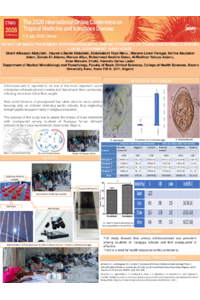
Introduction: Schistosomiasis is reported to be one of the most important worm infestations of mankind and is widely distributed over three continents, affecting more than 200 million people. Mass administration of praziquantel has taken place in many centers focusing only on children attending public schools. The purpose of this study was to assess the impact of mass treatment with praziquantel among students of Tsangaya School (Almajiri Schools) in Kura Local Government, Kano State. Methods: The study is a cross-sectional prospective interventional study involving four Tsangaya Schools named Tsangaya A, Tsangaya B, Tsangaya C, and Tsangaya D, from which 181 Almajiri students were recruited and questionnaires administered. Urine and blood samples were collected before and after drug intervention for macroscopic and microscopic examination for detection of Schistosoma eggs and assessment of packed cell volume (PCV) for possible risk of anemia. Results: The majority of the Almajiri students (90.6%) were infected with Schistosoma haematobium only, while 1.7% were co-infected with S. mansoni, given the overall prevalence of 92.3%. Tsangaya A has the highest prevalence of 32.0%, while Tsangaya B has the lowest of 14.9%. Tsangaya C has a prevalence of 24.9%, while that of Tsangaya D has 20.4%. The prevalence dropped to 12.7% after intervention. The mean PCV (M=34.80%, SD=5.75) of the participant was found to be significantly lower than the PCV among participants after treatment (M=35.57%, SD=5.48), t=-4.923, df=166, P<0.001. The binary logistic regression model predicted a high (OR=2.65) risk of developing schistosomiasis when staying for a duration of more than 10 years. Conclusion: This study showed that urinary schistosomiasis was prevalent among students of Tsangaya schools and that praziquantel is effective. There is a need for health education in this community.
Keywords
Tsangaya school
Almajiri students
Schistosmiasis
Praziquantel
Pack cell volume
Poster
ee0d02019dc636c32d4692c2df585fe4 (1).pdf
EPIDEMIOLOGY OF CRYPTOSPORIDIUM INFECTIONS IN CHILDREN UNDER FIVE YEARS OF AGE AND YOUNG LIVESTOCK IN EASTERN ETHIOPIA: A ONE HEALTH APPROACH
Multisectoral Collaboration and Its Impact on Reducing Japanese Encephalitis (JE)/Acute Encephalitis Syndrome (AES) in India: An Integrated Approach to Global Health Security