Event submissions
Events2026 International Online Conference on Tropical Medicine and Infectious Disease
Published
This submission belongs to the session S3. Neglected Tropical Diseases of the event 2026 International Online Conference on Tropical Medicine and Infectious Disease
Published date
26 Jun, 2026
Academic Editor
'%3e%3cpath%20d='M12.6657%2010.9104C12.4185%2010.325%2012.0599%209.79327%2011.6097%209.34482C11.1609%208.89508%2010.6293%208.5365%2010.0442%208.28888C10.0389%208.28626%2010.0337%208.28495%2010.0285%208.28233C10.8446%207.69279%2011.3752%206.73249%2011.3752%205.64904C11.3752%203.8542%209.92103%202.39999%208.1262%202.39999C6.33136%202.39999%204.87715%203.8542%204.87715%205.64904C4.87715%206.73249%205.40774%207.69279%206.22393%208.28364C6.21869%208.28626%206.21345%208.28757%206.20821%208.29019C5.62129%208.5378%205.09463%208.89284%204.64265%209.34613C4.1929%209.79493%203.83432%2010.3266%203.58671%2010.9117C3.34345%2011.4845%203.21226%2012.0987%203.20023%2012.7209C3.19988%2012.7349%203.20233%2012.7488%203.20744%2012.7619C3.21255%2012.7749%203.22022%2012.7867%203.22998%2012.7968C3.23975%2012.8068%203.25142%2012.8147%203.26431%2012.8202C3.2772%2012.8256%203.29105%2012.8284%203.30504%2012.8284H4.09109C4.14874%2012.8284%204.19459%2012.7825%204.1959%2012.7262C4.2221%2011.7148%204.62823%2010.7676%205.34617%2010.0497C6.08899%209.30683%207.0755%208.89808%208.1262%208.89808C9.17689%208.89808%2010.1634%209.30683%2010.9062%2010.0497C11.6242%2010.7676%2012.0303%2011.7148%2012.0565%2012.7262C12.0578%2012.7838%2012.1037%2012.8284%2012.1613%2012.8284H12.9474C12.9613%2012.8284%2012.9752%2012.8256%2012.9881%2012.8202C13.001%2012.8147%2013.0126%2012.8068%2013.0224%2012.7968C13.0322%2012.7867%2013.0398%2012.7749%2013.0449%2012.7619C13.0501%2012.7488%2013.0525%2012.7349%2013.0522%2012.7209C13.0391%2012.0947%2012.9094%2011.4855%2012.6657%2010.9104ZM8.1262%207.9024C7.52486%207.9024%206.9589%207.6679%206.53312%207.24211C6.10733%206.81633%205.87283%206.25037%205.87283%205.64904C5.87283%205.0477%206.10733%204.48174%206.53312%204.05596C6.9589%203.63018%207.52486%203.39567%208.1262%203.39567C8.72753%203.39567%209.29349%203.63018%209.71927%204.05596C10.1451%204.48174%2010.3796%205.0477%2010.3796%205.64904C10.3796%206.25037%2010.1451%206.81633%209.71927%207.24211C9.29349%207.6679%208.72753%207.9024%208.1262%207.9024Z'%20fill='%235D1EE1'/%3e%3c/g%3e%3c/svg%3e) Archie Clements
Archie ClementsCitation
Sandra Saschenbrecker, Nadja Muigg, Oliver Klemens, Julia Maria Klemens, Improved and customized dengue serodiagnostics through combined NS1/IgM testing and novel dual-cut-off IgG ELISA, in Proceedings of 2026 International Online Conference on Tropical Medicine and Infectious Disease, 1 July–2 July 2026, MDPI: Basel, Switzerland
Share
Email
Facebook
Twitter
LinkedIn
Improved and customized dengue serodiagnostics through combined NS1/IgM testing and novel dual-cut-off IgG ELISA
'%3e%3cpath%20d='M12.6647%2010.9104C12.4176%2010.325%2012.0589%209.7933%2011.6088%209.34485C11.16%208.89511%2010.6283%208.53653%2010.0432%208.28891C10.038%208.28629%2010.0327%208.28498%2010.0275%208.28236C10.8437%207.69282%2011.3743%206.73252%2011.3743%205.64907C11.3743%203.85423%209.92005%202.40002%208.12522%202.40002C6.33038%202.40002%204.87618%203.85423%204.87618%205.64907C4.87618%206.73252%205.40677%207.69282%206.22296%208.28367C6.21772%208.28629%206.21248%208.2876%206.20724%208.29022C5.62031%208.53783%205.09365%208.89287%204.64167%209.34616C4.19192%209.79496%203.83334%2010.3266%203.58573%2010.9117C3.34247%2011.4846%203.21128%2012.0987%203.19925%2012.721C3.1989%2012.735%203.20135%2012.7489%203.20646%2012.7619C3.21157%2012.7749%203.21924%2012.7868%203.22901%2012.7968C3.23877%2012.8068%203.25045%2012.8148%203.26334%2012.8202C3.27623%2012.8256%203.29007%2012.8284%203.30406%2012.8284H4.09012C4.14776%2012.8284%204.19362%2012.7825%204.19493%2012.7262C4.22113%2011.7148%204.62726%2010.7676%205.34519%2010.0497C6.08802%209.30686%207.07452%208.89811%208.12522%208.89811C9.17592%208.89811%2010.1624%209.30686%2010.9052%2010.0497C11.6232%2010.7676%2012.0293%2011.7148%2012.0555%2012.7262C12.0568%2012.7839%2012.1027%2012.8284%2012.1603%2012.8284H12.9464C12.9604%2012.8284%2012.9742%2012.8256%2012.9871%2012.8202C13%2012.8148%2013.0117%2012.8068%2013.0214%2012.7968C13.0312%2012.7868%2013.0389%2012.7749%2013.044%2012.7619C13.0491%2012.7489%2013.0515%2012.735%2013.0512%2012.721C13.0381%2012.0947%2012.9084%2011.4856%2012.6647%2010.9104ZM8.12522%207.90243C7.52388%207.90243%206.95792%207.66793%206.53214%207.24215C6.10636%206.81636%205.87185%206.2504%205.87185%205.64907C5.87185%205.04773%206.10636%204.48177%206.53214%204.05599C6.95792%203.63021%207.52388%203.3957%208.12522%203.3957C8.72655%203.3957%209.29252%203.63021%209.7183%204.05599C10.1441%204.48177%2010.3786%205.04773%2010.3786%205.64907C10.3786%206.2504%2010.1441%206.81636%209.7183%207.24215C9.29252%207.66793%208.72655%207.90243%208.12522%207.90243Z'%20fill='%235D1EE1'/%3e%3c/g%3e%3c/svg%3e)
Sandra Saschenbrecker 1
Nadja Muigg 1
Oliver Klemens 1
Julia Maria Klemens 1
1. Institute for Experimental Immunology, affiliated to EUROIMMUN Medizinische Labordiagnostika AG, Lübeck, Germany
Abstract
Introduction
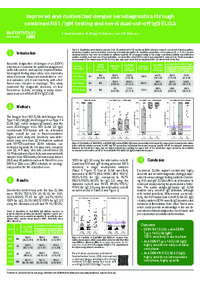
Accurate diagnostics of dengue virus (DENV) infection are essential for patient management, outbreak control, and vaccine implementation. Serological testing plays a key role, especially when molecular assays are unavailable or viremia subsides; yet, cross-reactivity with other flaviviruses remains a challenge. This study examined the diagnostic accuracy of four Euroimmun ELISAs, including a newly developed dual-cut-off Anti-DENV IgG ELISA.
Methods
The Dengue Virus NS1 ELISA, Anti-Dengue Virus Type 1-4 ELISA (IgM), Anti-Dengue Virus Type 1-4 ELISA (IgG; native antigen/gE-based), and the novel Anti-Dengue Virus NS1 ELISA 2.0 (IgG; recombinant NS1-based, with an alternative higher cut-off for flavivirus-endemic regions) were analyzed. Sensitivity was determined using sera from 22 Vietnamese patients with RT-PCR-confirmed DENV infection, collected during acute (t1, 1-6dpo), early convalescent (t2, 4-9dpo), and late convalescent (t3, 13-19dpo) phases. Specificity was assessed with samples from 500 healthy German blood donors (HBD) and 40 patients each with West Nile virus (WNV) or Zika virus (ZIKV) infection, all serologically positive for the respective virus.
Results
Sensitivities were 90.5%/70.0%/0% (t1/t2/t3) for NS1, 33.3%/85.0%/77.3% for IgM, 66.7%/100%/100% for IgG, and 33.3%/65.0%/100% vs. 19.1%/50.0%/100% for IgG 2.0 (standard vs. alternative cut-off). Combined NS1/IgM testing achieved 100% sensitivity in single acute-phase samples. Overall specificity was 85.7% (HBD/WNV/ZIKV: 95.0%/50.0%/5.0%) for IgG, compared to 95.7% (98.2%/95.0%/65.0%) vs. 99.5% (99.8%/97.5%/97.5%) for IgG 2.0 (standard vs. alternative cut-off).
Conclusion
Euroimmun ELISAs support customized, highly accurate and versatile diagnostic strategies applicable to various dengue testing contexts. Combining NS1 and IgM ELISAs offers an alternative to molecular assays during the acute phase of infection. The native antigen/gE-based IgG ELISA enables early sensitive IgG detection, although with limited specificity. With minimal cross-reactivity, the NS1-based dual-cut-off ELISA 2.0 (IgG) reliably captures DENV-specific IgG dynamics and enhances differentiation from other flaviviruses, which could provide an advantage in the use for convalescent-phase diagnostics, surveillance, and pre-vaccination serostatus determination.
Keywords
antibody detection
antigen detection
dengue virus
DENV
ELISA
IgG
IgM
NS1
serology
West Nile virus
Zika virus
Poster
CTMID_2026_Dengue_hoch.pdf
Multisectoral Collaboration and Its Impact on Reducing Japanese Encephalitis (JE)/Acute Encephalitis Syndrome (AES) in India: An Integrated Approach to Global Health Security
Predicting the Future Distribution of Japanese Encephalitis Vectors in India Using MaxEnt Species Distribution Modeling