Event submissions
Events2026 International Online Conference on Tropical Medicine and Infectious Disease
Published
This submission belongs to the session S3. Neglected Tropical Diseases of the event 2026 International Online Conference on Tropical Medicine and Infectious Disease
Published date
26 Jun, 2026
Academic Editor
'%3e%3cpath%20d='M12.6657%2010.9104C12.4185%2010.325%2012.0599%209.79327%2011.6097%209.34482C11.1609%208.89508%2010.6293%208.5365%2010.0442%208.28888C10.0389%208.28626%2010.0337%208.28495%2010.0285%208.28233C10.8446%207.69279%2011.3752%206.73249%2011.3752%205.64904C11.3752%203.8542%209.92103%202.39999%208.1262%202.39999C6.33136%202.39999%204.87715%203.8542%204.87715%205.64904C4.87715%206.73249%205.40774%207.69279%206.22393%208.28364C6.21869%208.28626%206.21345%208.28757%206.20821%208.29019C5.62129%208.5378%205.09463%208.89284%204.64265%209.34613C4.1929%209.79493%203.83432%2010.3266%203.58671%2010.9117C3.34345%2011.4845%203.21226%2012.0987%203.20023%2012.7209C3.19988%2012.7349%203.20233%2012.7488%203.20744%2012.7619C3.21255%2012.7749%203.22022%2012.7867%203.22998%2012.7968C3.23975%2012.8068%203.25142%2012.8147%203.26431%2012.8202C3.2772%2012.8256%203.29105%2012.8284%203.30504%2012.8284H4.09109C4.14874%2012.8284%204.19459%2012.7825%204.1959%2012.7262C4.2221%2011.7148%204.62823%2010.7676%205.34617%2010.0497C6.08899%209.30683%207.0755%208.89808%208.1262%208.89808C9.17689%208.89808%2010.1634%209.30683%2010.9062%2010.0497C11.6242%2010.7676%2012.0303%2011.7148%2012.0565%2012.7262C12.0578%2012.7838%2012.1037%2012.8284%2012.1613%2012.8284H12.9474C12.9613%2012.8284%2012.9752%2012.8256%2012.9881%2012.8202C13.001%2012.8147%2013.0126%2012.8068%2013.0224%2012.7968C13.0322%2012.7867%2013.0398%2012.7749%2013.0449%2012.7619C13.0501%2012.7488%2013.0525%2012.7349%2013.0522%2012.7209C13.0391%2012.0947%2012.9094%2011.4855%2012.6657%2010.9104ZM8.1262%207.9024C7.52486%207.9024%206.9589%207.6679%206.53312%207.24211C6.10733%206.81633%205.87283%206.25037%205.87283%205.64904C5.87283%205.0477%206.10733%204.48174%206.53312%204.05596C6.9589%203.63018%207.52486%203.39567%208.1262%203.39567C8.72753%203.39567%209.29349%203.63018%209.71927%204.05596C10.1451%204.48174%2010.3796%205.0477%2010.3796%205.64904C10.3796%206.25037%2010.1451%206.81633%209.71927%207.24211C9.29349%207.6679%208.72753%207.9024%208.1262%207.9024Z'%20fill='%235D1EE1'/%3e%3c/g%3e%3c/svg%3e) Archie Clements
Archie ClementsCitation
Diego Mendicino, Alejandra Roman-Miyasato, Analia Coitinho, Marcela D´Angelo, Empowering Rural Communities for Neglected Tropical Disease Prevention: Outcomes of a Participatory Vector Surveillance System for Chagas Disease, in Proceedings of 2026 International Online Conference on Tropical Medicine and Infectious Disease, 1 July–2 July 2026, MDPI: Basel, Switzerland
Share
Email
Facebook
Twitter
LinkedIn
Empowering Rural Communities for Neglected Tropical Disease Prevention: Outcomes of a Participatory Vector Surveillance System for Chagas Disease
'%3e%3cpath%20d='M12.6647%2010.9104C12.4176%2010.325%2012.0589%209.7933%2011.6088%209.34485C11.16%208.89511%2010.6283%208.53653%2010.0432%208.28891C10.038%208.28629%2010.0327%208.28498%2010.0275%208.28236C10.8437%207.69282%2011.3743%206.73252%2011.3743%205.64907C11.3743%203.85423%209.92005%202.40002%208.12522%202.40002C6.33038%202.40002%204.87618%203.85423%204.87618%205.64907C4.87618%206.73252%205.40677%207.69282%206.22296%208.28367C6.21772%208.28629%206.21248%208.2876%206.20724%208.29022C5.62031%208.53783%205.09365%208.89287%204.64167%209.34616C4.19192%209.79496%203.83334%2010.3266%203.58573%2010.9117C3.34247%2011.4846%203.21128%2012.0987%203.19925%2012.721C3.1989%2012.735%203.20135%2012.7489%203.20646%2012.7619C3.21157%2012.7749%203.21924%2012.7868%203.22901%2012.7968C3.23877%2012.8068%203.25045%2012.8148%203.26334%2012.8202C3.27623%2012.8256%203.29007%2012.8284%203.30406%2012.8284H4.09012C4.14776%2012.8284%204.19362%2012.7825%204.19493%2012.7262C4.22113%2011.7148%204.62726%2010.7676%205.34519%2010.0497C6.08802%209.30686%207.07452%208.89811%208.12522%208.89811C9.17592%208.89811%2010.1624%209.30686%2010.9052%2010.0497C11.6232%2010.7676%2012.0293%2011.7148%2012.0555%2012.7262C12.0568%2012.7839%2012.1027%2012.8284%2012.1603%2012.8284H12.9464C12.9604%2012.8284%2012.9742%2012.8256%2012.9871%2012.8202C13%2012.8148%2013.0117%2012.8068%2013.0214%2012.7968C13.0312%2012.7868%2013.0389%2012.7749%2013.044%2012.7619C13.0491%2012.7489%2013.0515%2012.735%2013.0512%2012.721C13.0381%2012.0947%2012.9084%2011.4856%2012.6647%2010.9104ZM8.12522%207.90243C7.52388%207.90243%206.95792%207.66793%206.53214%207.24215C6.10636%206.81636%205.87185%206.2504%205.87185%205.64907C5.87185%205.04773%206.10636%204.48177%206.53214%204.05599C6.95792%203.63021%207.52388%203.3957%208.12522%203.3957C8.72655%203.3957%209.29252%203.63021%209.7183%204.05599C10.1441%204.48177%2010.3786%205.04773%2010.3786%205.64907C10.3786%206.2504%2010.1441%206.81636%209.7183%207.24215C9.29252%207.66793%208.72655%207.90243%208.12522%207.90243Z'%20fill='%235D1EE1'/%3e%3c/g%3e%3c/svg%3e)
Diego Mendicino 1,2
Alejandra Roman-Miyasato 3
Analia Coitinho 1
Marcela D´Angelo 3
1. Facultad de Bioquímica y Ciencias Biológicas, Universidad Nacional del Litoral, Santa Fe S3001XAI, Argentina
2. Consejo Nacional de Investigaciones Científicas y Técnicas, Santa Fe S3001XAI, Argentina
3. Escuela Superior de Sanidad, Universidad Nacional del Litoral, Santa Fe (3000), Argentina
Abstract
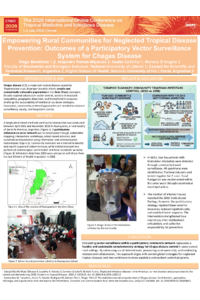
Introduction: Chagas disease (CD), a neglected tropical disease caused by Trypanosoma cruzi, disproportionately affects socially and economically vulnerable populations in the Gran Chaco ecoregion. Despite regional advances in vector control, persistent structural inequalities, geographic dispersion, and limited health resources challenge the sustainability of traditional top-down strategies. Innovative, community-centered approaches are needed to enhance surveillance, equity, and long-term control.
Methods: A longitudinal mixed-methods community intervention was conducted between April 2021 and November 2023 in a rural locality of Santa Fe Province, Argentina. A participatory collaborative social network was co-constructed through stakeholder mapping, intersectoral workshops, school-based activities, and sustained communication using information and communication technologies. Community members were trained to identify and report suspected triatomine bugs, while institutional partners performed entomological confirmation and focal insecticide spraying. Infestation data from 2023 were compared with those from the last Ministry of Health inspection in 2018.
Results: In 2023, four households with triatomine infestation were detected through community-based surveillance. All specimens were identified as Triatoma infestans and tested negative for T. cruzi. Focal fumigation was implemented within the same week through coordinated municipal action. The number of infested houses matched the 2018 institutional findings; however, the participatory strategy required fewer external resources, reduced logistical costs, and enabled faster response. The intervention strengthened local awareness, inter-institutional articulation, and collective responsibility for prevention.
Conclusions: Embedding vector surveillance within a participatory community network represents a feasible and sustainable complementary strategy for Chagas disease control in underserved rural settings. By addressing social determinants, promoting local ownership, and reinforcing intersectoral collaboration, this approach aligns with current global strategies for neglected tropical diseases and may contribute to more equitable and resilient control programs.
Keywords
Chagas Disease
Trypanosoma cruzi
Community Participation
Vector Control
Poster
RCV Chagas.pdf
Prevalence of Toxocara canis Infection in Dogs in Mexico: A Systematic Review
Seasonal Dynamics and Population Genetic Structure of Plasmodium falciparum in North-Central Nigeria: Implications for Malaria Surveillance and Control