Event submissions
Events2026 International Online Conference on Tropical Medicine and Infectious Disease
Published
This submission belongs to the session S1. Vector-Borne Diseases of the event 2026 International Online Conference on Tropical Medicine and Infectious Disease
Published date
26 Jun, 2026
Academic Editor
'%3e%3cpath%20d='M12.6657%2010.9104C12.4185%2010.325%2012.0599%209.79327%2011.6097%209.34482C11.1609%208.89508%2010.6293%208.5365%2010.0442%208.28888C10.0389%208.28626%2010.0337%208.28495%2010.0285%208.28233C10.8446%207.69279%2011.3752%206.73249%2011.3752%205.64904C11.3752%203.8542%209.92103%202.39999%208.1262%202.39999C6.33136%202.39999%204.87715%203.8542%204.87715%205.64904C4.87715%206.73249%205.40774%207.69279%206.22393%208.28364C6.21869%208.28626%206.21345%208.28757%206.20821%208.29019C5.62129%208.5378%205.09463%208.89284%204.64265%209.34613C4.1929%209.79493%203.83432%2010.3266%203.58671%2010.9117C3.34345%2011.4845%203.21226%2012.0987%203.20023%2012.7209C3.19988%2012.7349%203.20233%2012.7488%203.20744%2012.7619C3.21255%2012.7749%203.22022%2012.7867%203.22998%2012.7968C3.23975%2012.8068%203.25142%2012.8147%203.26431%2012.8202C3.2772%2012.8256%203.29105%2012.8284%203.30504%2012.8284H4.09109C4.14874%2012.8284%204.19459%2012.7825%204.1959%2012.7262C4.2221%2011.7148%204.62823%2010.7676%205.34617%2010.0497C6.08899%209.30683%207.0755%208.89808%208.1262%208.89808C9.17689%208.89808%2010.1634%209.30683%2010.9062%2010.0497C11.6242%2010.7676%2012.0303%2011.7148%2012.0565%2012.7262C12.0578%2012.7838%2012.1037%2012.8284%2012.1613%2012.8284H12.9474C12.9613%2012.8284%2012.9752%2012.8256%2012.9881%2012.8202C13.001%2012.8147%2013.0126%2012.8068%2013.0224%2012.7968C13.0322%2012.7867%2013.0398%2012.7749%2013.0449%2012.7619C13.0501%2012.7488%2013.0525%2012.7349%2013.0522%2012.7209C13.0391%2012.0947%2012.9094%2011.4855%2012.6657%2010.9104ZM8.1262%207.9024C7.52486%207.9024%206.9589%207.6679%206.53312%207.24211C6.10733%206.81633%205.87283%206.25037%205.87283%205.64904C5.87283%205.0477%206.10733%204.48174%206.53312%204.05596C6.9589%203.63018%207.52486%203.39567%208.1262%203.39567C8.72753%203.39567%209.29349%203.63018%209.71927%204.05596C10.1451%204.48174%2010.3796%205.0477%2010.3796%205.64904C10.3796%206.25037%2010.1451%206.81633%209.71927%207.24211C9.29349%207.6679%208.72753%207.9024%208.1262%207.9024Z'%20fill='%235D1EE1'/%3e%3c/g%3e%3c/svg%3e) John Frean
John FreanCitation
Yael Dahan-Moss, Theresa Mazarire, Givemore Munhenga, Megan Ridden, Leo Braack, Lizette Koekemoer, Ednah Baloyi, Mbavhalelo Shandukani, Basil Brooke, Malaria vector surveillance in the endemic areas in South Africa over a five-year period: a retrospective study, in Proceedings of 2026 International Online Conference on Tropical Medicine and Infectious Disease, 1 July–2 July 2026, MDPI: Basel, Switzerland
Share
Email
Facebook
Twitter
LinkedIn
Malaria vector surveillance in the endemic areas in South Africa over a five-year period: a retrospective study
'%3e%3cpath%20d='M12.6647%2010.9104C12.4176%2010.325%2012.0589%209.7933%2011.6088%209.34485C11.16%208.89511%2010.6283%208.53653%2010.0432%208.28891C10.038%208.28629%2010.0327%208.28498%2010.0275%208.28236C10.8437%207.69282%2011.3743%206.73252%2011.3743%205.64907C11.3743%203.85423%209.92005%202.40002%208.12522%202.40002C6.33038%202.40002%204.87618%203.85423%204.87618%205.64907C4.87618%206.73252%205.40677%207.69282%206.22296%208.28367C6.21772%208.28629%206.21248%208.2876%206.20724%208.29022C5.62031%208.53783%205.09365%208.89287%204.64167%209.34616C4.19192%209.79496%203.83334%2010.3266%203.58573%2010.9117C3.34247%2011.4846%203.21128%2012.0987%203.19925%2012.721C3.1989%2012.735%203.20135%2012.7489%203.20646%2012.7619C3.21157%2012.7749%203.21924%2012.7868%203.22901%2012.7968C3.23877%2012.8068%203.25045%2012.8148%203.26334%2012.8202C3.27623%2012.8256%203.29007%2012.8284%203.30406%2012.8284H4.09012C4.14776%2012.8284%204.19362%2012.7825%204.19493%2012.7262C4.22113%2011.7148%204.62726%2010.7676%205.34519%2010.0497C6.08802%209.30686%207.07452%208.89811%208.12522%208.89811C9.17592%208.89811%2010.1624%209.30686%2010.9052%2010.0497C11.6232%2010.7676%2012.0293%2011.7148%2012.0555%2012.7262C12.0568%2012.7839%2012.1027%2012.8284%2012.1603%2012.8284H12.9464C12.9604%2012.8284%2012.9742%2012.8256%2012.9871%2012.8202C13%2012.8148%2013.0117%2012.8068%2013.0214%2012.7968C13.0312%2012.7868%2013.0389%2012.7749%2013.044%2012.7619C13.0491%2012.7489%2013.0515%2012.735%2013.0512%2012.721C13.0381%2012.0947%2012.9084%2011.4856%2012.6647%2010.9104ZM8.12522%207.90243C7.52388%207.90243%206.95792%207.66793%206.53214%207.24215C6.10636%206.81636%205.87185%206.2504%205.87185%205.64907C5.87185%205.04773%206.10636%204.48177%206.53214%204.05599C6.95792%203.63021%207.52388%203.3957%208.12522%203.3957C8.72655%203.3957%209.29252%203.63021%209.7183%204.05599C10.1441%204.48177%2010.3786%205.04773%2010.3786%205.64907C10.3786%206.2504%2010.1441%206.81636%209.7183%207.24215C9.29252%207.66793%208.72655%207.90243%208.12522%207.90243Z'%20fill='%235D1EE1'/%3e%3c/g%3e%3c/svg%3e)
Yael Dahan-Moss 1,2
Theresa Mazarire 1,2
Givemore Munhenga 1,2
Megan Ridden 3
Leo Braack 4

Lizette Koekemoer 1,2
Ednah Baloyi 5
Mbavhalelo Shandukani 5
Basil Brooke 1,2
1. Centre for Emerging Zoonotic and Parasitic Diseases, National Institute for Communicable Diseases, a division of the National Health Laboratory Service, Johannesburg, South Africa
2. Wits Research Institute for Malaria, Faculty of Health Sciences, University of the Witwatersrand, Johannesburg, South Africa
3. University of Pretoria Institute for Sustainable Malaria Control, University of Pretoria, Pretoria, South Africa
4. Faculty of Tropical Medicine, Mahidol University, Bangkok, Thailand
5. Malaria and other Vector borne diseases, Department of health, Pretoria, South Africa
Abstract
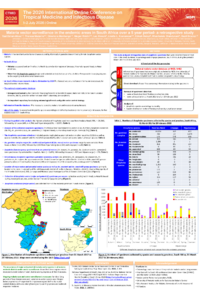
Malaria in South Africa is seasonal and primarily occurs in the endemic provinces of Limpopo, Mpumalanga and KwaZulu-Natal. Malaria transmission depends on the occurrence of mosquito vector populations and thus malaria control relies heavily on the implementation of vector control interventions. Vector surveillance is essential for optimal vector control, and, as the country moves towards malaria elimination, enhanced vector surveillance is necessary to obtain comprehensive information on those primary and potential vectors that are responsible in varying degrees for ongoing residual transmission.
This retrospective study collated Anopheles mosquito collections from sentinel sites in the three endemic provinces from 01 March 2017 to 28 February 2022. Field-collected specimens were identified to species by morphology and polymerase chain reaction assays.
A total of 32,955 Anopheles mosquitoes were collected and identified from sentinel sites in the KwaZulu-Natal (n=25,359; 77.0%), Limpopo (14.5%) and Mpumalanga (8.6%) provinces. Of the collected Anopheles specimens, 73.7% (n= 24,304) were identified as members of vector species/populations in South Africa, i.e., Anopheles arabiensis (58.8%), An. parensis (6.7%), An. vaneedeni (2.2%), and An. merus (6.1%). Furthermore, the collections included species implicated as vectors in other countries (11.9%). Anopheles arabiensis (major vector) was the predominant species collected through all seasons in KwaZulu-Natal and in autumn in Mpumalanga. Anopheles pretoriensis and An. rufipes (potential vectors) were the most abundant species in spring and summer in Limpopo. In Mpumalanga, An. merus (potential vector) predominated the collection in winter, spring and summer.
The occurrence of major and potential vector species in all malaria-endemic districts under vector surveillance shows that these regions remain receptive to malaria transmission, but to varying degrees and at different times/seasons. This supports ongoing implementation of vector control strategies in each endemic province. We recommend ongoing vector surveillance and the collection of insecticide susceptibility data for vector populations in endemic districts.
Keywords
Vector control
surveillance
endemic provinces
primary and potential vector species
Poster
July 2026 Conference 21 June 2026 afternoon.pdf
National epidemiological patterns and clinical characteristics of leprosy in Brazil: a population-based analysis of surveillance data from 2001 to 2025
Physiological and environmental factors affecting thermal tolerance in the major malaria vector Anopheles arabiensis (Diptera: Culicidae).