Event submissions
Events2026 International Online Conference on Tropical Medicine and Infectious Disease
Published
This submission belongs to the session S3. Neglected Tropical Diseases of the event 2026 International Online Conference on Tropical Medicine and Infectious Disease
Published date
26 Jun, 2026
Academic Editor
'%3e%3cpath%20d='M12.6657%2010.9104C12.4185%2010.325%2012.0599%209.79327%2011.6097%209.34482C11.1609%208.89508%2010.6293%208.5365%2010.0442%208.28888C10.0389%208.28626%2010.0337%208.28495%2010.0285%208.28233C10.8446%207.69279%2011.3752%206.73249%2011.3752%205.64904C11.3752%203.8542%209.92103%202.39999%208.1262%202.39999C6.33136%202.39999%204.87715%203.8542%204.87715%205.64904C4.87715%206.73249%205.40774%207.69279%206.22393%208.28364C6.21869%208.28626%206.21345%208.28757%206.20821%208.29019C5.62129%208.5378%205.09463%208.89284%204.64265%209.34613C4.1929%209.79493%203.83432%2010.3266%203.58671%2010.9117C3.34345%2011.4845%203.21226%2012.0987%203.20023%2012.7209C3.19988%2012.7349%203.20233%2012.7488%203.20744%2012.7619C3.21255%2012.7749%203.22022%2012.7867%203.22998%2012.7968C3.23975%2012.8068%203.25142%2012.8147%203.26431%2012.8202C3.2772%2012.8256%203.29105%2012.8284%203.30504%2012.8284H4.09109C4.14874%2012.8284%204.19459%2012.7825%204.1959%2012.7262C4.2221%2011.7148%204.62823%2010.7676%205.34617%2010.0497C6.08899%209.30683%207.0755%208.89808%208.1262%208.89808C9.17689%208.89808%2010.1634%209.30683%2010.9062%2010.0497C11.6242%2010.7676%2012.0303%2011.7148%2012.0565%2012.7262C12.0578%2012.7838%2012.1037%2012.8284%2012.1613%2012.8284H12.9474C12.9613%2012.8284%2012.9752%2012.8256%2012.9881%2012.8202C13.001%2012.8147%2013.0126%2012.8068%2013.0224%2012.7968C13.0322%2012.7867%2013.0398%2012.7749%2013.0449%2012.7619C13.0501%2012.7488%2013.0525%2012.7349%2013.0522%2012.7209C13.0391%2012.0947%2012.9094%2011.4855%2012.6657%2010.9104ZM8.1262%207.9024C7.52486%207.9024%206.9589%207.6679%206.53312%207.24211C6.10733%206.81633%205.87283%206.25037%205.87283%205.64904C5.87283%205.0477%206.10733%204.48174%206.53312%204.05596C6.9589%203.63018%207.52486%203.39567%208.1262%203.39567C8.72753%203.39567%209.29349%203.63018%209.71927%204.05596C10.1451%204.48174%2010.3796%205.0477%2010.3796%205.64904C10.3796%206.25037%2010.1451%206.81633%209.71927%207.24211C9.29349%207.6679%208.72753%207.9024%208.1262%207.9024Z'%20fill='%235D1EE1'/%3e%3c/g%3e%3c/svg%3e) Archie Clements
Archie ClementsCitation
Mario Javier Olivera, Foodborne Chagas Disease as an Emerging Transmission Pathway: A One Health Analysis of Outbreak Preparedness in Colombia, in Proceedings of 2026 International Online Conference on Tropical Medicine and Infectious Disease, 1 July–2 July 2026, MDPI: Basel, Switzerland
Share
Email
Facebook
Twitter
LinkedIn
Foodborne Chagas Disease as an Emerging Transmission Pathway: A One Health Analysis of Outbreak Preparedness in Colombia
'%3e%3cpath%20d='M12.6647%2010.9104C12.4176%2010.325%2012.0589%209.7933%2011.6088%209.34485C11.16%208.89511%2010.6283%208.53653%2010.0432%208.28891C10.038%208.28629%2010.0327%208.28498%2010.0275%208.28236C10.8437%207.69282%2011.3743%206.73252%2011.3743%205.64907C11.3743%203.85423%209.92005%202.40002%208.12522%202.40002C6.33038%202.40002%204.87618%203.85423%204.87618%205.64907C4.87618%206.73252%205.40677%207.69282%206.22296%208.28367C6.21772%208.28629%206.21248%208.2876%206.20724%208.29022C5.62031%208.53783%205.09365%208.89287%204.64167%209.34616C4.19192%209.79496%203.83334%2010.3266%203.58573%2010.9117C3.34247%2011.4846%203.21128%2012.0987%203.19925%2012.721C3.1989%2012.735%203.20135%2012.7489%203.20646%2012.7619C3.21157%2012.7749%203.21924%2012.7868%203.22901%2012.7968C3.23877%2012.8068%203.25045%2012.8148%203.26334%2012.8202C3.27623%2012.8256%203.29007%2012.8284%203.30406%2012.8284H4.09012C4.14776%2012.8284%204.19362%2012.7825%204.19493%2012.7262C4.22113%2011.7148%204.62726%2010.7676%205.34519%2010.0497C6.08802%209.30686%207.07452%208.89811%208.12522%208.89811C9.17592%208.89811%2010.1624%209.30686%2010.9052%2010.0497C11.6232%2010.7676%2012.0293%2011.7148%2012.0555%2012.7262C12.0568%2012.7839%2012.1027%2012.8284%2012.1603%2012.8284H12.9464C12.9604%2012.8284%2012.9742%2012.8256%2012.9871%2012.8202C13%2012.8148%2013.0117%2012.8068%2013.0214%2012.7968C13.0312%2012.7868%2013.0389%2012.7749%2013.044%2012.7619C13.0491%2012.7489%2013.0515%2012.735%2013.0512%2012.721C13.0381%2012.0947%2012.9084%2011.4856%2012.6647%2010.9104ZM8.12522%207.90243C7.52388%207.90243%206.95792%207.66793%206.53214%207.24215C6.10636%206.81636%205.87185%206.2504%205.87185%205.64907C5.87185%205.04773%206.10636%204.48177%206.53214%204.05599C6.95792%203.63021%207.52388%203.3957%208.12522%203.3957C8.72655%203.3957%209.29252%203.63021%209.7183%204.05599C10.1441%204.48177%2010.3786%205.04773%2010.3786%205.64907C10.3786%206.2504%2010.1441%206.81636%209.7183%207.24215C9.29252%207.66793%208.72655%207.90243%208.12522%207.90243Z'%20fill='%235D1EE1'/%3e%3c/g%3e%3c/svg%3e)
Mario Javier Olivera 1
1. Parasitology Group, National Institute of Health, Bogotá 111321, Colombia
Abstract
Introduction
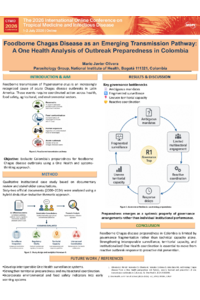
Foodborne transmission of Trypanosoma cruzi is an increasingly recognized cause of acute Chagas disease outbreaks in Latin America. Unlike classical vector-borne transmission, these events involve high parasite inocula, severe clinical presentations, and rapid clustering of cases. In Colombia, outbreaks associated with contaminated beverages and artisanal food production reveal vulnerabilities that extend beyond clinical detection into surveillance, food safety, and intersectoral coordination. This study aimed to evaluate public health preparedness for foodborne T. cruzi transmission in Colombia using a One Health and systems-thinking framework.
Methods
A qualitative institutional case study was conducted using a One Health and systems-thinking framework. Sixty-two official documents issued between 2000 and 2024—including surveillance guidelines, outbreak reports, regulatory instruments, and response protocols—were reviewed. Structured consultations were performed with stakeholders from health, food safety, agricultural, and territorial authorities. Data were analyzed using hybrid deductive–inductive thematic analysis focusing on surveillance integration, regulatory clarity, territorial response capacity, and intersectoral coordination.
Results
Preparedness for foodborne Chagas disease was limited by fragmented institutional responsibilities and delayed cross-sector activation. Surveillance systems operated in parallel, often linking food safety investigations only after clinical confirmation of acute cases. Upstream prevention was constrained by unclear mandates for identifying contamination pathways. Territorial capacity varied widely, and coordination mechanisms functioned mainly during outbreaks rather than prevention phases. These factors produced response delays and hindered early containment.
Conclusions
Foodborne Chagas disease represents a distinct epidemiological scenario requiring integrated surveillance beyond vector control frameworks. Strengthening preparedness requires interoperable surveillance systems, defined cross-sector responsibilities, and institutionalized One Health coordination. Addressing governance gaps is essential to prevent recurrent outbreaks and to adapt Chagas disease control strategies to emerging transmission pathways.
Keywords
Chagas disease
Trypanosoma cruzi
Foodborne transmission
One Health
Outbreak preparedness
Poster
sciforum-175594 Poster.pdf
Serological Evidence of Bat-Borne and Shrew-Borne Hantavirus Infections in Humans: A Comparative Study from Thailand, Sri Lanka, and Zambia
Prevalence and Intensity of Soil-Transmitted Helminthiasis in Urban and Peri-Urban Dumpsites in Ibadan, Southwestern Nigeria: A Cross-Sectional Study.